
Best Helical Pier Installation for Disaster Relief in 2026
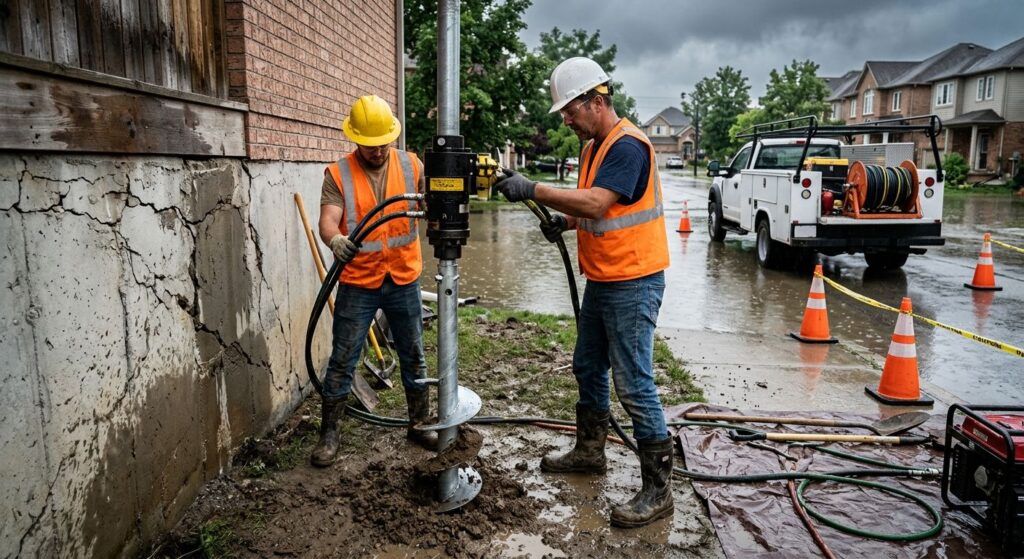
Table of Contents
- Foundation Stabilization After Disasters: Helical Pier Solutions
- Helical Pier Installation for Disaster Relief: Key Advantages and Limitations
- Helical Piers vs. Concrete: Which Is Stronger for Disaster Recovery?
- How Deep Should Helical Piers Be Installed After a Disaster?
- Cost Considerations for Helical Pier Installation in Disaster Relief
- Ensuring Lasting Performance: Corrosion Protection and Expert Installation
- Your Partner for Foundation Stability in Disaster Recovery
Foundation Stabilization After Disasters: Helical Pier Solutions
Helical pier installation for disaster relief provides quick stabilization for buildings whose footings have been undermined by floodwaters or earthquakes, by driving shafts with helical plates through the bearing soil to restore support. Family-owned and operated since 1996 in the Denver metro area, Rocky Mountain Steel Piering provides trained and certified installers who use MacLean/Dixie helical pier systems to repair both residential and commercial foundations affected by natural disasters. We bring complete project management skills from the initial inspection and design phases through final installation and load testing to ensure that your repaired foundations meet engineering performance specifications. Here’s what you should know about this type of deep foundation system before considering its use as part of your post-disaster recovery plan.
Key Takeaways
- These helical piles can withstand instant loads without requiring much ground improvement, which makes these ideal for building up following disasters.
- Once an accurate installation depth has been established for a compromised structure, the most immediate question becomes what the stabilization work will cost and which on-the-ground factors influence that number.
- The long-term reliability of all helical pier foundation systems rests upon whether or not its steel components resist the destructive corrosion of the surrounding soil.
Helical Pier Installation for Disaster Relief: Key Advantages and Limitations
In addition to engineering benefits like load bearing capability, minimum site disturbance and deep soil penetration that make helical piers excellent candidates for disaster relief applications, there exist some limitations which all property owners and contractors must be made aware of. In fact, in order to maximize the effectiveness of the helical piers’ above mentioned positive qualities they must undergo careful site specific engineering evaluations at the time of installation.
Due to the mechanical insertion of the piers into the earth via rotary hydraulic equipment, piling may be up to around 66% more rapid in poor soil conditions than traditional methods which would have involved excavating and letting the concrete cure. Upon reaching its designated torque value and final depth, the pile will receive the building loads directly from the pile as soon as the pile has been installed. No curing concrete need be poured and no waiting is required for it to harden. Also, spoil volume produced is very low together with low levels of vibration generated during the installation process.
The corrosion resistance is built right into the system using Class B1 Hot-Dip Galvanized coatings which meet the requirements set forth under ASTM A153. This zinc coating protects the steel components from corrosion by moisture, debris, and chemically aggressive soil. If the surface soil has been disturbed, liquefied and washed away then installers can mechanically couple extension shafts to the central steel hub in lengths of 3-1/2, 5, 7, or 10 feet. Installers can drive the helical bearing plates past the compromised strata until they engage stable, load-bearing soil at depth. The extension shafts and their respective coupling plate configuration will be specified by our trained, certified installers upon inspection of the bearing strata identified during the site assessment.
A disaster recovery plan requires an engineered specification based upon the specific soil type and loads that will be placed upon it – the standard helical plate spacing is required to be a minimum of 2.36 times the diameter of the lower helix in order to function properly, according to technical information provided by Rocky Mountain Steel Piercing. The sole way to determine if a certain site can accommodate helical piers is through a thorough on-site inspection by a qualified professional. In 1996 our family owned business began providing those evaluations for potential sites before making recommendations.
Whether or not engineered steel can replace conventional concrete largely depends on many variable factors such as location, site conditions, time frames needed for projects, and when they will be used during emergency relief efforts.
Helical Piers vs. Concrete: Which Is Stronger for Disaster Recovery?
These helical piles can withstand instant loads without requiring much ground improvement, which makes these ideal for building up following disasters. Nonetheless, many property owners might be curious about whether helical piles are comparable to the traditional concrete foundation. There are actually differences between the two when you consider their material quality, rate of construction as well as what happens during and after a disaster.
Comparison of helical pier and concrete pier characteristics for post-disaster foundation stabilization.
| Feature | Helical Piers | Concrete (Drilled Piers) |
|---|---|---|
| Corrosion protection | Class B1 hot-dipped galvanized coating (ASTM A153) | — |
| Load readiness | Immediate load-bearing; no curing required | — |
| Installation speed | Faster installation in poor soils using mechanical coupling | — |
| Soil adaptability | Screws into deeper competent strata; effective in loose soils | — |
| Structural compliance | ICC-ES evaluated (ESR-3032) | — |
Concrete properties are general industry knowledge and are not sourced from the assigned references.
The table highlights how helical piers deliver built-in corrosion resistance through a Class B1 hot-dipped galvanized coating that meets ASTM A153 standards. Rocky Mountain Steel Piering applies this protective finish to all its helical pier components, guarding the steel against the moisture and aggressive soil chemistry often present after floods or severe storms. By the time a concrete pier gains sufficient strength—a process that can span days or weeks—helical piers are already bearing full design loads.
Every pier assembly comprises helical circular steel plates which have been joined together at their centers. To attain the right depth, our installers connect several steel hub extension shafts with each other and they are subsequently bolted in place and coupled until the entire installation can continue to move forward. The result is this modular style allows them to avoid any loose fills or liquefied soil which could cause issues if a drilled concrete shaft had already been formed, since the pier goes directly down deep enough in the firm ground without having to wait for the concrete to be set.
Helical Pier Systems go further than just having strong raw materials; they pass through multiple independent tests and evaluations to assure their quality. They include the ICC-ES ESR-3032 which verifies that the product as well as the process of installing them will provide stability when needed, something that concrete piers cannot achieve until specific applications are engineered on-site. Recognizing this aspect allows owners to understand why it would be crucial to assess and find the appropriate installation level after a major disaster, to make sure each pier can reach solid ground below to give additional support.
How Deep Should Helical Piers Be Installed After a Disaster?
In order to deliver the exceptional strength needed for disaster recovery, helical piers have got to be put in at a certain depth that can vary depending upon the sort of soil we have around us. There will likely not be any set dimension for how deep the helical piers should get buried right down into ground level; rather, this depth shall be determined after a thorough geotechnical analysis and the professional evaluation of a structural engineer.
When a building has suffered damage due to a natural catastrophe, the layering of soils below it can be compromised. Flooding could cause liquefaction of the soil, erosion may take away supporting materials from beneath the foundation, and debris could bury or crush the ground in an unpredictable manner. Because the existing depth tables are based upon normal conditions, they cannot accurately reflect this modified state of the earth’s surface. When performing remediation work after a disaster, our company sends qualified workers to the site to conduct field evaluations and provide engineering information about the condition of soils beneath the damaged buildings’ footings. Such information enables us to determine where the loadbearing portions of soil occur below the disturbed upper sections. In many cases, the natural disaster has caused the soils underfoot to become liquefiable, contain buried debris, eroded away, etc., requiring the pier to be embedded at greater depth into more soundly supporting soil types like rock or dense sand to carry the weight of a new foundation safely. The structural engineer works with the installer to decide how far down a given pier must go prior to being driven into place.
These are well-suited for situations in which a high degree of installation depth variability is required. The individual components of each pier consist of a lead section with helical plates that are driven into the soil, and additional extension shafts are attached to these plates using mechanical couplings as more depth is added. In accordance with the specs we provide for both the MacLean/Dixie Helical Piers, nominal plate spacing is required to be at least 2.36 times the diameter of the lower helix, ensuring proper load distribution and influencing overall pier length. In cases where extreme installation depths become necessary, our installer can keep on adding shafts until they arrive at suitable bearing strata.
A standard depth does not apply following disasters. The specific installation depends upon each location and compliance with its respective building codes and project geotechnical reports. A Colorado mountain home affected by landslides will require a different depth than a Front Range commercial building that settled after flooding. We rely on site-specific data and engineering judgment to design every helical pier system, giving property owners confidence that the foundation is anchored in stable ground.
Next, we will consider how required depth affects the number of extension shafts, installation times, and overall cost.
Cost Considerations for Helical Pier Installation in Disaster Relief
Once an accurate installation depth has been established for a compromised structure, the most immediate question becomes what the stabilization work will cost and which on-the-ground factors influence that number. Post-disaster helical pier costs are shaped first by urgency: foundations that sit in unstable, waterlogged soil continue to settle, and what begins as a straightforward pier installation can escalate into a far more extensive rehabilitation project if the damage is left to compound. Our field experience across the Front Range confirms that early intervention consistently limits the scope — and therefore the cost — of the final repair, a pattern we have observed: delaying repairs allows damage to worsen and costs to escalate.
A second set of cost drivers is tied to how the pier system itself performs under disaster conditions. Because the helical piers we install are engineered to achieve load-bearing capacity immediately, with no cure time required, projects avoid the hidden overhead of extended equipment rental, repeat crew mobilizations, and temporary shoring that slow-curing alternatives demand. That immediate-loading advantage reduces schedule risk, which in turn keeps project economics predictable even when site conditions are less than ideal. At the same time, we are transparent that every estimate we provide is preliminary: final pricing may adjust after an on-site inspection reveals factors such as debris clearance, access constraints, or the precise soil profile at depth. While the piers themselves are ICC-ES evaluated and manufactured to ASTM standards, we do not offer unconditional cost guarantees before our team has physically assessed the site.
When we view things from the perspective of the lifetime of the building or infrastructure in question, an investment in a permanent helical pier foundation will be looked at as being quite different from that required to continually fund emergency patches or short term temporary shoring. Emergency repairs following any type of disaster may create a never-ending loop of patchwork solutions, while an engineered deep foundation solution addresses the root cause of movement and halts the deterioration at its source. Once we understand the costs associated with such actions, our next priority is ensuring the installed system delivers lasting performance — and that means understanding the corrosion protection built into the pier assembly and how expert installation safeguards the investment for decades to come.
Ensuring Lasting Performance: Corrosion Protection and Expert Installation
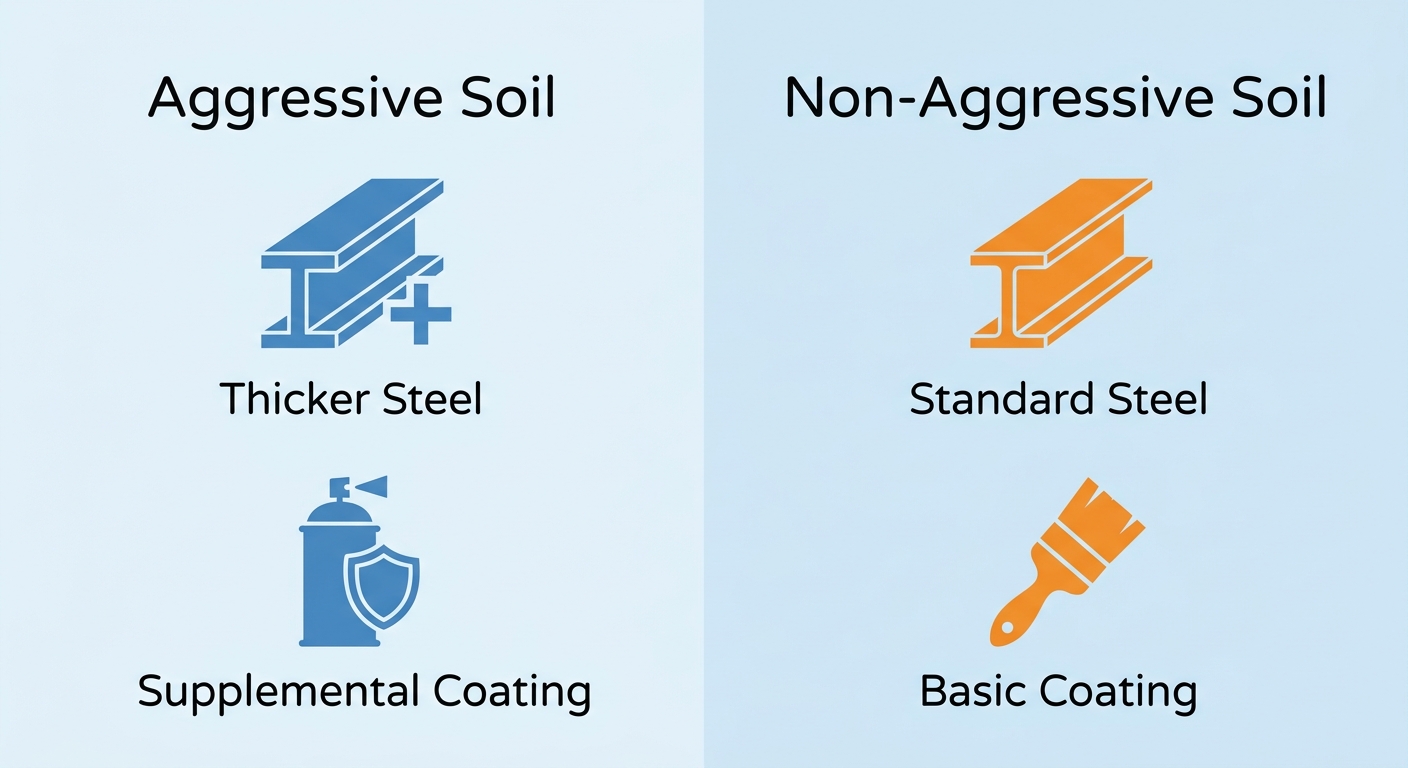
The long-term reliability of all helical pier foundation systems rests upon whether or not its steel components resist the destructive corrosion of the surrounding soil. ICC-ES AC358 spells out these requirements by establishing precise mandates for material thicknesses and types of protective coating based on a formal classification of soil corrosivity. This is because the load path must remain structurally sound for several decades.
Standard requirements for steel thicknesses include 0.25 inch if the soil is not overly aggressive, that is, where there is a medium pH level and low chemical reactivity. For aggressive soils, such as highly acidic ground or those containing high salt content, ICC-ES AC358 demands a minimum steel thickness of 0.375 inches, with a protective hot dip galvanized coating applied according to ASTM A123 to create a metallurgical bond and prevent rust. The most severe conditions occur in industrial soils or other special geological formations, requiring at least 0.5-inch steel, galvanized steel with a hot dip, and a cathodic protection system to help mitigate electrochemical deterioration.
The soils in the Front Range of Colorado will typically include expansive bentonite clay. Meeting ICC-ES AC-358 requirements is not merely a matter of code compliance; it is the engineering foundation that prevents steel section loss over time and guarantees the pier maintains its connection to stable bearing stratum. It ensures that the steel section does not lose thickness due to corrosion and also keeps the pier properly connected to any stable bearing layer underneath it.
The installation process itself has great bearing on the ultimate performance of these coatings in actual service, because it determines whether or not coating integrity is compromised by improper rotational handling during application. Our team is made up of trained and certified installers who execute each project with an understanding of how to preserve coating integrity during the rotational installation process. Since this system does allow immediate loading, structures can be placed back into service right away, and they will not need any sort of curing time at all. As a consequence, this system’s installation is non-invasive, permitting most residents to stay in place when repairs begin and continue, which was a prime concern in this type of disaster situation.
FAQ
What are the disadvantages of helical piles?
Helical piles require careful site-specific engineering evaluations and a thorough on-site inspection by a qualified professional to determine suitability. Post-disaster soil conditions can be unpredictable, and the system must be engineered to reach stable, load-bearing strata, which can be a limitation compared to simpler foundation methods.
Are helical piers stronger than concrete?
The provided information does not directly state whether helical piers are stronger than concrete. It notes that helical piers offer immediate load-bearing capacity without curing, built-in corrosion resistance via Class B1 galvanized coating, and ICC-ES evaluation, while concrete piers require days or weeks to gain strength and lack these specific advantages.
How deep should helical piers go?
Helical pier depth is not a fixed dimension. It is determined by a geotechnical analysis and structural engineer’s evaluation of the site. Installers add extension shafts as needed until the piers reach stable, load-bearing soil, which may be deeper after disaster-related soil disturbance.
Your Partner for Foundation Stability in Disaster Recovery
Building on corrosion-protected, installed systems, Rocky Mountain Steel Piering provides helical pier installation for disaster relief. Our helical piers reach competent soil layers to lift and stabilize foundations, preventing further damage from expansive clay soils. They provide immediate load-bearing with minimal site disturbance for disaster-recovery work.
Foundation cracks should be fixed early on, to minimize repairs later on and keep out water as well as mold. As a family-owned company dating back to 1996, we use ICC-ES evaluated pier systems that meet strict engineering standards and are installed by our trained, certified team.
Contact us. All website content is for general informational purposes and may be updated without notice; estimates and quotes are preliminary and are not legally binding until confirmed in writing after an on-site inspection. We do not guarantee specific results; outcomes depend on site conditions and inspections. By submitting information you consent to our Privacy Policy and to receive communications. Consult a licensed structural engineer or qualified professional for definitive diagnosis and design recommendations.
Get Your Disaster Recovery Assessment
Now that you understand the advantages of helical pier installation for disaster relief, including immediate loading and corrosion resistance, it’s time to take the next step. Our family-owned company, Rocky Mountain Steel Piering, has been providing foundation stability since 1996, with trained, certified installers who ensure lasting performance. Every project begins with an on-site assessment where our team evaluates your site-specific needs and develops a tailored repair plan. We use MacLean/Dixie helical pier systems with Class B1 galvanized coatings for durability in post-disaster conditions. Contact us in Littleton, Colorado to schedule your evaluation and get a custom quote for your foundation recovery project. With proper installation, you can prevent long-term damage and restore structural integrity to your property.