How Long Do Foundation Repairs Last: A Complete Guide for Homeowners
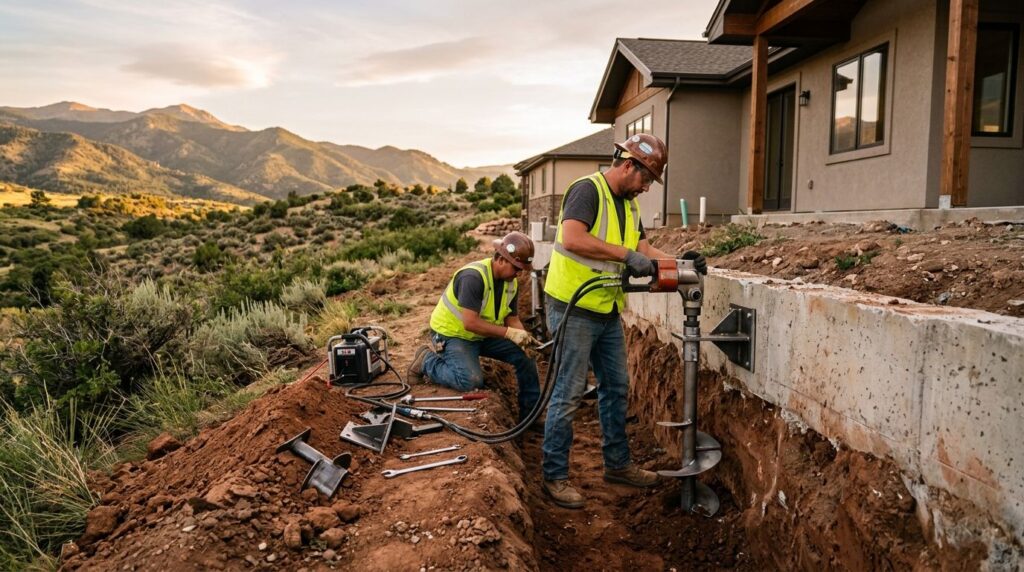
Table of Contents
- How Long Foundation Repairs Really Last on the Colorado Front Range
- How Long Do Foundation Repairs Typically Last?
- Does the Type of Foundation Repair Method Affect How Long It Lasts?
- How Long Do Foundation Piers Last? Steel Quality, Depth, and Soil
- What Factors Can Shorten the Lifespan of a Foundation Repair?
- Transferable Warranties and What Repair Guarantees Actually Cover
- Getting the Longest Life from Your Foundation Repair
How Long Foundation Repairs Really Last on the Colorado Front Range
If you’re a homeowner and wondering how long do foundation repairs last on the Colorado Front Range, know that repair longevity depends largely on local soil and moisture conditions. Here in this area, expansive bentonite clay soils from the Pierre Shale will swell considerably when wet – typically 4%-8%, and up to 10% in some cases – which can continue to put stress on foundation repairs over time.
We’ve been serving the Front Range since 1996 as a family-owned business specializing in steel pier systems, which reach stable soil layers to provide long-term stabilization. Our regional expertise helps homeowners understand that while no repair lasts forever, the right method and professional installation—backed by on-site engineering evaluations—can extend the life of a foundation repair well beyond common expectations in Colorado’s challenging soils.
Key Takeaways
- On the Colorado Front Range, how long foundation repairs typically last depends on the repair type used and whether we have eliminated the reasons for foundation movement, like expansive clay soils and poor drainage.
- In other words, how long your foundation lasts is dependent on the method used to address the underlying issue.
- How long steel foundation piers last has little to do with time on the calendar and much more to do with what they’re holding up.
- When homeowners ask how long do foundation repairs last, the honest answer depends on factors beyond the repair itself.
- Our warranties hinge on documented conditions and site-specific factors.
How Long Do Foundation Repairs Typically Last?
On the Colorado Front Range, how long foundation repairs typically last depends on the repair type used and whether we have eliminated the reasons for foundation movement, like expansive clay soils and poor drainage. Deep systems such as ICC-ES evaluated helical pier systems (ESR-3032) are designed to stop settlement of a foundation, and allow loading immediately following installation. It’s important to recognize these systems will reach the competent soil or strata, but will not promise a certain lifespan of the foundation.
The durability of repairs is based on certain factors at the job location. To determine how long a repair will last, we need to conduct a thorough on-site analysis of what type of soil, moisture content, and level of structural distress there is. Not noticing these initial signs like horizontal crack displacement, bowing basement walls, and sticky windows can shorten the life of the repair. Addressing the root cause—such as installing perimeter drainage or vapor barriers—is essential to prevent recurrence and extend the repair’s effectiveness. In our region, for example, expansive clay soil may expand up to 10% when it is saturated, which exerts significant pressure against a home’s foundation. That can lead to continued damage to the foundation if the moisture issue is left unresolved. This expansion demonstrates that moisture control is extremely important in determining the overall success of a repair.
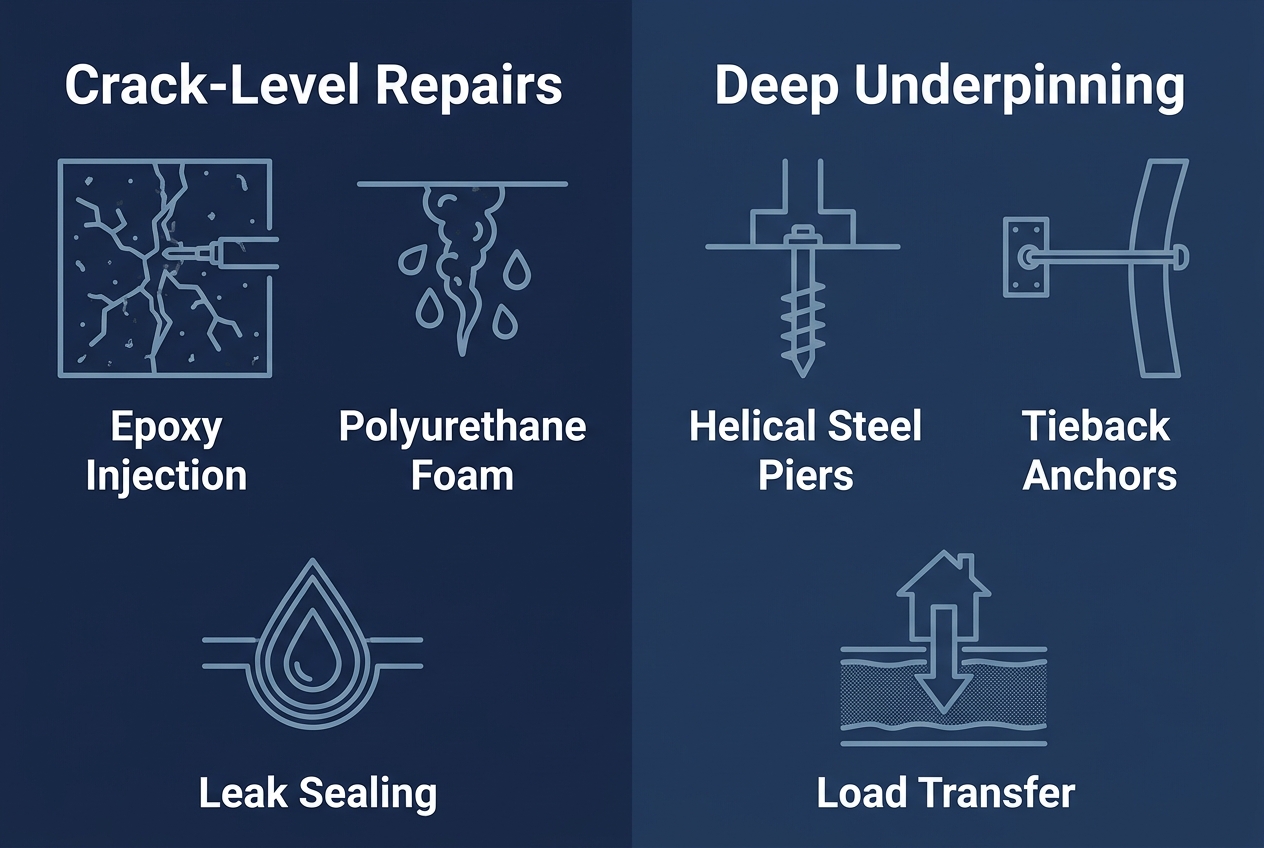
Now, we have to clarify the differences between foundation crack repair vs. foundation structure repair and stabilization. Epoxy injections and crack sealers can effectively address non-structural cracks, but they depend on ongoing soil and moisture management to maintain their integrity over time. On the other hand, helical piers foundation underpinning is designed for long-term stabilization and is a more permanent solution than other repairs when properly engineered and installed.
The repair method chosen is really the biggest variable that determines how long they last. So we will always recommend having your house evaluated by a professional to determine what’s best for your home.
Does the Type of Foundation Repair Method Affect How Long It Lasts?
In other words, how long your foundation lasts is dependent on the method used to address the underlying issue. Here in the Colorado Front Range, expansive bentonite clay soils will swell anywhere from 4% to 8% between seasonal moisture changes and up to 10% when saturated. If your foundation has cracks that allow water into the foundation walls, you need to seal these cracks. If the cracks are going to fail the foundation structurally, you need to stabilize them by shifting the loads onto more stable soil layers.
epoxy injection works by creating a structural bond within the cracks in concrete, and it works well on non-structural hairline cracks that mostly allow water through. On the other hand, polyurethane foam is designed to seal active leaks by expanding into any open spaces, but it won’t do anything to soil movement or load bearing. Since the two types of repairs tackle different issues, their performance is different as well: Epoxy bonds can last decades if installed correctly, whereas foam seals might have to be reapplied if soil conditions keep changing.
If the soil instability runs deep, helical steel piers may need to extend 17 ft on average, and sometimes more than 50 feet, to take the weight of the building off the foundation and into the ground where it will support well. They go around the surface soils that move seasonally and don’t support the foundation well in expansible clay, providing a more durable alternative in these regions. Systems such as the one evaluated under ICC-ES ESR-3032 have been tested for their capacities and show predictable performance, which can be relied upon if used properly, based on the problem they are designed to fix.
The correct method ensures that the repair will last as it addresses the actual cause of distress. If you are trying to stop a leaky roof or fix a foundation that’s been moving, having a professional come to assess the situation followed by appropriate engineering makes the difference in durability.
How Long Do Foundation Piers Last? Steel Quality, Depth, and Soil
How long steel foundation piers last has little to do with time on the calendar and much more to do with what they’re holding up. For Denver and Front Range homes built on expansive bentonite clay, it’s not really about how long the piers last, but rather, how long the piers can support your home’s foundation as the soil moves.
The soil condition in our area presents the first variable: bentonite clay can swell between 4% and 8% when saturated, exerting upward pressure that strains even the most robust foundation systems. The swelling is not the same everywhere though; it varies depending on the amount of moisture in the air, and what local geology is like, which is why getting an analysis from an expert to see if your soil will make your pier system’s life shorter or longer is necessary. Proper drainage and moisture management around the base of the foundation will also help keep the risk lower, ensuring the stability of the piers you’ve installed.
The installation depth is another key aspect to consider. Our helical piers are engineered to reach stable soil layers, typically around 17 feet below grade, where moisture fluctuations have minimal impact. If you live in an area with deep clay that’s expansive, or bedrock that’s uneven, we will install piers as deep as 50 feet or more, depending on what the soil testing reveals. The deeper the pier is installed, the less it will be affected by seasonal changes in the soil, which results in a more consistent performance for your home’s foundation over time.
Steel quality and engineered installation round out the equation. We fabricate our piers to ASTM standards and hot-dip galvanize components to resist corrosion, ensuring the material itself remains durable for decades. Combined with rotary installation techniques that minimize site disruption, these measures deliver immediate load-bearing capacity without cure time, so your foundation stabilization begins the moment the piers are set. Still, even the best-engineered system depends on site-specific conditions, which is why we recommend an on-site inspection to assess your home’s unique needs before finalizing any estimate.
What Factors Can Shorten the Lifespan of a Foundation Repair?
When homeowners ask how long do foundation repairs last, the honest answer depends on factors beyond the repair itself. Even when installed properly, stabilizing systems can be undermined by ongoing soil movement and moisture issues common across the Front Range. This environment exerts stress and strain on your repairs in a series of cycles that will slowly wear away even the strongest repair work.
We have expansive bentonite clay soils here that are the problem. Our soils will swell between 4%-8% when saturated (and in some instances can go up to 10%.) as they compress foundation walls and continue pushing relentlessly. Wetting and drying of the soil (seasonally) keeps the repair from being “fixed”, because the volume change of the soil will constantly be expanding and contracting again, causing the wall to move with each change. That’s why we recommend assessments to be done to determine if the cracks just need to be sealed, or if they require full structural stabilization.
Poor drainage and grading compound the problem by directing water toward the foundation. Industry standards recommend at least a 6-inch downward slope over the first 10 feet around the structure, but many properties fail to meet this basic requirement. When water pools near the foundation, it intensifies the swelling pressure on expansive clays and accelerates deterioration of both the repair and the surrounding soil.
Colorado’s freeze-thaw cycles can create even more stress. When water in the soil freezes and expands it creates even more lateral pressure on foundation walls. Added with drainage problems and expansive clay, these freeze-thaw cycles cause progressive damage that shortens the life of a fix.
Ignoring early warning signs speeds this up. Cracks spreading across a horizontal line, bowing basement walls, or windows that no longer seal properly may be indications that soil movement has continued unchecked. This means that lateral soil pressure is still acting on the foundation despite the previous repair, which is why tieback anchors and other stabilizing methods are used. Quick action to correct these problems will keep the repair from failing.
Ultimately, moisture control is the most controllable factor we have when it comes to extending the life of a repair. Proper grading, proper drainage systems, and being proactive about moisture is what can protect your investment as a homeowner.
Transferable Warranties and What Repair Guarantees Actually Cover
Our warranties hinge on documented conditions and site-specific factors. Every foundation repair project begins with an on-site inspection because soil conditions, drainage, and moisture levels determine what a warranty can realistically cover. Estimates are preliminary and may change after inspection, and guarantees hinge on maintaining the documented conditions at installation.
Our ICC-ES evaluated helical pier systems (ESR-3032), being engineered products, serve as the foundation for warranty confidence. They reach competent bearing strata that offer consistent bearing capacity and allow for immediate loading with no need for curing time. The trained and certified installers follow specific procedures to ensure that the installations will meet the requirements needed for the structure, supporting the warranty claims we make regarding the structure’s durability.
In Colorado, transferability is important during real estate. Foundation disclosure is required and warranty language that transfers to the new buyer can help with property value. We document projects in great detail so any warranty information follows with the house. However, it’s always a good idea for buyers to review the warranty directly. Coverage details, exclusions, and claim procedures vary per project and per product.
Many of the things that can void coverage are out of our hands: progressive soil movement from expansive clay, poor drainage or seasonal freeze/thaw are not covered under the warranty. Routine maintenance and timely response to any new cracks or moisture issues can help maintain the integrity of your repair and keep the terms of your warranty intact.
Before signing, consider these key questions:
- What specific defects or failures are covered, and for how long? Our warranties outline covered defects and typical durations, but exact terms depend on the product and installation conditions documented at the time of service.
- What maintenance or conditions must you uphold to keep the warranty valid? Maintaining proper drainage, monitoring moisture levels, and addressing new cracks promptly are essential to preserving warranty coverage.
- Which events or actions void the warranty? Events such as unapproved modifications, progressive soil movement beyond normal seasonal changes, or failure to address known drainage issues typically void coverage.
- Does the warranty transfer to a new owner, and under what terms? Many of our warranties include transfer provisions, allowing coverage to pass to subsequent homeowners; however, transfer terms and eligibility criteria vary by project and product.
- How are claims filed, and what documentation is required? Claims typically require proof of installation records, maintenance history, and evidence of the defect or failure as outlined in your warranty documentation.
Getting the Longest Life from Your Foundation Repair
How long do foundation repairs last? In Denver, and throughout the Front Range area, the truth is that it really depends on the quality of the repair done, and how you handle the soil and water around your house. Expansive bentonite clay soils can swell between 4%-8% when saturated, so even years after the foundation has been repaired, the soil is still exerting a strain on it. What kind of repair you make is important too: epoxy injections fix the structural bonds in cracks, while polyurethane foam is more focused on sealing leaks. Either way though, proper drainage is key, at least a 6” downward slope for the first 10’ around your foundation will help protect your repair. Keeping records and permits on your repair can also help when selling your house in Colorado and getting financed.
Actual results will vary based on site condition and inspections. Please consult with a licensed structural engineer or other qualified professional for proper diagnosis and design. Call us today to schedule an inspection and to receive your preliminary estimate.
Get Your On-Site Evaluation
Now that you understand how long foundation repairs last on the Colorado Front Range, the next step is finding out what your specific property needs. As we’ve covered, longevity depends on the repair method, steel quality, installation depth, and how well you manage moisture around your home. The expansive bentonite clay soils in this region make every foundation situation unique, which is why a thorough on-site inspection matters. Rocky Mountain Steel Piering has been a family-owned steel pier specialist since 1996, serving homeowners in Littleton, Denver, and communities across the Front Range. Our estimates are confirmed in writing following an inspection, so you’ll know exactly what your repair plan entails. Whether you’re dealing with settling, cracking, or drainage concerns, an evaluation will clarify your options. Call us at +1 303-471-1155 or request your inspection to get started.