
Parking Lot Light Pole Foundations: Complete Guide to Installation
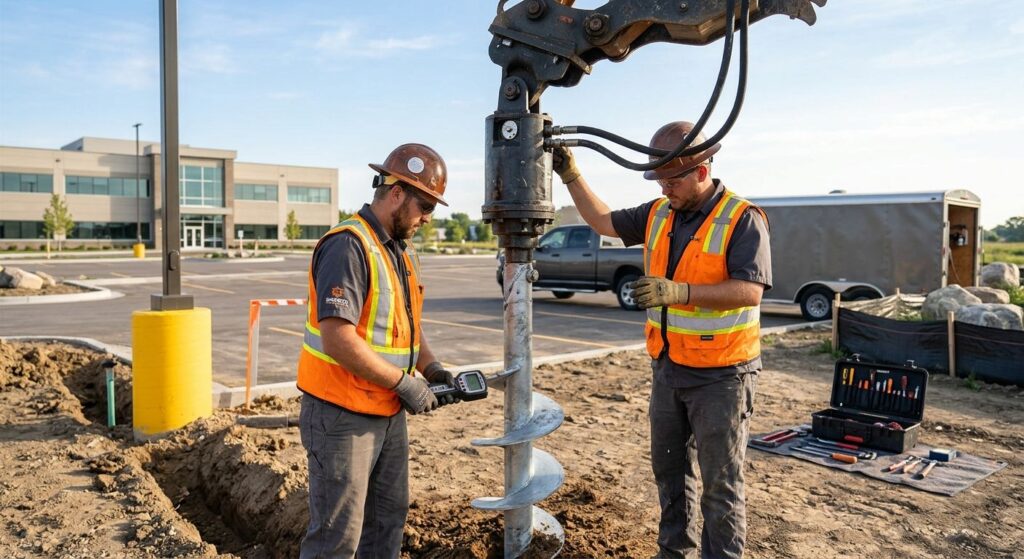
Table of Contents
- Helical Pier Foundations for Parking Lot Lighting Projects
- Parking Lot Light Pole Foundations: How Helical Piers Deliver Reliable Support
- Key Advantages of Helical Piers Over Traditional Concrete Bases
- The Helical Pier Installation Process for Light Pole Foundations
- Best Practices for Long-Lasting Light Pole Foundations
- Ensuring Reliable Support for Your Parking Lot Lighting
Helical Pier Foundations for Parking Lot Lighting Projects
Parking lot light pole foundations constructed with helical piers are able to carry structural loads down into solid earth via circular steel plates that are affixed to a central hub. This avoids the need for the wait-time and excavation required by concrete poles. Our design merges the instant carrying capacity offered by the MacLean/Dixie System with a class b1 hot-dip galvanised coating as stipulated by astm a153, making sure your steel stands up to weathering season-in, season-out in parking lots all around colorado.
For commercial lighting projects, the speed advantage is significant. A helical pier reaches its design torque during installation and accepts the light pole at once, meaning no days lost waiting for concrete to set and no heavy equipment tearing up pavement or landscaping around the site. That keeps parking lots open and minimizes disruption for tenants, customers, and traffic flow.
We are a family owned company, which has been around since 1996, and we have earned the title the experts in steel piers, based upon our certified installation crews who deliver predictable capacities on every project. The same engineered approach that supports the boardwalks and municipal buildings located throughout Littleton, Denver, and Douglas County translates directly to reliable parking lot light pole support that developers and property managers count on.
Key Takeaways
- Helical piers provide immediate load-bearing capability as well as rapid installation, but can these piers ensure a lasting load bearing capacity for parking lot lighting?
- Helical piers deliver faster, cleaner, and more resilient foundations for light pole installations compared to traditional concrete bases.
- A reliable helical foundation for a light post will require following specific steps that entail inspection on-site, then utilizing appropriate engineering technique(s).
- After installing all helical piers, one must stick to some rules to make sure that the pier foundations work as expected for years.
- The choice between different kinds of parking lot light pole foundations is driven primarily by stability as well as installation convenience.
Parking Lot Light Pole Foundations: How Helical Piers Deliver Reliable Support
Helical piers provide immediate load-bearing capability as well as rapid installation, but can these piers ensure a lasting load bearing capacity for parking lot lighting? In order to accomplish this task, there must be several considerations taken into account including the engineering of the foundation elements, the state of the soil in which they will be installed, and how well corrosion resistant the structure may be designed to be.
Key Components of a Helical Pier Foundation
The helical pier foundation comprises various carefully constructed parts that transfer the loads to the lower levels of ground through these components. It employs circular-shaped steel plates called helical plates, welded to a central steel hub along a shaft. Shafts could be made out of standard square bars or structural pipe sections, permitting us to find a perfect fit for your particular needs for both the light post itself plus the site around it. Each piece has a Class B1 hot-dip galvanized coating to comply with ASTM A153 and ensure corrosion resistance.
The Role of Soil Conditions in Load Capacity
Soil conditions directly influence load-bearing performance. Weak or unstable soils, such as expansive clays, loose fill, or saturated ground, can cause a conventional concrete foundation to settle or rotate over time. The helical pier gets around that by extending deep into good bearing soil below where those problematic layers lie. Each one is pushed down using torque-monitored rotary equipment until it reaches competent ground. The load is monitored while advancing and measured at that point against a Kt for a given soil type. This relationship is furthered through load testing according to ASTM standards which include D1143 Axial Compression, and D3689 Lateral Testing. This will give all of the documented performance data necessary for the design engineer to sign-off on the system as constructed. Since our system is modular, we have the option to increase the depth in increments. If the top soil does not meet enough load requirements, additional shafts will be added in sequence until the helix reaches a layer that is able to withstand the loads. Then once the designed torque has been met, loading of the helical piles can commence. No concrete curing time is necessary due to the helical pile being used instead, and this results in much shorter construction times. It also means that pole installations may start immediately upon arrival at site.
Corrosion Protection for Long-Term Performance
The long-lasting nature of a light pole base frequently depends upon whether or not the pole has been protected against ground and water borne corrosion. The hot dipped galvanizing of the Class B1 material used in our helical piers meets the standards set forth within ASTM A153, which produces a metallurgically bonded zinc layer which serves as a protective barrier against any kind of damage from dampness and water tables as well as chemical or mineral components found in the ground. In contrast to paint or sealants, which can only be applied at the surfaces, hot dip galvanizing coats everything involved, from helical plates to shafts and couplings alike. This extends the service life of such light poles for decades. Regular inspections confirm the coating maintains its integrity under demanding conditions, preserving the structural support for parking lot lights. When the information about various components, soil studies and corrosion protection is given to you, then the comparison between such bases for light poles and concrete ones should also be made.
Key Advantages of Helical Piers Over Traditional Concrete Bases
Helical piers deliver faster, cleaner, and more resilient foundations for light pole installations compared to traditional concrete bases. As a family-owned and operated foundation specialist since 1996, we have seen firsthand how these advantages translate to successful projects.
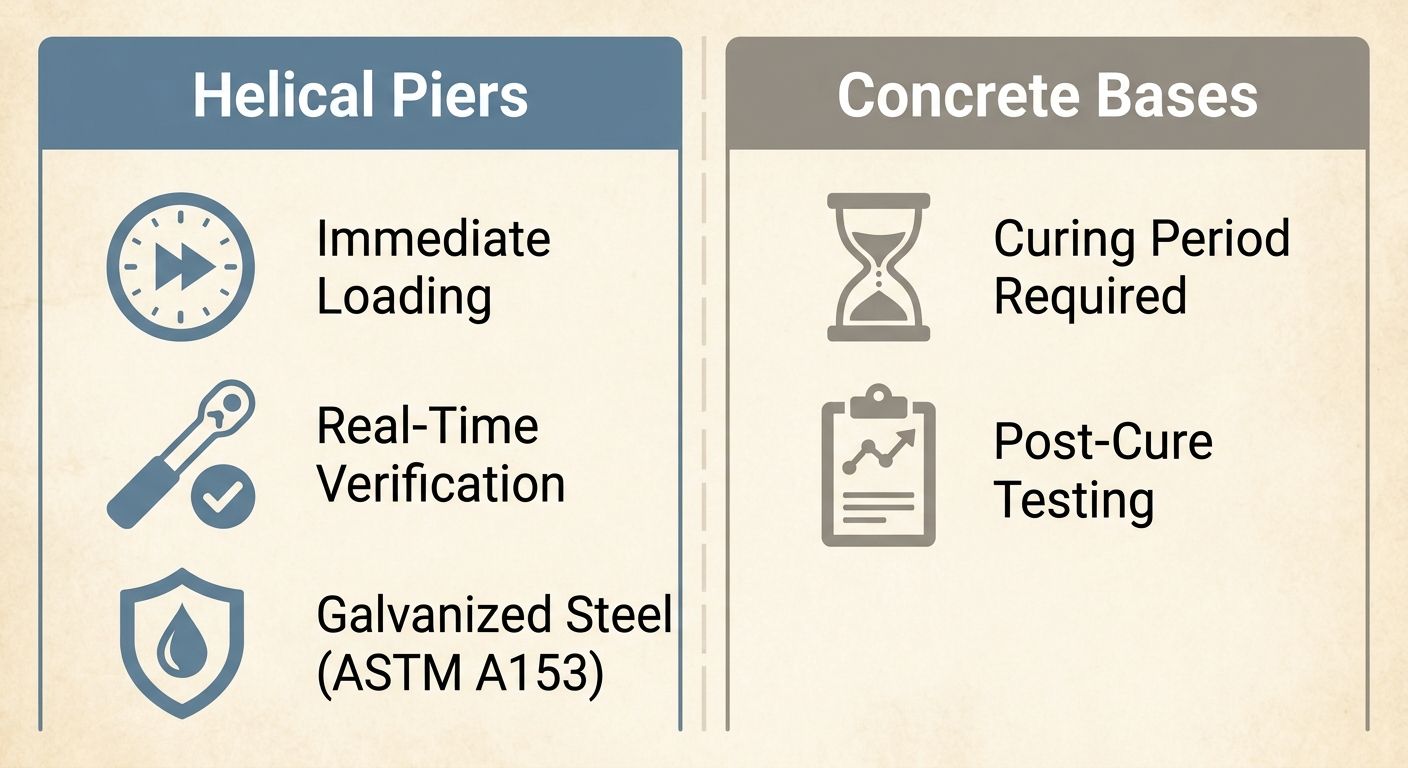
The table here shows how helical piers stack up against concrete bases in terms of their ability to perform well along four dimensions.
| Aspect | Helical Piers | Concrete Piers |
|---|---|---|
| Installation Speed | Immediate loading; no cure time required | Requires curing period |
| Load Capacity Verification | Torque-to-capacity correlation in real time (ASTM D1143/D3689) | |
| Corrosion Resistance | Hot-dipped galvanized coating meets ASTM A153 | |
| Equipment Impact | Compact rotary equipment minimizes site disruption | Heavy excavation and concrete trucks required |
Faster Completion with Immediate Loading
Concrete light pole foundations involve excavation, formwork, concrete pours, and cure times that often extend a project timeline by several days. The MacLean/Dixie Helical system has rotary equipment attached that record torque in real-time as the helical is advanced into the ground. As you advance the piers into the soil, the torque is recorded and correlated to soil-specific capacity factors, producing a real-time load rating per ASTM D1143 & D3689. Since there is no cure time needed, the foundation is ready at the completion of the helical torque value. Poor soil conditions may allow us to install these helical systems much faster than if we were to pour concrete, sometimes 66% faster.
Lightweight Equipment and Minimal Site Disruption
Helical piers make use of compact, rubber-tracked drive motors that enable them to move around the parking area without damaging the paving. There will be no deep holes to dig or spoilage from removing earth as the helical pier is driven down through the soil and only a small amount of earth is moved out of its way. No heavy dump trucks or concrete mixing vehicles are used by our installation crew unlike what would normally happen during the construction of cast-in-place footings. Installation will generate limited vibrations, allowing the surrounding soil to remain intact and less likely to settle in adjoining paved surfaces.
Built to Withstand Environmental Challenges
Helical pier shafts are hot-dipped galvanized to meet ASTM A153, giving the steel lasting protection against rust in wet or corrosive soils. We can extend the pier segments deep enough to reach below the frost line, which minimizes the risk of frost heave that can lift and crack conventional concrete foundations. In high water table areas, the galvanized coating resists constant moisture without spalling the way concrete can when water enters cracks and freezes. The helical plate design distributes the load evenly and resists lateral forces from wind loads on the pole. By anchoring in competent soil below the active zone, freeze-thaw cycles do not shift the foundation, keeping light poles plumb year after year.
The Helical Pier Installation Process for Light Pole Foundations
A reliable helical foundation for a light post will require following specific steps that entail inspection on-site, then utilizing appropriate engineering technique(s). Certified installers with sufficient training and education to finish this job will make certain that there won’t be any concrete cure time needed. That means that once a company has made its way down until reaching the intended bearing strata, the foundation can be put into service immediately.
Pre-Installation Site Assessment and Engineering
Every successful light pole foundation installation begins with a comprehensive site assessment evaluating subsurface conditions and structural demand. Our team investigates soil profiles to identify competent bearing strata capable of supporting design loads. Variables like expansive bentonite clay directly influence pier depth, shaft diameter, and helix plate configuration. The engineering stage translates the light pole’s height, weight, and anticipated wind load into a custom pier design, specifying the exact lead section and any extension shafts required to reach load-bearing soil. This tailored approach ensures the foundation system aligns with local conditions and project specifications before any equipment arrives on site.
Step-by-Step Installation: From Driving to Connection
With the design finalized, our crews proceed through a methodical sequence:
- Positioning the Equipment: The installer positions the rotary drive head over the layout point and ensures the lead section is plumb and correctly aligned.
- Driving the Initial Section: The rotary motor advances the first pier segment into the soil while continuously monitoring hydraulic pressure. This real-time torque data correlates directly to bearing capacity, providing instant feedback on soil resistance.
- Adding Extension Shafts: When the lead section nears ground level, installation pauses to bolt on a subsequent extension shaft using an engineered coupling. This process repeats until the helical bearing plates reach the designated load-bearing stratum, indicated by a consistent and rising torque signature.
- Securing the Light Pole Base: After the final pier section is driven to the specified depth, our crews attach the structural steel bracket or embedment at the top. All hardware connecting the bracket to the pier shaft is tightened to the manufacturer-specified torque values, ensuring a rigid, long-term connection for the light pole.
With the pier set and the bracket secured, the foundation is ready to accept the light pole superstructure immediately, no concrete curing delays are required.
Quality Control and Load Verification
During installation, each helical pier goes through strict quality control procedures in order to make sure each meets its designed load capability.
- Real-Time Torque Monitoring: Our equipment records installation torque for every pier, applying a soil-specific capacity factor (Kt) to verify the achieved axial capacity aligns with engineering specifications.
- Standardized Testing Alignment: The load verification methodology follows ASTM D1143 for axial compression and ASTM D3689 for lateral load behavior, providing reliable documentation for project records.
- Final Installation Check: Once the target design torque is met, our installers perform a visual inspection of all connections and pier alignment, confirming the system meets plan requirements.
This monitored installation sequence confirms that the pier is bearing in competent soil and can support design loads immediately, streamlining the overall project timeline.
Best Practices for Long-Lasting Light Pole Foundations
After installing all helical piers, one must stick to some rules to make sure that the pier foundations work as expected for years.
Working with Certified Installers and Engineered Plans
Our crews of trained, certified installers follow stamped, engineered plans that specify the MacLean/Dixie helical pier configuration for the site. Each pier receives a Class B1 hot-dipped galvanized coating meeting ASTM A153, which protects against corrosion in buried service. During installation, we verify load capacity using torque-to-capacity correlation, a method that correlates installation torque with a soil-specific capacity factor. This approach, backed by standardized testing under ASTM D1143 (axial compression) and ASTM D3689 (lateral load), allows us to confirm the required capacity before the light pole is erected. With no curing time required, the foundation can be loaded immediately, giving engineers and property owners confidence in long-term performance. Adherence to engineered plans and certified workmanship helps ensure that each light pole foundation meets the structural demands of a busy parking lot.
Site Preparation and Soil Analysis
Prior to any excavation, we clear the site of debris and arrange for a utility locator service to mark all underground lines, eliminating the risk of damaging existing utilities. A thorough soil analysis is then conducted to understand the profile—information that directly influences the pier design. Soil composition, density, and bearing capacity determine the required helix configuration, shaft type, and embedment depth. Because the torque-to-capacity factor is soil-specific, the installation readings provide real-time confirmation that the pier has reached a competent load-bearing stratum. Without proper soil evaluation, the foundation could experience settlement or tilt over time. We work with professional engineers to integrate the soil report into the engineered plans, ensuring the foundation is tailored to the parking lot’s subsurface conditions. This site-specific approach, combined with our certified installers’ expertise, minimizes the uncertainty often associated with light pole foundations in parking lots.
Maintenance and Inspection for Enduring Performance
Regular inspection keeps helical pier light pole foundations performing reliably. We advise checking that the pole remains plumb and that all fasteners connecting the pier base plate to the pole are secure, particularly after severe storms or ground movement. Re-torquing bolts to the specification in the installation documents at those intervals prevents loosening and misalignment. The hot-dipped galvanized coating (ASTM A153) offers strong corrosion protection, but owners should periodically inspect exposed hardware for scrapes or coating wear and touch up any damaged areas. Monitoring the surrounding grade for signs of erosion or ponding water also helps avoid moisture-related deterioration. In regions with freeze-thaw cycles, checking bolt torque and pole alignment after seasonal ground movement becomes especially important. A small investment in these inspections can prevent larger, more costly repairs. By incorporating these checks into a routine maintenance schedule, property managers help extend the service life of the foundation and maintain safe, dependable parking lot lighting.
By following them, we will help make certain that your parking area light pole base supplies consistent assist for many several years.
FAQ
Can helical piers for light pole foundations be installed in poor or unstable soil conditions?
Yes, helical piers can be installed in poor or unstable soil. They are driven deep past problematic layers like expansive clay, loose fill, or saturated ground to reach competent bearing soil. Modular extension shafts allow depth increases until torque monitoring confirms the pier is in load-bearing stratum.
Are helical piers for light pole foundations resistant to environmental factors like corrosion and high water tables?
Yes, helical piers are resistant to corrosion and high water tables. All components receive a Class B1 hot-dipped galvanized coating that meets ASTM A153, creating a metallurgically bonded zinc barrier. This coating protects against moisture, chemicals, and mineral damage without spalling the way concrete can.
Do helical pier foundations for light poles require heavy excavation or large machinery on-site?
No, helical pier foundations do not require heavy excavation or large machinery. Installation uses compact, rubber-tracked rotary drive motors that advance the pier into the soil with minimal surface disruption. No deep digging, soil spoilage, dump trucks, or concrete mixing vehicles are needed.
Why are Helical Piers a Better Choice for Parking Lot Light Pole Foundations Compared to Traditional Concrete Piers?
Helical piers are a better choice because they provide immediate load-bearing with no concrete curing time, use lightweight rotary equipment that minimizes site disruption, and offer corrosion resistance through hot-dipped galvanizing. They also reach below frost lines to prevent frost heave, unlike concrete foundations.
How Quickly can Helical Pile Foundations for Light Poles be Installed Compared to Poured Concrete?
Helical pile foundations can be installed up to 66% faster than poured concrete, especially in poor soil conditions. The pier reaches design torque and accepts the light pole immediately, eliminating days lost to concrete curing. Real-time torque monitoring verifies capacity during installation, streamlining the entire timeline.
Ensuring Reliable Support for Your Parking Lot Lighting
The choice between different kinds of parking lot light pole foundations is driven primarily by stability as well as installation convenience. Helical pier systems provide a solution that takes the foundation deep into the soil while leaving the environment mostly unaffected at ground level. We’ve been using this technique in our construction projects in the Denver metro area.
Pier installation speed is really fast if you’re working on soils like clay or fill that can be found on most parking lots, up to about 66% faster than pouring out new concrete! The piers start to take weight right away without needing any wait periods for hardening. Each part gets treated with a Class B1 hot-dipped galvanizing according to ASTM A153 standards which means they last for ages before getting corroded.
Contact our team if you are a property owner, engineer or contractor located in Littleton. Site-specific evaluation will help us analyze the soils as well as required pier loadings needed to develop an acceptable pier configuration.
All information on this website is for general informational purposes and may be updated without notice. Estimates and quotes are preliminary and are not legally binding until confirmed in writing following an on-site inspection. We do not guarantee specific results for every project; actual outcomes depend on site conditions and inspections. By submitting information you consent to our Privacy Policy and to receive communications; see Privacy Policy for details. Consult a licensed structural engineer or qualified professional for definitive diagnosis and design recommendations.
Explore Our Helical Pier Systems
You’ve now learned how helical pier foundations provide reliable support for parking lot light poles, with immediate loading and minimal site disturbance. The detailed technical specifications that make this possible are available in our helix pier product information. From square shaft to structural pipe options and ASTM A153 galvanized coatings, every component is engineered for performance. Delve into the exact plate thicknesses, diameters, and coupling bolt standards that ensure your foundation withstands environmental challenges. Our resource page offers the in-depth data you need to make informed project decisions. Take the next step in your research and see the quality materials behind every installation.