
Torque to Capacity Correlation Helical Piles: Ultimate Engineering Guide
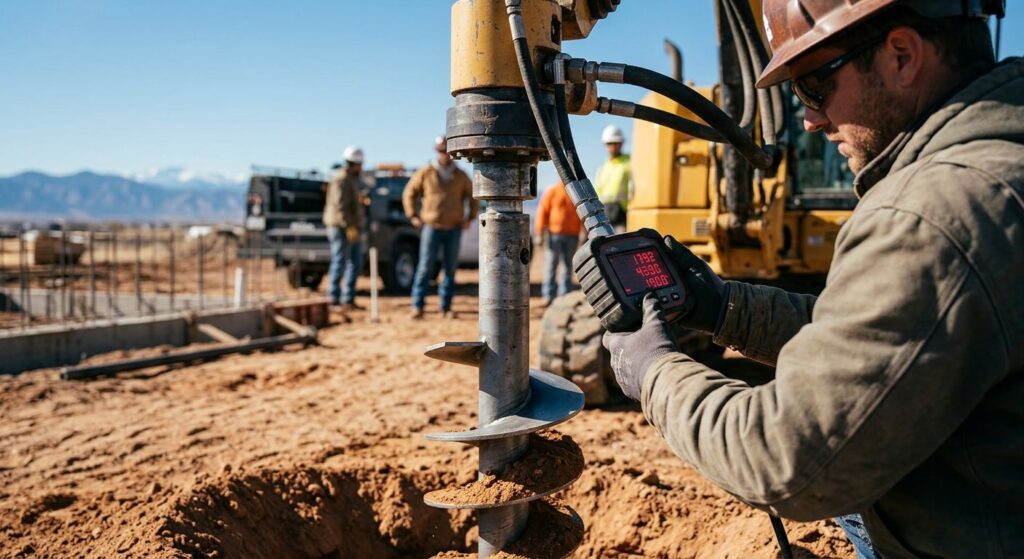
Table of Contents
Torque-to-Capacity Correlation for Helical Piles
The torque-to-capacity correlation in helical piles is an empirical relationship that allows us to estimate axial capacity directly from the energy required to advance the pile into the soil. It is expressed as Q_ult = Kt * T, where Q_ult is the ultimate capacity, T is the final installation torque, and Kt is the Kt factor — a proportionality constant that varies with soil type, helix geometry, and embedment depth. At Rocky Mountain Steel Piering, Inc., we rely on this relationship because it gives us real-time insight into pile performance without waiting for cure times or conducting immediate static tests.
Our internal installation records consistently show that the Kt factor in helical piles provides reliable capacity estimates when correlated with site-specific geotechnical data. Based on our data for commercial helical piles, torque-based capacity estimation becomes predictable across a wide range of diameters and soil profiles. As outlined in geotechnical design references, the method is widely accepted, though its accuracy improves when validated against occasional full-scale load testing. We always interpret the correlation within the context of local soil conditions, using installation torque monitoring during every project to verify design assumptions as piles are advanced.
1. Torque-to-Capacity Fundamentals
At RMS Screw Piles, The Experts in Steel Piers, we rely on the established torque to capacity correlation helical piles to predict their performance during installation. This relationship is expressed as Q = Kt * T, where Q represents the ultimate axial capacity, Kt is the empirical torque factor, and T is the measured installation torque. This principle provides us with an immediate, real-time indication of load-bearing potential without waiting for concrete to cure or for extensive load testing to be completed.
The torque factor (Kt) is derived from extensive empirical data and varies based on soil stratigraphy, pile shaft geometry, and the configuration of the helical bearing plates. The American Society of Civil Engineers provides guidelines that support this torque-to-capacity methodology, and our internal experience, as detailed in our FAQ on commercial load capacities, reinforces the necessity of site-specific verification. For further reading on the broader principles at play, you can consult dedicated geotechnical engineering resources.
Effective installation torque monitoring is crucial because it allows our trained installers to document the consistency of the soil profile and verify that the pile has reached a competent bearing stratum. While this correlation is a powerful tool for quality assurance, it is important to understand that definitive design values must always be confirmed by a licensed structural engineer, as actual capacities are intrinsically dependent on project-specific soil conditions.
2. The Kt Factor for Capacity
Building on the fundamentals of helical piles, the core of determining load capacity is the torque to capacity correlation helical piles demonstrate during installation. Engineers rely on a specific empirical relationship known as the Kt factor helical piles are engineered with, which links installation torque to ultimate pile capacity. This relationship is commonly expressed as T = Kt * Q, where T represents the measured installation torque and Q is the predicted ultimate capacity.
Manufacturers such as Hubbell supply pre-established Kt values for their own product lines, giving engineers a useful starting point for estimation. However, the Kt factor is not a fixed constant; it shifts depending on soil conditions, pile geometry, and the installation equipment used. Our internal RMS comparison guide emphasizes that site-specific adjustments are frequently needed to maintain accuracy. For example, cohesive soils like clay typically exhibit different torque-to-capacity behavior than granular sands.

Helical pile torque-to-capacity soil type comparison.
This variability makes installation torque monitoring a vital quality control practice. By continuously recording torque during driving, contractors can verify in real time that each pile achieves the required design capacity before moving on. For standardized design protocols that govern these procedures, we recommend consulting American Society of Civil Engineers resources. In the following section, we will apply these torque-correlated capacity principles to practical design examples and field testing protocols.
3. Torque Monitoring in Quality Control
The torque to capacity correlation helical piles provides a critical real-time quality control measure during installation. This relationship is explained by the KT factor (torque factor) for helical piles, which, per ICC-ES AC358, typically ranges from 8 to 12 ft⁻¹, correlating installation torque to ultimate capacity. At Rocky Mountain Steel Piering, Inc., our trained installers rely on installation torque monitoring to verify that every pier achieves its target capacity before it is put into service. This real-time verification is embedded in a broader quality control program that also confirms contractor licensing and insurance—a practice that reflects our commitment to integrity on every Colorado project.
This non-destructive method allows immediate loading without cure time, a distinct advantage over alternatives. For commercial-scale projects, including helical piers for commercial buildings, real-time torque data ensures foundation integrity. However, final capacity should always be validated by a licensed structural engineer for definitive assurance. As The Experts in Steel Piers, we combine decades of family-owned experience with meticulous quality control.
4. Monitoring Methods and Equipment
As The Experts in Steel Piers, we rely on the torque to capacity correlation helical piles to verify capacity in real time as each pier advances. Our crews employ integrated monitoring to confirm pile capacities without load testing every pier.
The kt factor helical piles converts installation torque into axial capacity. This torque to capacity correlation helical piles lets us validate design loads on the spot, and consistent installation torque monitoring through dedicated instruments ensures reliability for each shaft.
We equip our crews with torque gauges, pressure gauges, inclinometers, and digital data loggers. Hubbell torque gauges and data loggers are widely used in the industry to document compliance. Before installation, any excess concrete from onsite concrete crushing is cleared to ensure unobstructed monitoring. As shown by RMS Foundation Solutions’ tieback shoring applications, real-time monitoring on helical pier tiebacks validates lateral capacity. The resulting torque and alignment data build a record that directly informs post-installation assessments.
5. Interpreting Torque Graphs
Building on the installation torque monitoring data we collect during every helical pile installation, interpreting the resulting torque graph is essential for confirming that design loads have been achieved. The torque-to-capacity correlation is the fundamental principle we rely on: Q = kT * T, where Q represents the ultimate capacity, T is the average installation torque, and kT is an empirical factor. This torque to capacity correlation helical piles provide allows us to verify capacity in real time without waiting for cure times or conducting separate load tests on every pile.
The kT factor helical piles use is validated by field load tests and typically ranges from 3 to 10 ft⁻¹, depending on soil conditions and pile geometry, as documented in industry standards established by the American Society of Civil Engineers (ASCE). An ideal torque graph demonstrates a steady, proportional increase as the pile advances, followed by a sharp jump when it reaches the target bearing stratum. We continuously monitor for warning signs like erratic fluctuations or sudden torque drops, which can indicate obstructions, voids, or inconsistent soil layers. As a family-owned and operated company since 1996 serving the Colorado Front Range, we understand how our expansive bentonite clay soils can create challenging installation conditions that require careful torque interpretation.
Proper installation torque monitoring provides immediate quality assurance, confirming that the pile has achieved sufficient capacity before structural loading begins. This verification step is critical because inadequate torque-based capacity verification can lead to foundation settlement over time, a risk exacerbated by poor drainage affecting the expansive soils common in Littleton and Denver. Continuous torque monitoring during installation ensures our team can make immediate decisions, adjusting depth or adding extensions until the graph confirms the design assumptions have been met.
Our helical piles are trusted for demanding applications including electrical and utility infrastructure solutions, where load predictability and long-term performance are non-negotiable. The torque-to-load relationship serves as our first line of verification, with the resulting capacity values then feeding into subsequent load testing protocols that further validate structural integrity.
6. Documentation Best Practices
Accurate and thorough documentation forms the backbone of a reliable helical pile installation. At Rocky Mountain Steel Piering, Inc., we prioritize recording the torque-to-capacity correlation for every screw pile we install because it provides the most immediate and reliable verification of performance during construction. This process directly ties the rotational force applied during installation to the estimated axial capacity of the pile, offering a real-time quality control check and a permanent record for engineers and property owners.
The cornerstone of this correlation is the kt factor. This empirically derived value, specific to the pile shaft geometry, converts the installation torque into an estimated capacity. We meticulously document the precise kt factor used for each pile shaft on our installation logs, a practice aligned with general industry standards and quality guidelines from the International Concrete Repair Institute for foundation and repair work. This documentation allows for an immediate field estimate of pile load-bearing performance.
Installation torque monitoring is the method used to capture the raw data for the correlation. Our certified installers record, at a minimum, the final installation torque reading for each pier after it has advanced past the active zone and into competent bearing strata, as verified by soil characteristics. The data gathered through proper installation torque monitoring provides the instant verification that the project’s specified capacity is being met in the specific, on-site soil conditions. Without these precise records, proving the integrity of the foundation becomes a much more complex and invasive undertaking.
The recommended procedure for this critical recording is straightforward:
- Drive the helical pile to the target depth and bearing stratum.
- Record the terminal installation torque, measured in ft-lbs, from the calibrated drive head.
- Calculate the predicted capacity using the documented kt factor (Qu = Kt x T).
- Log this data on the pile log and in the project’s master closeout package.
These documents are then shared with the project’s general contractor and the engineer of record for approval and future reference. The use of this data helps verify that general contractors in Colorado can have full confidence in the foundational work. For over 30 years, our family-owned company, operating as The Experts in Steel Piers since 1996, has upheld these rigorous documentation practices to ensure traceability and long-term accountability for every helical pier installed. It is important to remember that while this method provides a strong predictive metric, all capacity estimates should be reviewed and accepted by a licensed structural engineer, as ultimate site performance depends on actual, inspected soil conditions.
Ensuring Reliable Foundation Performance with Torque Data
Engineers rely on torque-to-capacity correlation to assess helical pier performance during installation. This principle describes the consistent relationship between the installation torque of the shaft and the ultimate geotechnical capacity of the pier. When penetration is uniform with steady torque readings, the torque to capacity correlation helical piles demonstrates confirms predictable load transfer to competent bearing strata.
The Kt factor is an empirical multiplier that refines this relationship for specific site conditions. By applying the kt factor helical piles formula, our trained installers convert measured torque values into estimated capacity figures. Continuous installation torque monitoring provides real-time validation, allowing our team to identify variable soil layers and make immediate adjustments using guidelines from the International Concrete Repair Institute.
Rocky Mountain Steel Piering, Inc. applies these torque-based methods to verify pier integrity without overpromising. Final load performance is site-dependent and requires on-site inspection for definitive capacity determination, enabling predictable outcomes with minimal site impact.