
Helical Piers for Commercial Buildings: 2026 Comparison Guide
Table of Contents
- Helical Piers for Commercial Buildings in Colorado
- Commercial Helical Pile Load Ratings and Testing
- Helical Piers for New Commercial Construction Projects
- Helical Piers for Tiebacks and Shoring Applications
- ASTM Standards Governing Commercial Helical Piers
- Helical Piers for Municipal Boardwalk and Infrastructure Projects
- Evaluating Helical Piers for Your Commercial Project
Helical Piers for Commercial Buildings in Colorado
For helical piers for commercial buildings in Colorado, foundation stability must address the state’s expansive soils and punishing freeze-thaw cycles that routinely undermine conventional footings. These conditions create persistent settlement and structural movement that commercial developers cannot afford to overlook. Helical pier systems transfer structural loads to competent bearing strata well below the active zone, eliminating curing delays and allowing immediate loading once installation is complete.
Colorado commercial projects demand code-compliant solutions backed by rigorous engineering validation. Before installation begins, engineers require helical pile load capacity testing to confirm design assumptions and verify that each pier meets project-specific performance thresholds. Commercial foundation underpinning specifications drafted by structural engineers in Colorado frequently reference ASCE foundation underpinning guidelines for installation protocols, material standards, and quality assurance procedures.
As The Experts in Steel Piers, we deliver turnkey commercial foundation solutions across the Denver metro and Front Range region. Ready to start your construction project? Our team provides site-specific engineering analysis and custom project scoping for developers, contractors, and municipal clients.
Commercial Helical Pile Load Ratings and Testing
For helical piers in commercial buildings, load ratings are determined through a systematic combination of engineering analysis, installation torque measurement, and on-site verification testing. At Rocky Mountain Steel Piering, Inc., we apply proven correlation methods to translate measured installation parameters into predictable load capacities that meet rigorous structural demands.
Understanding helical pile load capacity testing begins with the fundamental torque-to-capacity relationship. During installation, our rotary equipment records the torque required to advance each helical pile into the bearing stratum. This measured torque directly correlates to axial load capacity through an accepted empirical formula: the installation torque multiplied by a soil-specific capacity factor known as Kt. RMSSCO’s trained installers follow a consistent process to achieve the predicted torque and thus the design load, ensuring repeatable outcomes across commercial sites. Key variables that influence load ratings include soil conditions, pile diameter, and embedment depth. Based on typical soil conditions and installation torque, these factors allow us to predict capacities with a high degree of confidence.
Industry standards govern every aspect of load verification. ASTM International specifies standardized testing methods that define acceptable procedures for capacity confirmation. ASTM F3161 provides the standard for helical pile installation, including torque verification requirements. Axial compression testing follows ASTM D1143 protocols, while lateral load behavior is evaluated under ASTM D3689. Our installation methods comply with helical pier corrosion protection standards, ensuring long-term durability in demanding commercial environments. These recognized standards give engineers and specifiers confidence that verified capacities meet project design requirements.
For commercial foundation underpinning specifications, proof testing often supplements torque correlation. We may perform on-site load tests to validate predicted capacities under actual soil conditions, a practice that aligns with industry best-practice—consult a professional structural engineer when definitive capacities must be confirmed. RMSSCO delivers predictable capacities backed by rigorous testing, though estimates and quotes are preliminary and not legally binding until confirmed in writing following an on-site inspection. As The Experts in Steel Piers, our family-owned business brings three decades of experience to every commercial project. Rigorous load testing verifies capacity, and equally important is safeguarding those capacities over the building’s life through proper corrosion protection—discussed in the following section.
Helical Piers for New Commercial Construction Projects
While helical piers are equally effective for residential projects, their advantages become even more pronounced in new commercial construction. For new commercial buildings, helical piers offer a time-efficient foundation solution that keeps projects on schedule. As The Experts in Steel Piers, we have spent 30 years delivering predictable, code-compliant foundation systems for commercial structures across the Front Range. For benchmarks on Denver commercial structural support, Engineering News-Record provides relevant case studies.
Speed is one of the most compelling reasons architects and contractors specify helical pier foundations. Because no concrete curing is required, the piers can be installed and immediately loaded, accelerating commercial construction schedules significantly. In poor soil conditions, helical pier installation can be up to approximately 66% faster than traditional methods, minimizing project delays and keeping crews productive. Our rotary installation techniques create minimal site disturbance, which is a critical advantage on tight commercial sites where protecting adjacent infrastructure matters. With superior performance in installation of helix pier systems, we help general contractors maintain momentum from foundation through framing.
Load capacity is verified during installation using torque correlation, a real-time method that gives engineers confidence before backfill is ever placed. For commercial applications, formal helical pile load capacity testing per ASTM D1143 is a standard requirement, providing documented proof of performance that satisfies building departments and structural engineers. Our systems deliver predictable capacities under normal conditions, allowing design teams to move forward with certainty. When commercial foundation underpinning specifications must be met, the engineering data from torque monitoring and static load testing creates a defensible compliance record that protects project stakeholders.
Helical piers perform exceptionally well in poor soil conditions, including expansive clays and loose fill that often complicate commercial site preparation. Because installation disturbs surrounding soil far less than drilled shafts or driven piles, the bearing stratum remains intact, preserving the design assumptions the geotechnical engineer relied on. This reliability makes steel pier systems a preferred deep foundation option for new commercial structures where soil reports indicate variable or weak subsurface conditions.
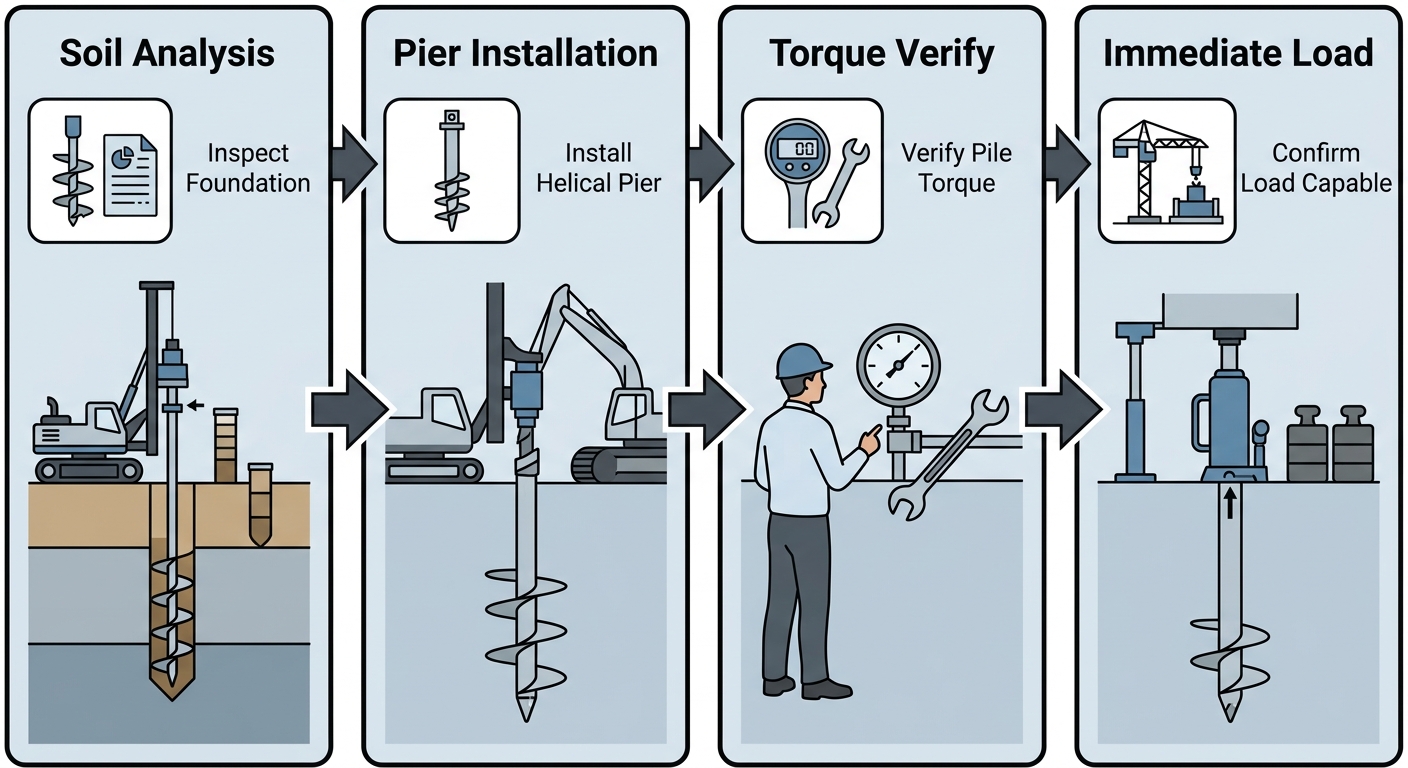
Four-stage helical pier installation process for commercial projects.
Our commercial helical pier solutions are tailored to your project. Everything begins with an on-site inspection followed by a custom quote, so you receive a foundation plan matched to your specific soil conditions and structural loads. As a family-owned and operated business since 1996 with an A+ BBB accreditation, we stand behind every commercial installation. Ready to start your construction project?
Helical Piers for Tiebacks and Shoring Applications
Beyond foundation repair, helical piers are also highly effective for tieback and shoring systems—critical for commercial excavation and earth retention projects. We provide helical piers for commercial buildings as a robust solution for lateral bracing, delivering reliable structural support under demanding site conditions.
Helical pier tiebacks function as lateral anchors that resist soil pressures against retaining walls and excavation faces. Our internal design and installation guidance, developed through decades of field experience, specifies how helical pile load capacity testing verifies each anchor’s performance before construction proceeds. According to RMSSCO’s technical documentation, proper torque monitoring during installation—combined with post-installation load tests—confirms that tieback anchors meet project-specific pullout resistance requirements. This approach allows engineers to validate design assumptions in real time and adjust layouts without lengthy delays, a significant advantage when commercial foundation underpinning specifications demand stringent documentation and predictable outcomes.
In shoring systems, helical piers provide both temporary and permanent earth retention. We follow design standards published by the American Society of Civil Engineers (ASCE), which establish structural design criteria, safety factors, and load testing protocols for helical piles used in lateral support applications. Helical pier shoring systems provide the necessary lateral support during construction of retaining walls and adjacent structures, including those with decorative finishes such as stamped concrete in Denver, Colorado. For commercial projects where excavation depths and surcharge loads vary widely, our installers achieve predictable capacities on installation—subject to site conditions and engineering review—without the cure time or heavy equipment footprint common to grouted anchors.
Compared to traditional tieback methods, our helical piers for commercial buildings offer several practical benefits. Installation rates improve substantially in poor soils—often up to 66 percent faster because helical sections advance quickly through loose or saturated strata while torque data provides continuous capacity feedback. Immediate loading eliminates concrete cure delays, keeping excavation schedules on track. The rotary installation technique also minimizes site disturbance, preserving existing landscape features and adjacent structures. We have delivered superior performance in installation of helix pier systems on boardwalks, municipal facilities, and commercial retaining walls while maintaining clean, accessible work areas.
Helical pier shoring and tieback designs require engineering review and on-site inspection to confirm soil parameters and load demands. We invite project engineers and contractors to request a custom quote for tieback or shoring scopes after a site evaluation. Understanding the tieback and shoring applications sets the stage for exploring installation methods and project planning.
ASTM Standards Governing Commercial Helical Piers
The exceptional speed, low site impact, and immediate load-carrying performance of helical piers for commercial buildings are not accidental—they result from strict engineering and quality control measures defined by the American Society for Testing and Materials. As The Experts in Steel Piers, we manufacture and install commercial helical pile systems in full compliance with the most current ASTM standards to ensure every project achieves predictable, verifiable results.
ASTM F3143-18 serves as the primary standard specification for commercial helical piles. It establishes the minimum requirements for manufactured pile dimensions, helix plate geometry, steel material properties, and installation criteria. Meeting this standard confirms that the helical pile system is proportioned correctly and installed to achieve engagement with competent load-bearing soil. For projects requiring structural verification, ASTM D4945-12 defines the procedures for high-strain dynamic testing of deep foundation elements. This standard guides helical pile load capacity testing in the field, allowing our certified installers to verify that an installed pier meets the required design capacity under static axial compressive load before the structure imposes its full weight.
Material integrity underpins every standard. ASTM A572/A572M specifies the high-strength, low-alloy structural steel used in our pier shafts and helix plates. Galvanized per ASTM A153, these components deliver long-term corrosion resistance suited to the variable soil conditions found throughout the Front Range region. By holding material, fabrication, and installation to these rigorous industry benchmarks, we provide commercial foundation underpinning specifications that structural engineers and local building officials can approve with confidence.
While ASTM standards for commercial helical piers focus on large-scale structural integrity, the same commitment to quality extends to every project we support. Even a master bath remodel in Highland Ranch may require underpinning solutions that benefit from the same engineering discipline. RMSSCO’s certified installers adhere to the latest revisions of all referenced ASTM standards because compliance is a key differentiator between a warrantied commercial foundation system and one based on assumption. Understanding these standards is the first step; next we explore how RMSSCO applies them on every commercial project.
Helical Piers for Municipal Boardwalk and Infrastructure Projects
For municipal boardwalk and infrastructure projects, helical pier systems provide a reliable, low-disruption foundation solution that meets the demanding timelines and sensitive site conditions typical of public works. Our helical piers for commercial buildings and municipal structures deliver predictable load capacities and immediate loading capability, making them an ideal choice for waterfront boardwalks, pedestrian bridges, and other civil infrastructure where traditional concrete foundations would be impractical.
Helical piers are installed with minimal environmental disturbance, a critical advantage for boardwalk projects located in sensitive waterfront or wetland areas. The rotary installation process creates little to no soil displacement, preserving the natural habitat and complying with environmental regulations. Unlike poured concrete foundations that require extensive excavation and curing time, helical piers provide immediate load-bearing capacity upon installation. This eliminates weather-dependent cure delays and accelerates project schedules — a crucial benefit for public infrastructure with fixed completion deadlines. Each installation is backed by helical pile load capacity testing to verify performance, and our commercial foundation underpinning specifications meet rigorous municipal standards. In areas with challenging soil conditions, such as loose sand or karst topography, property owners often explore sinkhole insurance coverage as an additional layer of protection, though our systematic installation approach is designed to provide stable support in a wide range of soil profiles.
As a family-owned and operated company since 1996, Rocky Mountain Steel Piering, Inc. brings decades of specialized experience to every municipal project. We are The Experts in Steel Piers, with an A+ BBB accreditation and a proven record of superior performance in installation of helix pier systems. Our trained and certified installers follow rigorous protocols for municipal projects, ensuring that every helical pier meets engineered specifications and capacity requirements. Our municipal boardwalk installations exemplify how helical piers outperform traditional methods in speed, reliability, and minimal site impact. Ready to start your construction project? Schedule a consultation with our team to discuss your municipal infrastructure needs.
Evaluating Helical Piers for Your Commercial Project
As you evaluate helical piers for commercial buildings, the right system can make a profound difference in your project’s schedule and long-term performance. At Rocky Mountain Steel Piering, Inc., we are The Experts in Steel Piers — family-owned and operated since 1996 — and we have seen firsthand how site-specific engineering and rigorous helical pile load capacity testing give commercial developers the confidence to proceed on aggressive timelines. Our certified installers verify load capacities through monitored torque and on-site verification, ensuring your foundation meets the precise commercial foundation underpinning specifications your engineer requires.
Helical pier systems inherently allow immediate loading with no cure time, which translates into faster installation rates even in poor soils. When our installers use rotary installation techniques and site-specific analysis, you get superior performance in installation of helix pier systems without the disruption that often delays commercial schedules. Our A+ BBB-accredited team serves the Denver metro and Front Range region with turnkey project execution.
Ready to start your construction project? Contact us today for a custom on-site evaluation and quote. All information is for general informational purposes. Actual project outcomes depend on site-specific conditions; consult a licensed structural engineer for definitive design recommendations.
Resources
- Schedule a Master Bath Remodel Consultation with RMSSCO
- Schedule a Sinkhole Repair Consultation with RMSSCO
- Schedule a Free Stamped Concrete Consultation with RMSSCO
- Compare Push Piers vs Helical Piers with RMSSCO
- Get a Free Helical Pier Installation Cost Estimate from RMSSCO
- Call RMSSCO for Helical Pier Installation Cost Estimates
- Get Expert ICC-ES AC358 Foundation Consultation from RMSSCO
- Read the 2025 ASCE Infrastructure Report Card Online
- Find Denver Commercial Structural Support News on ENR
- Access ASTM Helical Pier Corrosion Protection Standards