
Understanding Hydrostatic Pressure Foundation Cracks: Key Causes Explained
Table of Contents
Understanding Hydrostatic Pressure Foundation Cracks
Hydrostatic pressure foundation cracks result from excess water pressure in saturated soil pressing against foundation walls. When the soil surrounding a foundation becomes waterlogged from heavy rainfall, melting snow, or poor drainage, it expands and exerts powerful lateral force against the wall. This sustained pressure can cause the concrete or masonry to crack, typically producing horizontal or diagonal fractures near the base of the wall.
These cracks signal potential structural concerns because they allow water seepage into basements and crawl spaces, potentially leading to further deterioration over time. For more detailed engineering principles on soil pressure, consult civil engineering professional resources such as those provided by the American Society of Civil Engineers. We encourage you to schedule an on-site evaluation if you notice these patterns. Consult a licensed structural engineer or qualified professional for definitive diagnosis and design recommendations.
1. How Hydrostatic Pressure Builds Up
Hydrostatic pressure is the force that stationary water exerts against any surface it contacts — and in foundation engineering, that surface is often a basement wall. When the soil surrounding a foundation becomes saturated, water fills the voids between soil particles and begins to push outward and upward. This lateral force, known as hydrostatic pressure foundation cracks risk, increases with water content and depth, meaning the base of a wall almost always experiences the greatest stress.
Heavy rainfall, melting snow, or a naturally high water table can quickly saturate the backfill. Poor surface drainage compounds the problem by directing even more water against the foundation. Soil type plays a decisive role: expansive clay soils hold water tightly and swell, while loose sandy soils drain more quickly but still transmit pressure when saturated. As the seasons shift — especially during spring thaw or prolonged wet periods — the ground can become waterlogged for weeks, continuously pressing against the wall. According to RMS, our team has observed that this sustained pressure eventually exceeds the tensile strength of concrete or masonry. When that happens, walls begin to develop horizontal or stair-step cracks, often near the midpoint or base.
This continuous pressure can eventually lead to pressure-induced foundation cracks that widen over time, allowing moisture to enter. While every site is different, understanding the buildup mechanism is the first step toward evaluating a foundation’s condition. For a definitive diagnosis, consult a licensed structural engineer.
2. Signs of Hydrostatic Pressure Damage
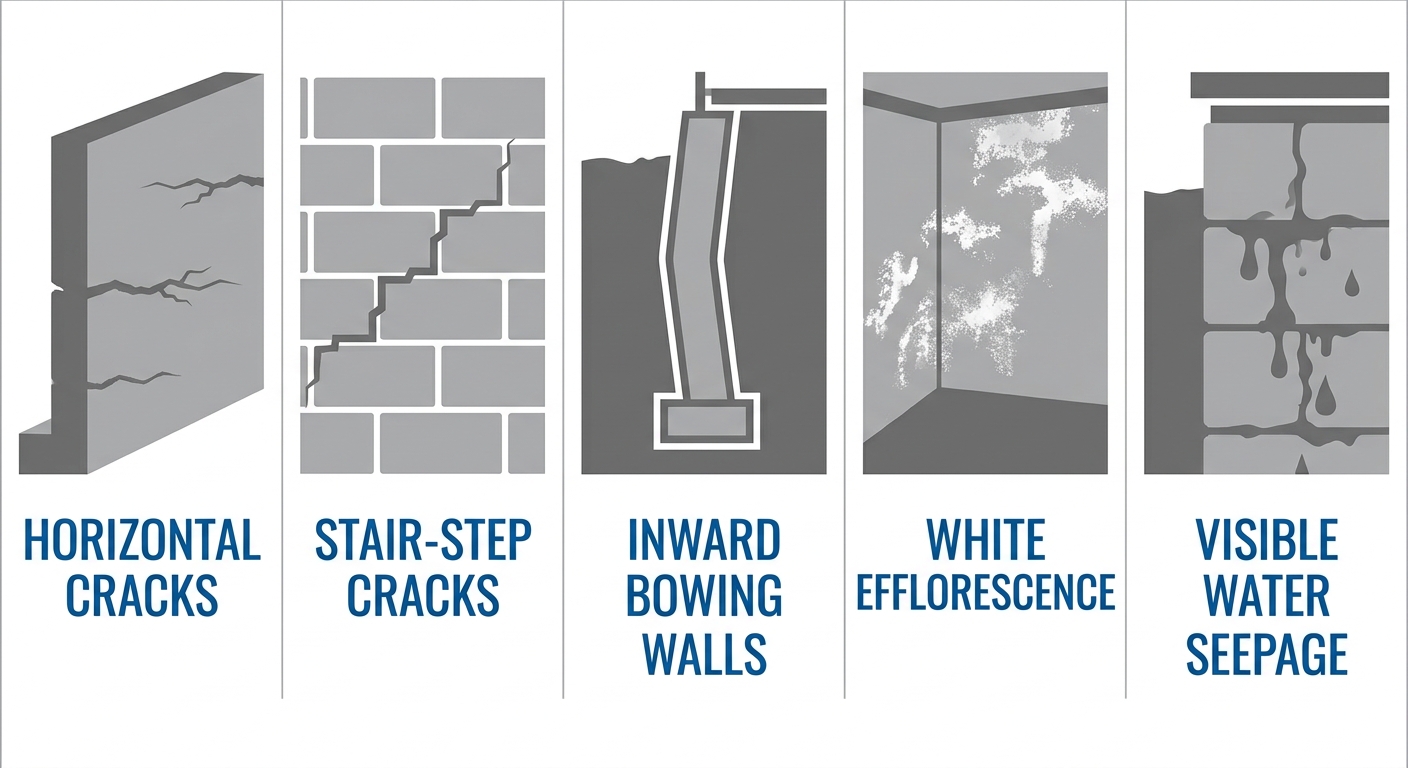
These forces leave clear visual clues. Recognizing hydrostatic pressure foundation cracks and related symptoms early is the first step toward protecting your home’s structural integrity.
- Horizontal cracks in foundation walls — often at mortar joints — result from saturated soil pressing inward, causing the wall to flex and crack under tension.
- Stair-step cracks in block walls follow mortar lines diagonally as lateral soil loads force the wall to shift.
- Inward bowing or leaning walls indicate sustained lateral pressure that gradually deforms the wall plane.
- Efflorescence, a white powdery residue on interior surfaces, is left behind when water seeps through porous concrete and evaporates, depositing dissolved minerals.
- Active water seepage, damp spots, or even standing water near walls confirms that moisture is penetrating through cracks or porous masonry.
- Uneven or sloping floors upstairs and sticking doors or windows can signal foundation movement caused by soil pressure shifting the structural frame.
These signs often worsen over time if the underlying drainage or waterproofing issue goes unaddressed. As experts in steel piers, we know that ignoring small cracks today can lead to hydrostatic pressure foundation cracks that require far more extensive repairs tomorrow. Still, no single sign guarantees water pressure is the cause—a licensed structural engineer or qualified foundation repair specialist should perform an on-site inspection for a definitive diagnosis.
Once these signs are identified, understanding the underlying cause and available solutions is the next step.
3. The Impact of Poor Soil Grading
Beyond understanding what grading is, it’s critical to recognize the damage poor grading can cause. When soil slopes toward a foundation, rainwater and snowmelt concentrate against the basement or crawl space walls—leading to saturated soil that exerts hydrostatic pressure. Over time, this unrelenting lateral force pushes against below-grade concrete and masonry, resulting in foundation cracks caused by hydrostatic pressure.
We have seen how waterlogged soil compounds the problem through seasonal expansion and contraction. Clay-rich backfill swells when wet and shrinks as it dries, creating a cyclical ratcheting effect that widens fissures and can bow basement walls inward. In our experience, repeated moisture cycling works-hand-in-hand with poor grading to accelerate structural deterioration, and differential settlement often follows when one corner of the foundation remains wetter than the rest.
Correcting the slope is the most cost-effective first step we recommend. Once the ground directs water away from the house, the risk of hydrostatic pressure drops significantly. This makes proper grading an essential first step before installing effective yard drainage.
4. Epoxy Injection for Crack Repair
One proven method for repairing foundation cracks is epoxy injection, a technique where a two-part epoxy resin is injected under pressure into cleaned cracks to bond the concrete and restore structural integrity. This method is particularly effective for sealing cracks caused by hydrostatic pressure foundation cracks in poured concrete walls, reestablishing the monolithic strength of the wall while also creating a barrier against water seepage.
As described in our internal crack repair expertise, the process begins with thoroughly cleaning the crack and installing small surface ports along its length. The exterior face of the crack is sealed to prevent resin from leaking out, and then the epoxy is injected at low pressure, filling the fissure from the inside out. The injected resin cures to a hard, durable finish that often exceeds the tensile strength of the surrounding concrete, making it ideal for repairing non-moving, dormant cracks.
Ignoring foundation cracks can lead to serious structural issues, so prompt repair is essential. Understanding the consequences of ignoring foundation cracks helps property owners recognize the urgency of professional repair. Epoxy injection demands skilled execution to be effective; as The Experts in Steel Piers, our trained installers ensure proper bonding and full crack fill to avoid failures. However, it is important to note that this method seals the crack but does not address the external source of water pressure. For cracks with active water seepage, a more flexible sealant such as polyurethane foam may be a better alternative. Consult a licensed structural engineer for a definitive diagnosis and to determine the right solution for your specific situation.
5. Perimeter Drain Systems as a Solution
When soil around a home’s foundation becomes waterlogged, the resulting buildup creates hydrostatic pressure that can push against foundation walls and cause cracks. A perimeter drain system—also known as a footing drain or French drain—is one of the most effective ways to relieve the stress that leads to cracks caused by hydrostatic pressure.
A perimeter drain system is a subsurface drainage network installed around the foundation footings. It consists of perforated pipe laid in a gravel bed that collects groundwater before it can accumulate against the wall. Instead of allowing water to saturate the soil, the system captures it and channels it to a sump pump basin or a gravity-fed daylight outlet, giving the water a low-resistance path away from the structure. By intercepting and redirecting this water, the drain system can relieve the lateral force on the foundation and help reduce the risk of future cracking.
At Rocky Mountain Steel Piering, Inc., we install perimeter drain systems as part of our comprehensive foundation repair services, using trained installers who understand Front Range soil and drainage conditions. We are family-owned and operated since 1996, and we tailor each drainage solution to the specific needs of the home. This approach works for both new construction and existing homes experiencing hydrostatic pressure issues. If you believe water pressure is affecting your foundation, please reach out to us to schedule a consultation.
6. Why Water Is the Leading Cause of Foundation Failure
Among the many threats to a foundation, water stands out as the most pervasive. The science behind this begins with hydrostatic pressure foundation cracks—a term that describes the immense force water-saturated soil exerts against foundation walls. When soil becomes oversaturated from seasonal rainfall, poor drainage, or a rising water table, it expands and pushes laterally against buried concrete. In many cases, if left unaddressed, this sustained water pressure can lead to bowing walls and horizontal cracks, while the expanding and contracting soil causes vertical settlement or heaving.
This water-induced foundation damage is cumulative and often remains invisible until significant structural problems develop. At Rocky Mountain Steel Piering, Inc., The Experts in Steel Piers, we have seen how persistent soil moisture compromises the integrity of a home’s foundation. According to RMSSCO, helical pier systems are often selected to address foundation issues caused by persistent moisture, as they anchor the structure to stable, load-bearing soil. Understanding how water damages foundations makes clear why specialized repair systems—such as helical piers—are often necessary to restore lasting stability.
7. When to Call a Professional
When hydrostatic pressure foundation cracks appear in your basement wall, it is crucial to call a professional immediately. These horizontal or stair-step cracks signal lateral wall movement and will not resolve on their own. We have seen that early intervention using engineered steel pier solutions can prevent further damage and more costly repairs down the road.
We recommend you contact us if you observe any of the following signs:
- Sticking doors or windows that no longer open smoothly
- Uneven or sloping floors throughout your home
- Water seepage or damp spots on basement walls
- Bowing or bulging foundation walls
- Gaps forming around window frames or exterior door frames
Hydrostatic pressure foundation cracks often worsen quickly without proper intervention. While only a licensed structural engineer can provide a definitive diagnosis, our trained installers offer a thorough preliminary evaluation and a free, no-obligation estimate. We can help you understand the severity of the situation and recommend a path forward.
As a family-owned and operated company since 1996 with an A+ BBB rating, we deliver superior performance in installation of helix pier systems. Helical piers and tiebacks are permanent solutions that can be installed without curing time, minimizing disruption to your household. The Experts in Steel Piers are ready to assist you.
If you notice any of the warning signs above, it is time to call a professional. Contact Rocky Mountain Steel Piering, Inc. today for a free custom quote and protect your home’s foundation.
8. Long-Term Prevention Strategies
Hydrostatic pressure foundation cracks develop when water-saturated soil pushes against basement walls, and long-term prevention relies on diverting water away from the foundation perimeter. At Rocky Mountain Steel Piering, Inc., we recommend several proven yard drainage solutions that greatly reduce this risk.
Proper grading is the first line of defense. The soil around your home should slope away from the foundation at a minimum 5% grade, ensuring that rainwater and snowmelt flow outward rather than pooling against basement walls. Downspout extensions carry this protection further by discharging roof runoff at least 5 to 10 feet from the house, preventing localized soil saturation.
French drains and curtain drains installed around the foundation perimeter intercept groundwater and channel it safely away from the structure. These systems require regular maintenance to remain effective—we advise cleaning gutters, verifying downspout extensions, and inspecting drain outlets annually. According to our yard drainage resources at RMS Steel Contractors, consistent attention to these details preserves long-term foundation protection.
While perimeter drain systems can complement yard drainage, they are not a substitute for managing surface water. If yard drainage alone does not resolve persistent hydrostatic pressure on foundation walls, a structural assessment may be needed. Consult a licensed structural engineer or qualified professional for definitive diagnosis, and contact Rocky Mountain Steel Piering for a custom-quote assessment if you suspect existing damage.
All information on this website is for general informational purposes and may be updated without notice. Estimates and quotes are preliminary and are not legally binding until confirmed in writing following an on-site inspection. We do not guarantee specific results for every project; actual outcomes depend on site conditions and inspections.
Safeguard Your Foundation from Hydrostatic Pressure
One of the most common threats to your foundation is hydrostatic pressure foundation cracks, which develop when water-saturated soil pushes laterally against basement or foundation walls. According to the American Society of Civil Engineers (ASCE), this groundwater pressure is a leading cause of horizontal cracks and bowing walls in residential structures. Without intervention, continued pressure can lead to structural failure, water intrusion, and decreased property value — a progression our team at Rocky Mountain Steel Piering, Inc. has observed since 1996.
As The Experts in Steel Piers, we provide engineered solutions designed to resist this force. Our helical pier systems and tiebacks counteract lateral movement, while perimeter drains relieve groundwater pressure before it reaches your foundation. You can explore the helical pier installation cost on our FAQ page, then contact us for an inspection to discuss how our systems can help mitigate hydrostatic pressure damage to your home.
Resources
- Learn the Costly Consequences of Ignoring Foundation Cracks
- Schedule a Yard Drainage Consultation with Experts
- Discover Helical Pier Installation Cost Information
- Discover Tower Hill Insurance Sinkhole Coverage Details
- Find Expert Barndominium Builders in Grand Junction
- Find Foundation Repair Cost Information in Denver
- Understand the Causes of Foundation Failure Easily
- Discover Civil Engineering Resources and Professional News