
Polyurethane Foam vs Mudjacking: 2026 Comparison Guide
Table of Contents
Polyurethane Foam vs. Mudjacking: A Head-to-Head Comparison
In comparing polyurethane foam vs mudjacking, the two methods present distinct approaches to concrete leveling. Polyurethane foam is lightweight and injected through small, minimally invasive holes, while traditional mudjacking relies on a much heavier slurry that can place additional stress on underlying soils and is susceptible to washing out over time.
Cure time represents another critical difference. Polyurethane foam cures in minutes, allowing driveways and slabs to be used immediately after our work is complete. Mudjacking typically requires a 24- to 48-hour waiting period before the surface can bear weight.
Polyurethane also expands beneath the slab to fill voids comprehensively, delivering consistent support that resists moisture intrusion. Our polyurethane concrete lifting in Denver achieves minimal disruption and rapid results, particularly beneficial in the region’s expansive clay soils. Understanding these differences helps explain why polyurethane foam offers a superior solution for many projects, though we encourage property owners to request a custom quote based on their specific site conditions.
1. Longer Lasting Results
When comparing polyurethane foam vs mudjacking, the primary advantage is clear: polyurethane lifting offers longer-lasting stability for concrete slabs and foundations. We have seen that results from polyurethane foam injections can last 5 to 10 years or more, depending on the surrounding soil composition and environmental conditions.
Unlike traditional mudjacking, which uses a heavy cement slurry that can add weight to the soil and absorb moisture over time, our polyurethane foam remains lightweight and waterproof. According to RMS Structural Consulting Services, polyurethane foam stabilization provides durable support for decades because its closed-cell structure resists water intrusion and prevents the erosion that often leads to re-settlement.
This inherent durability means that choosing polyjacking vs mudjacking is not just a technical preference but a decision that minimizes the need for costly future repairs. The foam expands to fill subsurface voids, creating a stable, bonded base that resists movement far better than the mud slurry alternative.
In the long run, this resilience makes a strong case for the polyurethane concrete lifting cost to be viewed as an investment in performance. For property owners seeking polyurethane concrete lifting in Denver, our team provides custom quotes after a thorough site inspection.
Contact us to learn more about polyurethane concrete lifting in Denver.
2. Smaller Drill Holes
Another key benefit is the smaller drill holes required for injection. When comparing polyurethane foam vs mudjacking, hole size alone is one of the most overlooked yet decisive advantages of the polyurethane approach.
Our crew drills only ⅝″ to 1″ diameter openings for polyurethane concrete repair grouts, while traditional mudjacking demands much larger 1½″ to 2½″ entry points. Those few millimeters of difference translate directly into less damage to your existing slab, fewer patches to blend, and a noticeably cleaner finished surface. For commercial properties in Denver, this means minimal disruption, less visible evidence of the repair, and a faster return to normal operations.
Beyond the smaller holes, these narrow openings also help control overall polyurethane concrete lifting cost by shrinking the scope of cosmetic concrete repair after the lift. As our internal FAQ explains, jobs with reduced concrete repair needs are inherently more efficient and can lower the total project expense. The same high-density foam that makes polyjacking vs mudjacking a faster option also leaves behind a repair that is far less intrusive than its older counterpart.
3. Superior Overall Performance
When comparing polyurethane foam vs mudjacking for overall performance, polyjacking consistently outpaces traditional mudjacking in the key areas that matter most to property owners. With over 30 years of experience as a family-owned and operated company since 1996, we have seen firsthand why polyurethane foam lifting delivers predictable, professional results on residential and commercial projects alike.
In the polyjacking vs mudjacking debate, the performance advantages become clear. Polyurethane foam achieves immediate load-bearing capacity after injection, allowing traffic on the repaired driveway within minutes. Traditional mudjacking, by contrast, requires a 24- to 48-hour cure time before the slab can carry weight. This immediate loading capability eliminates extended downtime, a critical factor for busy commercial driveways where quick turnaround keeps operations running.
Polyjacking also creates far less site disruption. Our certified installers inject the high-density foam through small, dime-sized holes rather than the large excavation areas typical of mudjacking, preserving surrounding landscaping and minimizing impact on adjacent structures. Based on our field experience, polyurethane lifting can be completed in poor soil conditions up to 66% faster than mudjacking, since the foam’s expanding action stabilizes loose substrate without extensive digging or soil removal.
The predictable, precise lifting control of polyurethane foam means each injection is monitored and adjusted in real time, producing accurate slab alignment. Mudjacking can be less predictable and often leaves a gritty slurry residue on the finished surface. Together, these performance benefits make polyjacking the dependable choice for driveway concrete lifting. Superior speed, immediate load support, minimal mess, and precise control translate directly into faster project completion and lasting satisfaction. For specific cost considerations, we provide a custom quote based on your project specifications after an on-site inspection.
All information is for general informational purposes; estimates require an on-site inspection and actual outcomes depend on site conditions.
4. More Cost-Effective for Many Projects
When evaluating polyurethane foam vs mudjacking, polyurethane foam lifting is typically more cost-effective for many projects due to inherent efficiencies in labor, material handling, and project timelines. Our experience as a family-owned and operated company since 1996 has shown that polyjacking vs mudjacking can reduce on-site crew requirements and equipment staging, which lowers overall project expenses for commercial and residential clients alike.
The lightweight nature of polyurethane foam significantly cuts transportation and material costs compared to the heavy slurry used in traditional mudjacking. Fewer workers and less time on site translate directly into savings, and the faster cure time means minimal disruption to business operations. These factors contribute to a more favorable polyurethane concrete lifting cost profile when considering long-term value, as the durable, moisture-resistant foam helps prevent future settlement issues that would require additional repairs.
By streamlining the entire repair process from material delivery to final cleanup, we help our clients achieve structural stability without the extended downtime or heavy equipment footprint associated with older methods. This efficient approach reinforces why polyurethane foam lifting remains a smart investment for property owners seeking reliable concrete rehabilitation.
5. Safe for Structural Foundations
When considering a foundation repair method, the safety and long-term stability of your home are the primary concerns. Homeowners exploring options in polyurethane foam vs mudjacking often wonder if high-density foam is truly rated for load-bearing applications. The answer is a definitive yes. Polyurethane foam is engineered and extensively tested to provide secure support under structural loads like house foundations, not just for sidewalks or driveways.
This technique, often called slabjacking or polyjacking, offers critical advantages for structural work. Unlike traditional mudjacking, the foam we inject is a lightweight material that applies negligible additional weight on already settling soils. This is especially critical in our region, where expansive clay presents constant challenges. The process requires no heavy excavation, and the material cures almost instantly into an inert, waterproof state that will not wash out or decompose, providing immediate structural support with no waiting period. Our team at RMS S follows strict procedures to ensure the foam is properly injected and never used beyond load-rated safety margins, delivering the same superior performance in installation of helix pier systems that our customers expect.
When evaluating polyjacking vs mudjacking for a sinking foundation, the engineered nature of polyurethane makes it a permanent alternative to underpinning or piers for specific settling issues. As is the case with any structural decision, we always advise consulting a licensed engineer for a definitive diagnosis, but for many situations, high-density foam lifting provides a stable, lasting solution. While final project scopes vary, the lifetime support often validates polyurethane concrete lifting cost as an investment in your home’s future.
6. Immediate Load-Bearing Capacity
An additional key benefit is immediate load-bearing capacity, enabling work to proceed without unnecessary delay. Helical piers can support full structural loads the moment they reach their designed depth, removing the delays that slow down traditional foundation work. For general contractors and project managers, this means faster construction schedules and significantly reduced on-site disruption.
Conventional poured concrete piers present a different picture. They typically require 7 to 28 days of curing before they can safely bear significant weight. That waiting period can stall entire construction sequences and extend project timelines, which is why some teams compare options like polyurethane foam vs mudjacking when evaluating faster repair alternatives. Helical piers avoid the cure-time bottleneck entirely. As our internal technical resources confirm, a properly installed helical pier system carries operational loads immediately upon installation.
Beyond immediate loading, the long-term performance of helical piers is equally impressive.
7. Minimal Site Disruption
Beyond the differences in curing time and strength, the polyurethane foam vs mudjacking comparison makes clear that polyurethane injection creates significantly less site disruption. Unlike mudjacking, which requires large, messy holes and a wet cement slurry that demands extensive cleanup, our polyurethane-lifting method uses small ⅝-inch injection ports and introduces no on-site mixing or heavy hoses. According to Alchatek’s technical specifications, the low-viscosity grout expands and cures within minutes, making the lifted area ready for immediate use—a critical advantage for commercial operations that cannot afford extended downtime. When evaluating polyurethane foam vs mudjacking, decision-makers find that minimal site impact translates directly into less cleanup, faster project turnover, and satisfied occupants. These minimal-disruption benefits directly contribute to overall project efficiency and cost savings.
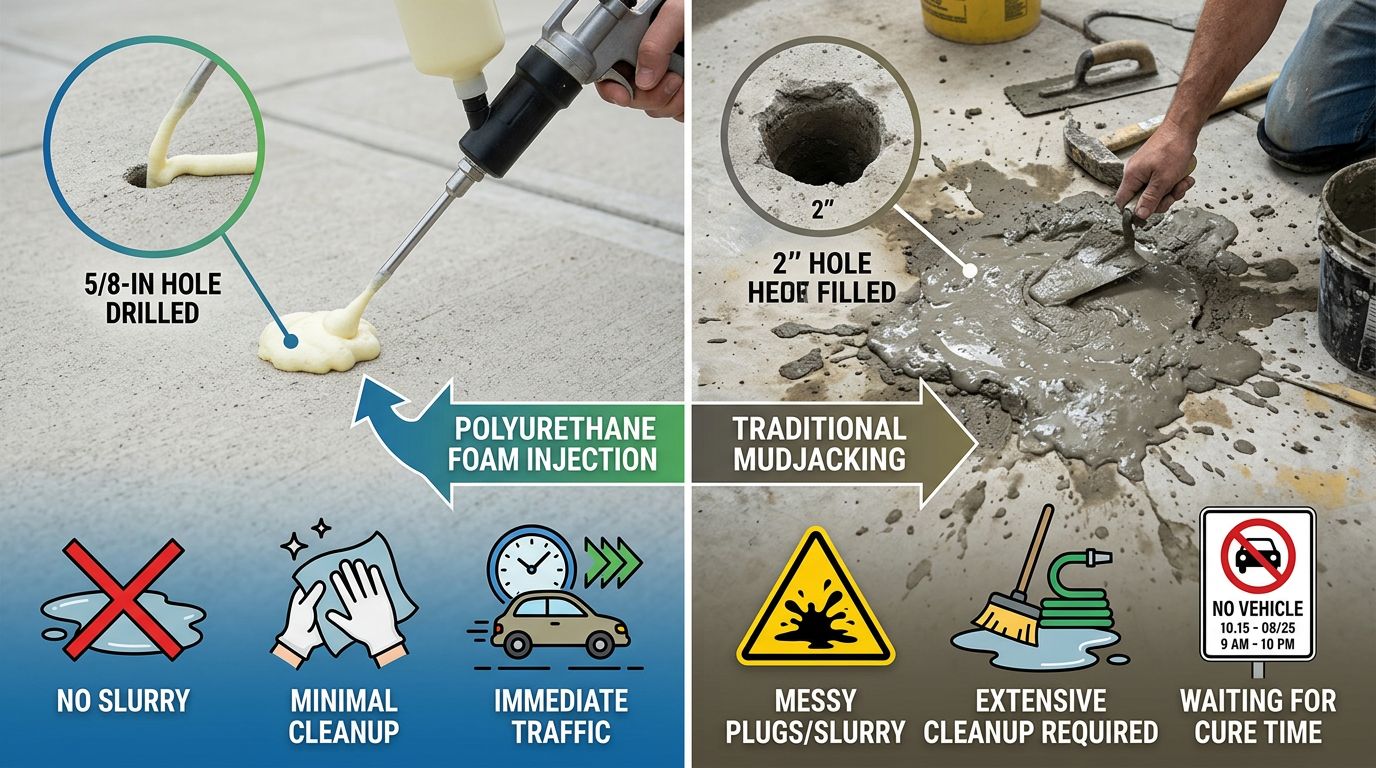
Clean polyurethane injection versus traditional mudjacking side-by-side
8. Versatile Application Scenarios
Beyond its core advantages, polyurethane foam excels in a wide variety of settings, and understanding polyurethane foam vs mudjacking reveals why foam jacking is often the preferred choice for diverse projects. From residential driveways in the Front Range to expansive commercial floors, this concrete leveling method adapts to many scenarios with minimal disruption.
For homeowners, polyurethane concrete lifting effectively addresses uneven sidewalks and sunken driveways in the Front Range, restoring safety and curb appeal. The method works on exterior surfaces like patios and pool decks, as well as interior slabs such as basement floors, without damaging adjacent structures. On the commercial side, polyjacking vs mudjacking comparisons frequently highlight foam’s value for warehouse concrete floors or loading dock slabs, where businesses benefit from rapid curing that allows immediate use and reduces operational downtime. It is often effective for concrete of varying thickness and age, though outcomes depend on site-specific soil conditions.
This adaptability across residential and commercial applications underscores why understanding the right contractor for your specific scenario matters. As a family-owned and operated company since 1996, we provide complimentary on-site evaluations to determine the most viable solution for your project’s unique conditions.
Making the Right Choice for Your Slab Lifting Project
When comparing polyurethane foam vs mudjacking for driveway repairs in Denver, property owners should weigh performance alongside long-term value. Polyurethane foam cures in about 15 minutes and exerts less stress on underlying soils, while traditional mudjacking can take up to 48 hours to set and adds significant weight. Although polyjacking vs mudjacking upfront costs differ, polyurethane’s lighter material typically reduces the risk of future settlement. We often find that the polyurethane concrete lifting cost proves to be a cost-efficient long-term solution because the material resists moisture and can last well beyond five years. Given these differences, we rely on top-grade helical pier and polyurethane systems to deliver predictable outcomes. For reliable polyurethane concrete lifting in Denver, contact our family-owned team—operating since 1996—for a custom quote. Actual results depend on site conditions and should be verified by a licensed engineer.
Resources
- Compare Polyjacking vs. Mudjacking for Denver Driveways
- Stabilize House Foundations with Polyurethane Foam Injection
- Get Custom Polyurethane Foam Injection Costs in Denver
- Find Polyjacking Contractors Serving Colorado Front Range
- Get Custom Helical Pier Installation Costs in Colorado
- Learn About Vapor Barriers for Colorado Crawlspaces
- Understand Water Intrusion Causes in Colorado Properties
- Discover Advanced Polyurethane Grouts for Infrastructure Repair