
Five Year Workmanship Warranty Construction: Best Home Builders
Table of Contents
- Five-Year Workmanship Warranties: A Foundation for Colorado Construction Projects
- Understanding Warranty Protection Against Construction Defects
- Workmanship Warranties in Custom Home Building and Remodeling
- Selecting a Contractor with a Five-Year Labor Guarantee in Centennial and Beyond
- Advanced Considerations: Scope, Exclusions, and Claim Processes in Five-Year Workmanship Warranties
- Frequently Asked Questions About Five-Year Workmanship Warranties
- Securing Your Project with a Reliable Workmanship Warranty
Five-Year Workmanship Warranties: A Foundation for Colorado Construction Projects
A key part of our quality promise is our five year workmanship warranty construction clients can rely on. This warranty forms the bedrock of our commitment to long-term performance, providing commercial project owners, architects, and general contractors with essential protection against defects in materials and installation. It is more than a policy—it is a statement of our confidence in every project we complete.
According to our official warranty policy, our five-year workmanship warranty covers all core services, including foundation repair, helical piers, tiebacks, and comprehensive concrete work such as stamped concrete in Denver, Colorado. Backed by trained, certified installers, this craftsmanship warranty aligns with the professional engineering standards upheld by the National Society of Professional Engineers (NSPE). This backing is critical in Colorado, where variable soil conditions—including expansive clay and shifting soils—can challenge long-term structural stability and make a robust warranty on workmanship a vital risk-mitigation tool.
For commercial clients, this five-year craftsmanship warranty provides peace of mind and underscores our dedication to reliability. As a family-owned company with an A+ BBB rating since 1996, we stand behind our work, delivering investment protection you can trust. Our workmanship warranty is complemented by turnkey project execution for reliable, lasting results.
Understanding Warranty Protection Against Construction Defects
When evaluating a five-year workmanship warranty for construction projects in Colorado, it is important to understand what warranty protection actually means. A construction defect warranty is a contractual promise covering the repair or replacement of defective components or faulty installation labor. It is not a performance guarantee that prevents issues from arising. Rather, it defines the remedies available if specific defects are discovered after project completion.
The table below distinguishes the two main types of construction defect warranties, each serving a distinct purpose in protecting your investment.
| Aspect | Material Warranty | Workmanship Warranty |
|---|---|---|
| Coverage Scope | Covers defects in manufactured components | Covers errors in installation labor |
| Duration (Typical) | 1-10 years depending on manufacturer | 1-5 years offered by contractor |
| What It Protects Against | Premature failure due to material defect | Faulty installation, poor assembly, non-compliance with specs |
| Example Claims | Corroded helical pier steel | Pier not driven to load-bearing depth |
| Responsible Party | Manufacturer | Contractor |
Understanding these distinctions is essential when reviewing warranty documentation for any structural project. A material defect such as corroded helical pier steel falls under the manufacturer’s responsibility, while an installation error like a pier not driven to its specified load-bearing depth is the contractor’s obligation to correct. In practice, both types of coverage may apply to different components of the same project, which is why reviewing the specific terms provided in your written contract is critical.
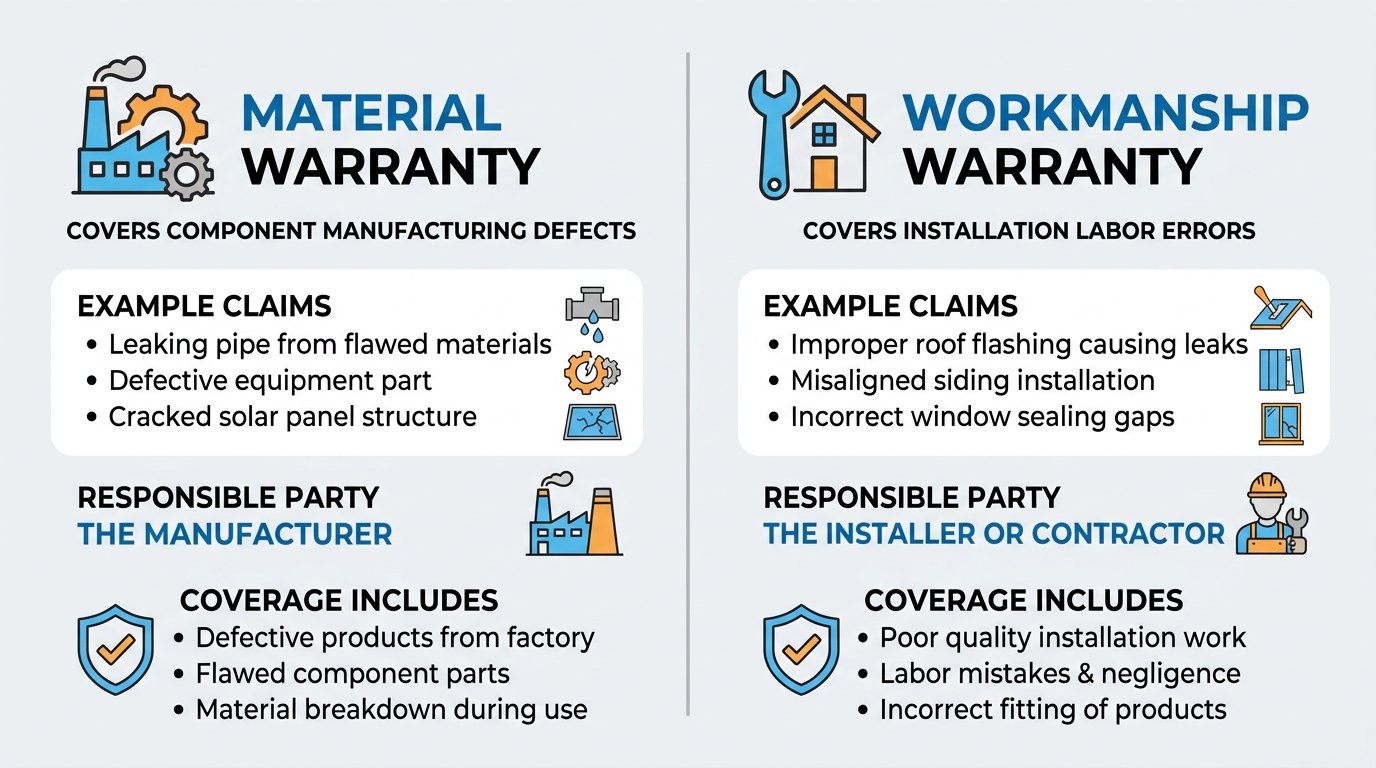
Material and workmanship warranty comparison infographic
A five-year workmanship warranty on construction installation labor is common in the industry, particularly for foundation and helical pier work. At Rocky Mountain Steel Piering, Inc., we provide a workmanship warranty covering our installation services, with the specific term detailed in the written quote and contract provided after a site inspection. This warranty typically covers errors in installation techniques, improper assembly, or failure to follow specified engineering requirements.
Material warranties, in contrast, are issued by the component manufacturer and generally range from one to ten years, depending on the product and its intended application in Colorado soil conditions. Industry standards play an important role in defining quality benchmarks for both materials and installation methods. ASTM International sets widely recognized specifications for construction materials including steel used in helical pier systems. Our installations use components fabricated to applicable ASTM standards, ensuring that material quality meets established industry benchmarks. While we do not claim formal ASTM certification, we align our work with these standards to deliver reliable results for residential and commercial foundation projects throughout the Denver metro area.
If a potential defect is identified, a qualified professional such as a structural engineer foundation inspection expert can assess causation and document the issue for the warranty claim. A thorough inspection helps determine whether the problem stems from a manufacturing defect, installation error, or site condition beyond the contractor’s control. This documentation is often required before a warranty claim can be processed by either the manufacturer or the installing contractor.
All warranty information on this website is for general informational purposes. Actual coverage, terms, and conditions are specified in the written contract provided after a site inspection. Consult a licensed structural engineer for defect diagnosis. Before you file a claim, the first step is to have the defect inspected, often by a structural engineer, which we cover next. Contact us to discuss warranty terms specific to your project.
Workmanship Warranties in Custom Home Building and Remodeling
When evaluating a five-year workmanship warranty for construction projects, homeowners need to understand what structural components are covered. At Rocky Mountain Steel Piering, Inc., we provide clear warranty terms because we believe every project in Colorado deserves long-term protection. A workmanship warranty covers installation labor and structural performance, distinct from material manufacturer warranties that address product defects. For custom homes and remodels in the Denver metro area, these guarantees safeguard critical foundation systems—including helical piers, tiebacks, and concrete work—against installation errors. Our family-owned company, operating since 1996, emphasizes that warranty coverage reflects the confidence we place in our trained, certified installers.
Protecting Custom Home Investments with Workmanship Guarantees
Custom home builders in Littleton and surrounding Colorado communities should prioritize workmanship warranties that specifically cover foundation stabilization and structural components. Our warranty typically includes foundation systems, helical piers, and tiebacks that form the backbone of a new home’s structural integrity. These elements bear the full weight of the structure, so installation defects can lead to costly repairs if left unprotected. Exclusions commonly involve normal wear on concrete surfaces and settled concrete that has not shifted beyond engineered tolerances. We also exclude damage from unauthorized modifications or neglect because these conditions fall outside the original installation scope. For homeowners investing in new construction, the five-year structural warranty provides meaningful coverage during the critical early years of ownership. Understanding these terms helps you avoid surprises and ensures the structural elements beneath your home receive the protection they deserve.
Remodeling: What the Standard Five-Year Warranty Covers
For remodeling projects, the standard five-year workmanship warranty on construction typically covers only affected foundation systems rather than the entire structure. This means if we install new helical piers to support an addition or modify existing footings, those specific components fall under warranty protection. Pre-existing conditions unrelated to our work remain the owner’s responsibility, as do added non-structural finishes like drywall or flooring that were not part of our scope. Material manufacturers separately warrant products such as piering brackets or epoxy compounds. The five-year labor guarantee period remains consistent, offering homeowners in the Denver metro area reliable coverage for structural modifications. We always document the specific work performed and excluded conditions before the project begins, which protects your investment and clarifies expectations for any future warranty claim.
The following table compares workmanship warranty coverage across different project types, highlighting the specific structural components, exclusions, and transferability terms that apply to each scope of work.
| Project Type | Structural Components Covered | Labor Guarantee Period | Material Exclusions | Transferability |
|---|---|---|---|---|
| New Custom Home | Foundation, helical piers, tiebacks | 5 years | Normal wear, settled concrete | Yes, to next owner within 5 years |
| Major Remodel | Affected foundation systems only | 5 years | Pre-existing conditions, added structures | Yes, with documented transfer |
| Addition | Perimeter piers, retaining walls | 5 years | Non-structural finishes | Yes |
| Foundation Retrofit | Helical pier systems, concrete lifting | 5 years | Soil-related settlement beyond original condition | Negotiable |
Transferability is a key distinction homeowners should evaluate: new custom homes and additions permit straightforward transfer to subsequent owners within the five-year term, while remodels require documented transfer processes. Foundation retrofits present negotiable transferability, so we encourage clients across the Front Range to discuss this detail before signing agreements. These terms reflect general practices and may vary by project and location.
Evaluating Full-Scope Protection for Your Project
We recommend assessing warranty terms carefully when planning new construction or major renovations. Key factors include scope of coverage, exclusions, transferability, duration, and the need for an on-site inspection before committing. According to construction industry news from Engineering News-Record (ENR), the five-year term remains a widely recognized standard for structural workmanship guarantees, though individual builder terms vary. Our team in Colorado evaluates each project’s unique site conditions before finalizing warranty documentation because soil behavior, foundation depth, and structural loads all influence long-term performance. We advise clients to review exclusions thoroughly and ask about conditions that could void coverage, such as unauthorized modifications or failure to address drainage issues. Before starting any foundation or structural project, consult a licensed structural engineer or qualified professional for definitive diagnosis and design recommendations. With the right warranty in place, the next step is ensuring your installer follows proper installation protocols to support a durable, protected structure.
Selecting a Contractor with a Five-Year Labor Guarantee in Centennial and Beyond
Beyond experience, a five-year workmanship warranty construction is a critical factor when selecting a contractor in Centennial and the broader Front Range. A comprehensive labor guarantee protects your investment long after the crew leaves, covering installation workmanship for structural repairs that must withstand Colorado’s expansive soils and seasonal movement. Without a written five-year labor guarantee, you risk paying for the same repair twice if installation errors surface after the first winter. As you evaluate contractors across Douglas County and the Denver metro area, understanding what a genuine workmanship warranty includes—and what it excludes—will help you choose a partner you can trust.
Researching Warranty Terms Before Hiring
Not all foundation repair warranties offer equal protection. A true five-year labor guarantee should explicitly cover installation labor, not just materials. Read every word of the proposed warranty document, paying close attention to the scope of covered work, the duration, and any exclusions tied to soil conditions or maintenance obligations. At Rocky Mountain Steel Piering, we have seen too many homeowners accept vague assurance language only to discover that critical components like pier adjustment work or tieback tensioning fall outside the written terms. A five-year workmanship warranty must name the specific repair methods it covers—helical pier installation, epoxy injection, and concrete replacement all involve distinct installation processes that should each appear in the coverage list.
The following table compares the warranty coverage you should expect for the foundation repair services Rocky Mountain Steel Piering provides in Centennial and throughout the Front Range.
| Repair Type | Typical Warranty Period | Labor Covered | Material Covered | Inspection Requirement |
|---|---|---|---|---|
| Helical Pier Installation | 5 years | Installation labor, adjustment work | Galvanized steel piers, brackets | Pre-installation load test |
| Tieback Systems | 5 years | Drilling, anchoring, tensioning | Tendons, plates, grout | Pull test verification |
| Concrete Lifting (Polyurethane) | 5 years | Injection labor, injection holes patching | Polyurethane foam | Post-lifting level survey |
| Epoxy Crack Injection | 5 years | Crack cleaning, injection, finishing | Epoxy resin, injection ports | Core sample or air test |
| Concrete Replacement | 5 years | Demolition, forming, finishing | Concrete mix, rebar (if applicable) | Cure time verification |
Each repair type listed above relies on inspection procedures that verify installation quality before we consider the work complete. The pre-installation load test for helical piers confirms bearing capacity before structural loads transfer to the piers, while the pull test for tieback systems validates the anchoring design under tension. These inspection steps protect you by documenting that the installation meets engineering specifications from day one, setting a clear baseline for the five-year workmanship warranty.
Rocky Mountain Steel Piering’s Commitment to Workmanship Assurance
We back our foundation repair work with a five-year workmanship warranty covering helical pier installation, tiebacks, and concrete repairs for projects in Centennial, Littleton, and across the Front Range. As The Experts in Steel Piers and a family-owned and operated since 1996 firm, we designed our warranty to reflect the superior performance in installation of helix pier systems that our crews deliver. Our five-year labor guarantee covers the installation labor for every helical pier we drive—including any adjustment work required to maintain design elevations—as well as the drilling, anchoring, and tensioning labor for tieback systems. For concrete repairs, including polyurethane foam lifting, epoxy crack injection, and full concrete replacement, our workmanship warranty protects the forming, injection, finishing, and patching labor you pay for.
This coverage applies when installations are performed by our trained crews and verified through the required inspections we complete on every project. Site conditions vary dramatically across the Front Range, from the bentonite-heavy soils underlying parts of Douglas County to the freeze-thaw exposure at higher elevations. The warranty is designed to perform under typical conditions encountered in our service area, but actual warranty eligibility and the full scope of coverage always depend on findings from our on-site inspection. We encourage you to request a custom quote and discuss warranty specifics before any work begins.
Steps to Verify a Contractor’s Warranty and Reputation
Before signing a foundation repair contract in Centennial or anywhere in the Denver metro area, take these verification steps to confirm the five-year labor guarantee is backed by a contractor that honors its commitments. First, request a written copy of the warranty document—not a verbal summary—and confirm that it lists the specific installation labor covered for each repair method you are paying for. Second, ask whether the warranty is transferable if you sell the property, which adds significant value for homeowners who may relocate within the warranty period. Third, understand the claims response process: who do you call, what documentation triggers a review, and what is the promised timeline for addressing a warranty claim?
Fourth, research the contractor’s history of honoring warranty claims by checking reviews that mention post-installation service, asking for references from projects completed at least two years ago, and verifying affiliations that signal professional accountability. Ask if the contractor is affiliated with a recognized professional engineering society like the National Society of Professional Engineers (NSPE), which sets engineering practice standards and ethics guidance that members are expected to follow. No warranty can replace thorough due diligence, but these steps will help you select a partner whose five-year labor guarantee represents a real commitment to workmanship quality. Contact us today to discuss your project and learn more about our five-year workmanship warranty.
Advanced Considerations: Scope, Exclusions, and Claim Processes in Five-Year Workmanship Warranties
Beyond the basics of coverage duration, it’s crucial to understand the finer points of coverage and exclusions that define our five year workmanship warranty for construction projects. This warranty covers on-site workmanship for five years from substantial completion. We back our helical pier and foundation work with this warranty for residential and commercial projects across the Denver metropolitan area and in Colorado. The warranty covers certain workmanship defects, while standard exclusions reflect practical site realities and industry norms. The table below summarizes the typical split between Covered and Not Covered items.
| Covered | Not Covered |
|---|---|
| Faulty installation labor | Normal soil settlement |
| Improper soil preparation by contractor | Natural disasters (earthquake, flood) |
| Use of substandard materials by contractor | Alterations made after project completion |
| Incorrect loads assumed in design | Damage from third-party excavation on site |
| Defective helical pier installation | Normal building movement within code |
These exclusions align with civil engineering and material standards from ASCE and ASTM, ensuring our warranty reflects rigorous industry norms.
Our five-year warranty covering workmanship specifically addresses defects caused by faulty installation labor, improper soil preparation by a contractor, the use of substandard materials, incorrect load assumptions in design, and defective helical pier installation. We cover these because they reflect workmanship failures that a skilled contractor can and should control, and they are consistent with the high standards we set for every project, including compliance with ASTM material specifications. Many exclusions, such as normal building movement, are standard across the industry and consistent with guidelines from your civil engineering professional organization. Normal soil settlement, natural disasters, post-project alterations, third-party excavation damage, and building movement within code tolerances are also excluded as standard practice. These reflect site conditions and external events beyond a workmanship guarantee.
We encourage property owners or contractors to notify us of any potential workmanship defects within the five-year warranty period. Our claims process is straightforward: upon notification, we schedule a professional inspection to determine whether the issue falls within warranty scope. If covered, we will repair or replace the affected work at no cost under the warranty terms. All claims must be initiated within five years from project completion. For a complete list of terms or to initiate a claim, contact our team. Consult a licensed structural engineer for definitive design recommendations.
With these advanced considerations in mind, you can see how our installation standards directly support warranty performance.
Frequently Asked Questions About Five-Year Workmanship Warranties
What does our five year workmanship warranty construction include?
Our warranty covers workmanship defects on installed helical pier and tieback systems for five years from installation. We protect both materials and labor, backed by our A+ BBB rating and family-owned heritage since 1996, providing reliable protection for homeowners in Littleton and across Colorado.
Is the warranty transferable to a new owner?
Yes. The five-year workmanship warranty is transferable to a new homeowner within the five-year period, subject to a simple transfer procedure. Contact our team to complete the process and maintain coverage.
Are there limitations or exclusions?
Our warranty excludes damage from extraordinary ground movement, settlement beyond design parameters, or failure to maintain proper drainage. We recommend scheduling a structural engineer foundation inspection before the warranty period ends—especially in the Denver area’s variable soils.
For full terms, review our Terms of Service or contact our team. All information is general and subject to our Terms of Service; a site inspection is required for final determination.
Securing Your Project with a Reliable Workmanship Warranty
When securing your project with a reliable workmanship warranty, RMS’s five-year workmanship warranty construction standards set the bar in Colorado.
Our warranty covers defects in materials and workmanship, not site conditions or future ground movement, which no contractor can guarantee. This five-year protection on workmanship reflects our commitment to quality and exceeds many expectations, giving you long-term peace of mind. As a family-owned and operated business since 1996 with an A+ BBB rating, we stand behind every installation across the Denver metro and Front Range. Contact us for a custom quote on your next project.