
Historic Foundation Restoration: Colorado Homeowner’s Guide
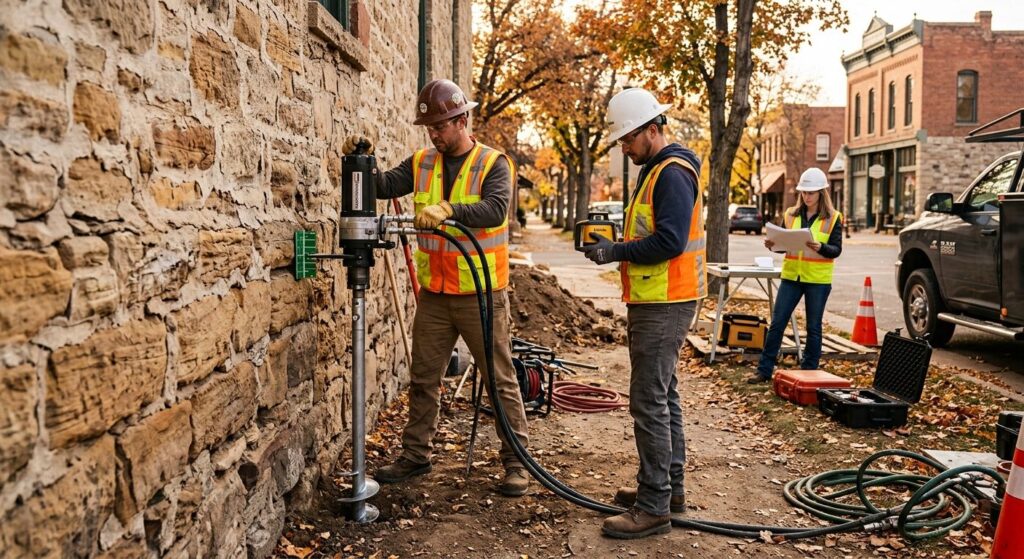
Table of Contents
- Foundations of the Past: Restoring Historic Properties in Littleton, Colorado
- Essential Preparations Before Starting Historic Foundation Restoration
- Assess the Foundation Condition
- Identify Foundation Materials and Type
- Determine the Best Stabilization Method
- Design the Restoration Plan with an Engineer
Foundations of the Past: Restoring Historic Properties in Littleton, Colorado
When it comes to historic structures, historic foundation restoration demands a careful balance between preserving architectural heritage and meeting modern engineering standards. The National Park Service’s preservation guidelines emphasize minimal intervention—repairing original materials rather than replacing them whenever possible—to maintain each building’s historical character. In Littleton, where many properties date back over a century, we approach every project with this philosophy, ensuring that any repair method respects the structure’s integrity while addressing present-day stability concerns.
For more complex failures, structural underpinning with helical piers offers a minimally invasive solution. As the American Society of Civil Engineers recommends, site-specific soil analysis is essential before choosing a repair method. Distinguishing between foundation settlement vs heaving is critical to selecting the right approach—settlement often requires underpinning, while heaving may call for drainage or moisture control. Our helical pier stabilization systems can help support historic foundations without the extensive excavation that would damage original materials, making them an ideal choice for preserving Littleton’s past. As with any historic renovation, we recommend consulting a licensed structural engineer for definitive diagnosis and design recommendations. Understanding these preservation principles, we turn to the specific methods that honor historic integrity while providing lasting stability.
Essential Preparations Before Starting Historic Foundation Restoration
When planning historic foundation restoration, preparation is key — and the single most important step is scheduling a structural engineer foundation inspection. At Rocky Mountain Steel Piering, Inc., a family-owned and operated business since 1996, we recommend that homeowners in Denver, Littleton, and across the Front Range begin with this forensic evaluation before any repair work. A licensed Professional Engineer will assess crack patterns, differential settlement, soil conditions, and the load-bearing capacity of your historic structure, producing a sealed report that becomes the blueprint for all subsequent repairs.
Understanding how your foundation is moving is equally critical. Foundation settlement — downward movement caused by soil compression or moisture loss — and heaving — upward displacement from expansive clay soils common in Colorado — produce distinct crack patterns that require different solutions. Historic buildings, often built on lime mortar and stone rubble foundations, may exhibit both conditions simultaneously. Proper diagnosis ensures that solutions such as structural underpinning or helical pier stabilization are applied only where the engineering findings support them.
Beyond the structural evaluation, we strongly recommend reviewing your building’s original construction documents and any prior renovation records. Assess site drainage and moisture intrusion patterns, as water is frequently the root cause of foundation distress in older buildings. Once these preparations are complete and a qualified contractor with demonstrated historic restoration experience has been identified, the restoration can proceed with confidence.
Assess the Foundation Condition
Before any restoration begins, the foundation’s condition must be assessed.
Instructions
- Walk the full perimeter, carefully inspecting mortar joints and foundation walls for cracking, bulging, or stair-step patterns; photograph any findings.
- Use a 4‑ft level on floors and footings — check for dips or rises that indicate settlement or heaving.
- Measure differential settlement between corners with a laser level, recording the offset at each point.
- Document door and window alignment — sticking or misalignment often signals structural movement; capture images with a ruler for scale.
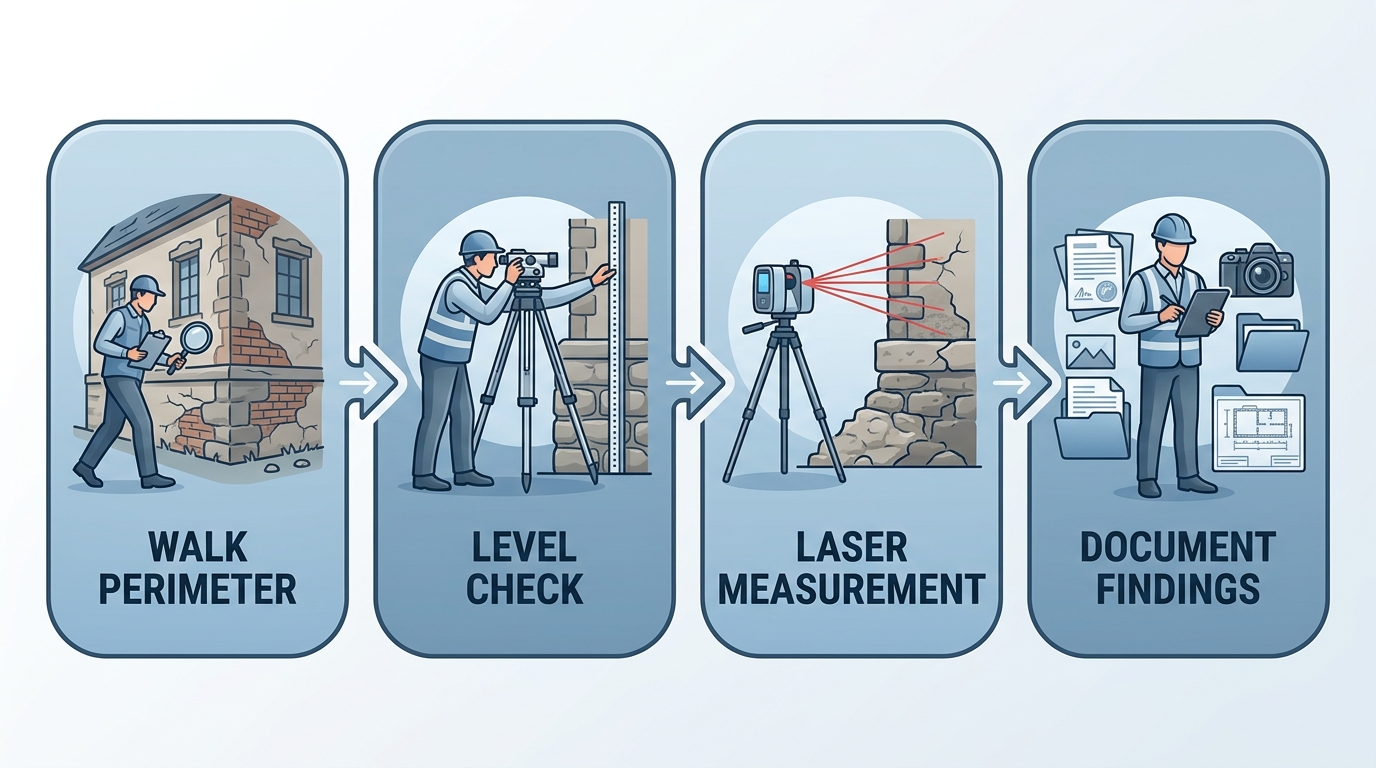
Foundation assessment process in four easy steps.
Why It Matters
A thorough assessment is critical in historic foundation restoration. Mistaking heaving for settlement can lead to incorrect repairs. If floors slope toward the center, it’s likely settlement; if a corner pushes up, suspect heaving — see our comparison of foundation settlement vs heaving for detailed signs. Sinkhole‑related damage may be covered by Tower Hill Insurance sinkhole coverage, making documentation crucial. For settlement, helical pier stabilization offers a vibration‑sensitive option ideal for historic structures, but proper diagnosis is essential.
Tips
- Use a plumb bob to check wall verticality without scratching historic plaster.
- Photograph cracks with a ruler for scale; as The Experts in Steel Piers, we stress that documentation helps track movement and supports insurance claims.
- If settlement is detected, structural underpinning may be required. Always consult a licensed structural engineer for a definitive diagnosis.
Identify Foundation Materials and Type
Instructions
Once you have noted the overall condition, the next step is to identify the specific foundation material and construction method. Examine exposed foundation walls for unit size, mortar joint width, and surface texture. These clues distinguish stone, brick, concrete, and rubble. For definitive identification, especially when sinkhole movement is suspected, consult a licensed structural engineer and refer to our sinkhole coverage FAQ.
Why It Matters
Proper material identification is critical whether you are undertaking a historic foundation restoration or researching building methods during national park trip planning. The material type directly influences whether structural underpinning is the most compatible repair pathway.
Tips
- Check mortar joint profile: stone has wide, irregular joints while brick shows narrow, uniform joints.
- Tap the surface with a small hammer—concrete gives a dense, solid sound unlike hollow block or rubble.
- Rough, mixed-material surfaces often indicate rubble, where helical pier stabilization can be especially effective.
With the material identified, you can now evaluate compatible restoration approaches such as helical pier stabilization or structural underpinning.
Determine the Best Stabilization Method
Once you understand the unique challenges of historic foundations, the next step is to determine the best stabilization approach. Our team uses a proven evaluation process that respects historical significance while ensuring long-term stability through modern engineering.
Instructions
Begin by obtaining a geotechnical report to assess soil conditions and identify any subsurface issues. We then have you consult a licensed structural engineer to determine exact load requirements and structural constraints. This evaluation compares helical piers, push piers, and concrete underpinning based on your site access, soil type, and structural needs.
Why It Matters
Selecting the correct method preserves the historical fabric of your structure and avoids unnecessary alteration. For historic foundation restoration projects, method selection is critical for maintaining authenticity. We recommend consulting Civil Engineering Society resources for design guidelines on historic structures.
Tips
Helical pier stabilization typically provides minimal disturbance and immediate load-bearing with faster installation in poor soils. Concrete underpinning requires excavation and longer cure times. As The Experts in Steel Piers, our family-owned team delivers superior performance in installation of helix pier systems. Final selection must follow professional engineering analysis.
After selecting the most suitable method, our team executes the installation with precision and minimal site disruption.
Design the Restoration Plan with an Engineer
Once a foundation assessment identifies issues, collaborate with a structural engineer to design a restoration plan that respects local requirements for historic foundation restoration in Denver and Douglas County. The engineer will evaluate soil conditions and loads, specifying helical pier stabilization or structural underpinning methods compatible with the historic building.
Instructions
Share all inspection data and historical records. The design must comply with Colorado building codes and preservation mandates. As The Experts in Steel Piers, our team recently applied this process on a historic Littleton church, integrating helical piers beneath stone walls without altering visible masonry. This collaborative approach ensures every element—from pier depths to load transfer—is engineered for long‑term stability.
Why It Matters
An engineered plan ensures code compliance and preserves the building’s original character. Properly designed underpinning prevents settlement and protects historic materials.
Tips
- Request load calculations and a step‑by‑step sequence that minimizes disruption.
- Specify helical pier stabilization or underpinning suitable for your soil conditions.
- Confirm all permits and preservation guidelines are met.
Implement Helical Pier Underpinning
Once the foundation assessment confirms the need for underpinning, the next step is implementation. For historic foundation restoration, we follow a precise process that minimizes disturbance. Our trained crew advances each helical pier by torqueing it to a target depth or until it reaches load-bearing soil, a process that produces very low vibration and requires no concrete cure time. Critically, torque readings taken during installation provide immediate verification of the pier’s load capacity, ensuring predictable performance.
Instructions
- Drill a pilot hole at each marked pier location.
- Attach the lead section with a helical bearing plate to the drive head.
- Advance the pier by applying rotational torque, adding extensions as necessary to reach load-bearing strata below historic fill.
- Monitor installation torque continuously in real time to confirm design capacity.
- Once verified capacity is achieved, secure the foundation bracket to the pier and attach it to the footing.
Important: Consult a licensed structural engineer for a site-specific design and load calculations.
Why It Matters
Helical piers are a superior choice for structural underpinning in older buildings for three key reasons. First, the low-vibration installation protects fragile historic masonry. Second, immediate load capacity is confirmed through torque monitoring, so there is no waiting for grout to cure. Third, the compact equipment allows for access in restricted spaces with minimal site disruption.
Tips
For effective helical pier stabilization, we recommend these practical strategies:
- Select pier size and helix configuration based on the structural load and soil conditions, as deeper sections may be required to penetrate historic fill.
- Specify hot-dip galvanized steel for corrosion protection in older, moist foundation environments.
- Ensure installation is performed only by certified installers, like our crew at Rocky Mountain Steel Piering, Inc., a family-owned and operated team since 1996.
All information on this website is for general informational purposes. Consult a licensed structural engineer for definitive diagnosis and design recommendations.
Repair Stone Foundation Mortar Deterioration
Once the cause of deterioration is identified, repointing the mortar joints becomes the primary repair task. For a successful historic foundation restoration, we recommend a two-step process: first, remove old mortar to a depth of at least 1 inch using a raking tool or a grinder with a dust shroud, then thoroughly clean the joint with a wire brush and water, allowing it to dry completely before packing in the new mix.
Instructions
Why It Matters
Using the correct mortar mix is critical because modern, high-strength products trap moisture inside the stone, leading to freeze-thaw spalling and structural failure within 5 to 10 years. Without proper repointing, even sound structural underpinning can be compromised, as water intrusion accelerates deterioration at the wall’s core.
Tips
For a seamless repair, test your mortar’s color and texture on a scrap board before applying it to the foundation; blend mineral pigments or vary sand shades to match the original material. As a family-owned and operated since 1996 company, we know that patience in this step preserves historic character. After the mortar is restored and the foundation is watertight, deeper structural issues—such as settlement—may require underpinning, which we address next. Consult a licensed structural engineer or qualified professional for definitive diagnosis and design recommendations.
Finalize Restoration and Protect Historical Features
Once the structural work is complete, finalize the restoration by documenting and safeguarding the visible historical features of your foundation.
Instructions
In historic foundation restoration, finalization requires a careful approach:
- Document all visible historical features (exposed brick, timber framing, decorative molding, original stone) with photographs and written records.
- Use reversible techniques such as lime‑based mortars, temporary shoring, and mechanical fasteners that avoid permanent alteration.
- When structural underpinning is required, our helical pier systems can provide stable support without damaging historic masonry when installed by our certified installers.
- Consult a licensed structural engineer for definitive diagnosis and design recommendations before finalizing any restoration work.
Why It Matters
Protecting historical features maintains your property’s authenticity and supports local heritage preservation. According to the National Park Service’s Preservation Briefs, preserving original fabric also enhances long‑term property value. This same principle guides every historic foundation restoration we complete.
Tips
- Label any removed historic elements and store them for possible future reinstallation.
- Use non‑invasive testing to verify soil conditions before final load transfer.
- Helical pier stabilization is often preferred for minimal site impact — the piers can be installed without heavy excavation, preserving the surrounding historic landscape.
Common Challenges in Historic Foundation Restoration
At Rocky Mountain Steel Piering, Inc., The Experts in Steel Piers, we understand that embarking on a historical renovation project reveals a range of structural concerns unique to older buildings. A key challenge in historic foundation restoration is correctly diagnosing whether a structure is experiencing settlement, heaving, or a combination of both.
According to RMS Structural Solutions, foundation settlement is the downward movement of a structure caused by soil compression, poor compaction, or moisture loss that shrinks expansive clays. Foundation heaving, in contrast, is the upward displacement often triggered when expansive clay soils—common throughout the Colorado Front Range—absorb water from snowmelt, rainfall, or leaking pipes. While both conditions produce cracked masonry and uneven floors, settlement cracks are usually wider at the top, whereas heaving cracks widen toward the bottom.
Differential movement between original foundations and later additions is another challenge in restoring old foundations. Older sections may sit on shallow stone footings while modern additions use deeper concrete, causing uneven stress as soils expand and contract.
Sourcing compatible materials for vintage foundation repair presents further difficulty. Matching period-appropriate stone or brick while ensuring compatibility with modern techniques such as structural underpinning or helical pier stabilization requires specialized assessment. Moisture intrusion and inadequate drainage accelerate deterioration, particularly in century-old mortar joints.
Understanding these challenges is the first step; the right repair method depends on the specific issue at hand. As a family-owned and operated business since 1996 with A+ BBB accreditation, we know effective solutions begin with a thorough professional evaluation before any structural intervention.
Ensuring Your Restored Historic Foundation Stands for Generations
Achieving lasting results from a historic foundation restoration depends on combining time-tested methods with modern engineering. We use helical pier stabilization to transfer structural loads to deep, competent soils, providing immediate load capacity with minimal disturbance to the historic structure. This structural underpinning approach creates a stable base that resists settlement and soil movement over time.
According to American Society of Civil Engineers standards, proper foundation repair must account for load-bearing requirements and material compatibility with existing masonry or stonework. We follow these guidelines throughout every phase of restoration in Littleton, Denver, and throughout Colorado.
As trained, certified installers, we ensure each helical pier is driven to specified torque and depth, then hot-dip galvanized for long-term corrosion protection. Regular monitoring and maintenance after installation help preserve restoration longevity, keeping your historic foundation stable for decades to come.