
Commercial Concrete Repair Techniques: Complete Guide 2026
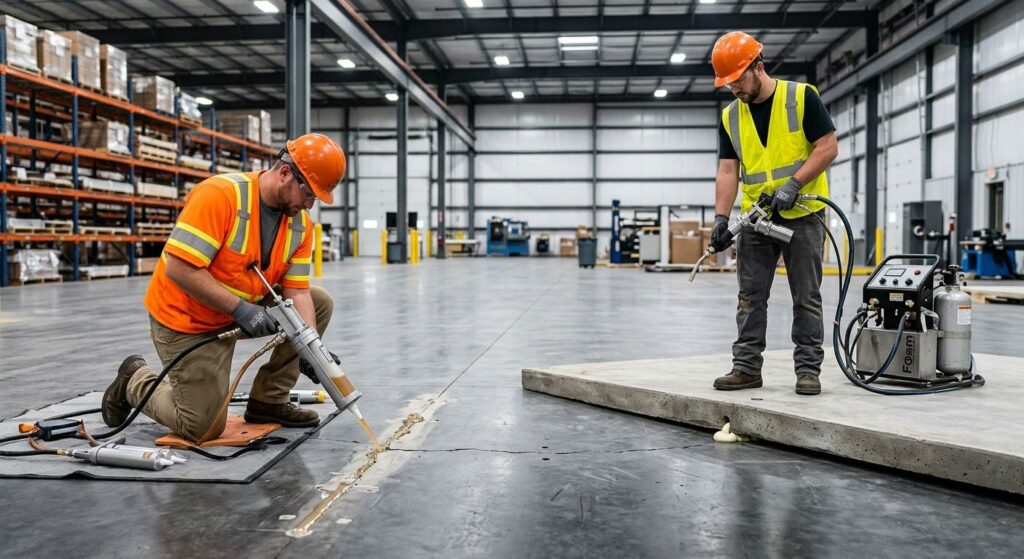
Table of Contents
Modern Commercial Concrete Repair Techniques
Fortunately, modern commercial concrete repair techniques can effectively address settlement, cracking, and other structural issues in commercial properties.
Polyurethane foam lifting is a minimally invasive method that injects high-density foam through small holes to raise sunken slabs; it cures quickly and provides immediate load-bearing capacity. For cracks that are not actively moving, epoxy injection crack repair restores structural integrity by bonding the concrete with high-strength adhesive. When damage is too extensive for these methods, concrete removal and replacement remains a reliable traditional option. Our techniques follow International Concrete Repair Institute (ICRI) guidelines to ensure quality and durability.
RMS Structural applies these techniques using certified installers and industry-leading equipment. For professional concrete services in Denver, contact our team. Actual results vary based on site conditions; consult a professional for an assessment.
1. Rapid Epoxy Injection Crack Repair
When evaluating commercial concrete repair techniques, rapid epoxy injection offers a proven method for restoring cracked concrete structures. We inject a high-strength epoxy resin into non-moving cracks, bonding the concrete back together and reinstating structural integrity.
This process is suitable for horizontal, vertical, and overhead applications—from foundation walls and slabs to beams—and can cure in as little as 30 minutes to 2 hours, minimizing downtime for busy commercial sites. Our technicians follow ICRI concrete repair guidelines to ensure every injection meets industry standards for durability and performance. This epoxy injection crack repair method creates a bond that often exceeds the tensile strength of the original concrete, providing long-term reliability. We bring this expertise to projects in Denver and throughout Colorado, where freeze-thaw cycles and expansive soils demand resilient repairs.
For non-moving structural cracks, epoxy injection restores integrity and avoids costly replacement. While epoxy injection excels for structural cracks, other methods like polyurethane foam lifting address settlement issues. Contact us for a custom quote tailored to your project.
2. Polyurethane Foam Lifting Efficiency
Among the most efficient commercial concrete repair techniques in Denver, polyurethane foam lifting delivers rapid results with minimal disruption. We use this method to restore settled concrete slabs quickly, often within minutes rather than days. Our experience with polyurethane foam lifting has shown that the process requires only small injection holes, dramatically reducing labor and site restoration costs. The high-density foam cures rapidly, often allowing for immediate load-bearing use—ideal for commercial floors subject to heavy traffic. According to ASCE concrete structural repair standards, this method aligns with recognized best practices for efficiency and durability. We have also found it to be especially effective in Colorado’s expansive soils, where installation rates can be up to 66% faster than traditional replacement. While polyurethane foam lifting offers rapid results, we also employ other techniques like epoxy injection crack repair for different repair needs. As a family-owned and operated since 1996, we tailor solutions to your project. Contact us for a custom estimate.
3. Spalled Joint Restoration for Warehouses
When considering commercial concrete repair techniques, warehouse managers often encounter spalled joints—deterioration along concrete slab edges caused by heavy forklift traffic and slab settlement. These chipped and crumbling edges create trip hazards, accelerate slab damage, and lead to disruptive downtime. If left unaddressed, spalled joints worsen, potentially causing slab failure and longer shutdowns. We address this joint deterioration repair through epoxy injection crack repair and polyurethane foam lifting. Epoxy injection fills and seals cracks to restore structural integrity, while polyurethane foam lifting re-levels settled slabs with minimal disruption. Our approach aligns with International Concrete Repair Institute (ICRI) guidelines for concrete restoration. Because every warehouse’s conditions are unique, a professional on-site inspection is essential to determine the best repair strategy. As a family-owned and operated company since 1996 with A+ BBB accreditation, we provide warehouse floor restoration across the Denver metro area. Contact us today for a thorough assessment. Beyond spalled joints, other common warehouse concrete issues include slab heaving and surface scaling, which we also address.
4. Structural Integrity Without Complete Removal
However, in many cases, structural integrity can be fully restored without the expense and disruption of complete removal. In Denver and across Colorado, commercial concrete repair techniques such as helical piers, polyurethane foam lifting, and epoxy injection provide lasting support while minimizing site disturbance. Helical piers transfer structural loads to stable soil without replacing the entire foundation. Polyurethane foam lifting, or polyjacking, injects high-density hydrophobic foam through small holes to compact subsoil and re-level settled slabs. Epoxy injection crack repair restores structural continuity by filling and bonding cracks.
These methods offer significant advantages over full removal, including reduced project timelines and lower overall investment. helical pier installation cost is often less than complete foundation replacement, making helical piers a practical choice for many projects. According to the American Society of Civil Engineers, such preservation techniques can achieve long-term structural stability. Our family-owned and operated company has provided these solutions since 1996, and we’ve seen how effective they are. Results depend on site conditions, and we’ll explore each technique in depth in the following sections.
5. Moisture Barriers for Slab Protection
While the techniques above address existing damage, proper moisture barriers can prevent many commercial concrete repair techniques. In Colorado’s freeze-thaw climate, unprotected slabs crack under moisture expansion, often necessitating epoxy injection crack repair or polyurethane foam lifting.
Under-slab vapor barriers, typically polyethylene sheeting, stop moisture from the ground before the concrete is poured. For existing slabs, a concrete sealing in Denver service applies penetrating or film-forming sealers to protect the surface. We at RMS Scon recommend both methods for long-term slab durability.
By stopping moisture at the source, these barriers reduce the risk of freeze-thaw cracking that otherwise demands costly repairs. In Colorado, where expansive soils and frost heave are common, investing in vapor protection and slab waterproofing is a proactive way to avoid future crack repair or structural foam lifting.
We at RMS Scon offer moisture/vapor barrier services; contact us for a free on-site inspection and custom quote. Consult a qualified structural engineer for definitive recommendations.
6. ASTM Compliant Epoxy Bonding Systems
Beyond the injection technique itself, for demanding commercial concrete repair techniques in Colorado, we ensure every epoxy bonding system meets rigorous ASTM concrete repair standards. Our systems comply with ASTM C881, the standard specification for epoxy-resin-base bonding systems for concrete, as published by ASTM International. Depending on the application, we select from Type I (load-bearing), Type II (non-load-bearing), or Type IV (moisture-tolerant) epoxies; for most structural crack repairs we rely on Type I and Type IV formulations to ensure durable bonds. For effective epoxy injection crack repair, surface preparation is critical; we follow ICRI Guideline No. 03730 from the International Concrete Repair Institute, which specifies abrasive blasting and a dry substrate to achieve high bond strength. As a family-owned and operated company since 1996, our trained installers follow these standards to avoid delamination or incomplete penetration, ensuring durable, code-conforming repairs. These compliant systems are critical for long-lasting repairs in both commercial and residential settings. Always consult a licensed structural engineer for project-specific repair designs.
7. Proactive Crack Diagnosis and Prevention
Early diagnosis is one of the most effective commercial concrete repair techniques for avoiding costly structural repairs. Proactive crack prevention strategies – from routine visual inspections to timely sealing – help commercial property owners in Colorado protect their investments before minor cracks escalate into major issues.
As a family-owned and operated company since 1996, we understand Colorado’s unique freeze-thaw challenges. When water enters hairline cracks and then freezes, it expands, widening the crack and creating pathways for deeper water intrusion. Repeated cycles accelerate concrete deterioration, making early detection essential to prevent structural damage.
Regular visual inspections for spalling, discoloration, or hairline cracking, aligned with International Concrete Repair Institute (ICRI) guidelines for crack classification, help prioritize repairs. Prompt crack chasing and epoxy injection crack repair seal existing openings, while polyurethane foam lifting corrects settlement issues before they worsen. These early concrete repair measures stop water intrusion and protect the integrity of your commercial slab.
We encourage you to contact us for a professional on-site inspection and custom quote. Consult a licensed structural engineer for a definitive diagnosis. Early detection leads to more effective repairs, which we’ll cover next.
8. Comparing Injection and Lifting Methods
Having examined each method separately, we now compare them directly. When comparing commercial concrete repair techniques, injection and lifting methods address different concrete challenges.
For cracks that compromise structural stability, epoxy injection crack repair in Denver is often the best approach. This method bonds the concrete back together, restoring its original strength and making it ideal for load-bearing walls, slabs, and beams. According to the International Concrete Repair Institute (ICRI), epoxy injection is recommended for non-moving cracks in structural members.
For settled slabs that remain structurally sound, polyurethane foam lifting in Colorado provides a minimally invasive solution. We inject hydrophobic foam through small ports to compact soil and raise the concrete back to grade, which works especially well for sunken driveways, sidewalks, and interior floors. This technique avoids the cost and disruption of full removal and replacement.
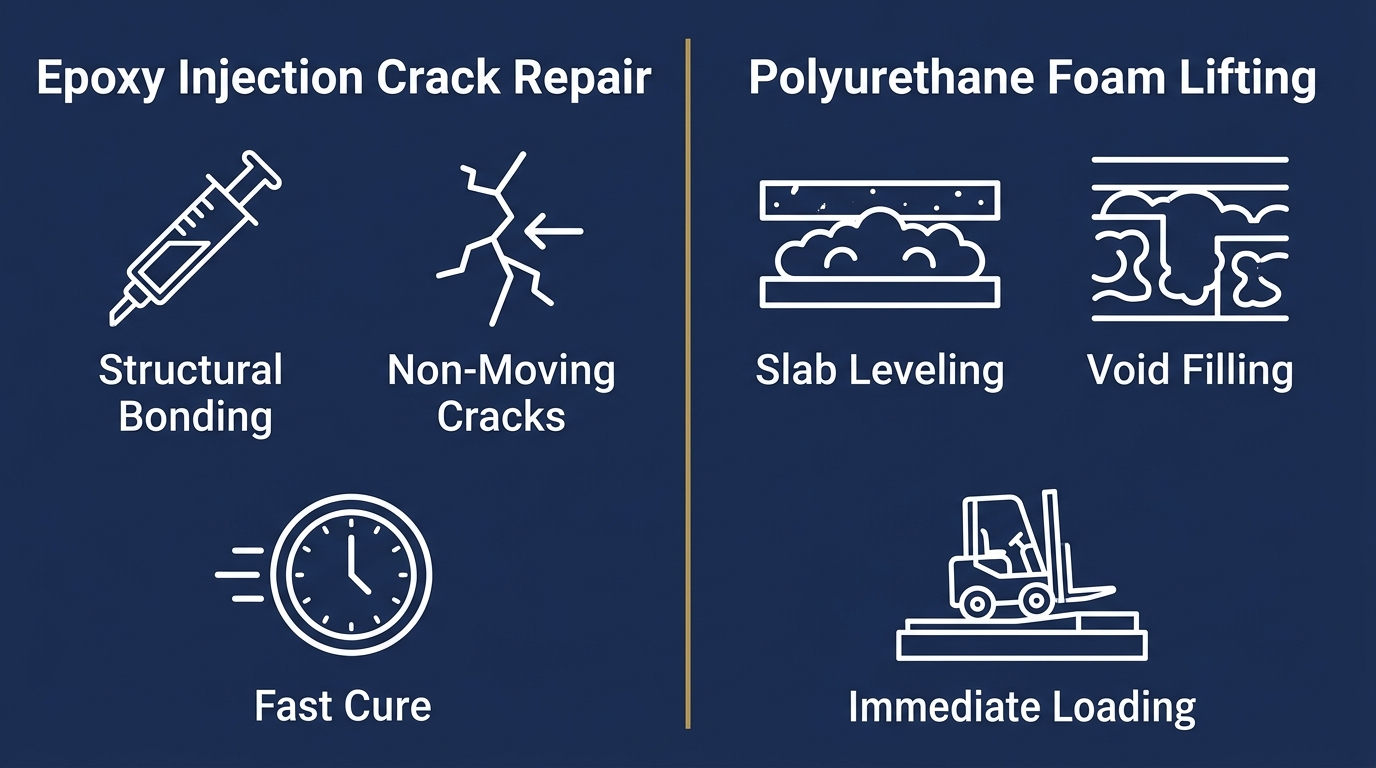
Both methods minimize disruption compared to full replacement, and we can assess which approach best suits your situation after an on-site inspection. As a family-owned and operated company since 1996, we provide both injection and lifting methods to deliver tailored solutions—contact our team for a custom recommendation.
Securing Commercial Concrete for the Long Haul
Commercial concrete structures in Denver endure harsh freeze-thaw cycles and expansive soils, demanding durable commercial concrete repair techniques for lasting stability. As The Experts in Steel Piers, we bring a structural perspective to commercial concrete repair techniques, employing epoxy injection crack repair to seal cracks and polyurethane foam lifting to correct settlement, both performed by certified installers. As a family-owned and operated since 1996 business with an A+ BBB rating, we follow American Society of Civil Engineers (ASCE) guidelines and apply decades of structural piering experience to deliver durable concrete solutions. Our work restores safety and extends the life of concrete slabs, walkways, and foundations across Denver. While results depend on on-site inspection, our proven techniques, detailed next, provide long-term stability for commercial property.