
Helical Pier Installation Cost: 2026 Colorado Homeowner’s Guide
Table of Contents
- Helical Pier Installation Cost in the Denver Metro Area: Key Factors to Consider
- How Much Do Helical Piers Cost Per Foot in Colorado?
- Helical Piers vs. Push Piers and Concrete Underpinning: A Cost Comparison
- How to Get an Accurate Helical Pier Installation Quote for Your Denver Property
- Engineering and Site Considerations That Affect Helical Pier Installation Costs
- Answers to Your Helical Pier Cost Questions
- Get a Custom Helical Pier Installation Quote from Rocky Mountain Steel Piering
Helical Pier Installation Cost in the Denver Metro Area: Key Factors to Consider
When evaluating helical pier installation cost in the Denver Metro Area, commercial property managers quickly discover that no two projects carry identical price tags. The highly variable conditions beneath each site directly influence the scope of work required.
Soil conditions across the Front Range present meaningful cost drivers. Expansive clays and deep fill soils are common, and reaching competent load-bearing strata often demands deeper pier installations — more materials and more labor. In some areas, a high water table further complicates drilling and can increase installation time. Unlike push piers, helical piers install with immediate load capacity and no cure time, a distinct advantage when project schedules matter. For commercial foundation stabilization, the Concrete Repair Institute resources provide detailed technical standards on helical pier design and testing.
The number of piers is determined by structural load calculations, typically from a geotechnical or structural engineer report. Commercial buildings generally require more piers than residential work, and site accessibility matters — tight lots, mature landscaping, or limited equipment access in an active property can all influence the project approach.
We at RMSSCO are The Experts in Steel Piers, and we provide custom quotes only after an on-site inspection. Every project is different — contact us for a written estimate. Actual costs depend on site-specific conditions; consult RMSSCO for a written estimate.
Ready to start your construction project? We are family-owned and operated since 1996.
How Much Do Helical Piers Cost Per Foot in Colorado?
With an understanding of how helical piers work, the next logical question is about their price. The answer is nuanced. We don’t publish a flat per-foot rate because the helical pier installation cost varies significantly from one Colorado property to the next. The total investment depends on a combination of subsurface conditions, project-specific engineering requirements, and site logistics. For a precise figure, we provide a custom quote after a thorough on-site inspection.
Colorado’s Unique Geology and Your Foundation
Colorado’s diverse terrain plays a major role in helical piers foundation repair pricing. The expansive clay soils common along the Front Range, for instance, present different challenges than the dense, rocky substrates you might encounter on a mountain property. According to our internal technical resources, soil density and composition directly influence how easily a pier can be advanced to the required load-bearing stratum. A project in Littleton with deep deposits of bentonite clay often calls for a different installation strategy than a project in the granite-heavy foothills west of Denver. We’ve been assessing these local conditions since 1996, which allows us to anticipate complications and plan for them accurately.
Key Factors That Shape Helical Pier Pricing
When calculating the cost of helical pier installation in Colorado, we look beyond a simple per-foot measure. Several interconnected variables define the final price:
- Pier Diameter and Shaft Type: Larger diameter piers and thicker wall shafts have a higher material cost but deliver greater capacity for heavier structures.
- Installation Depth: The depth required to reach competent, load-bearing soil is the most significant variable. Deeper installations require more shaft extensions, more labor, and more time.
- Site Accessibility: Tight lot lines, low overhead clearances, and landscaping can restrict equipment access. Limited access typically means using specialized, smaller machinery, which can affect project timelines.
- Structure Weight and Engineering Loads: A multi-story commercial building demands a far more robust pier configuration than a single-story home, directly influencing the number and specification of piers.
Our process for foundation repair with helical piers always begins with an analysis of these factors. As our internal company FAQ explains, we don’t use a one-size-fits-all approach because the ‘right’ solution is defined entirely by what’s underground. This is also why a direct helical pier vs push pier comparison needs to account for site conditions; a pier that works efficiently in one soil type might not be ideal in another.
How We Arrive at an Accurate Quote
There is no substitute for visual evidence and soil data. We visit your property, evaluate the structural distress, and assess site conditions. This inspection, combined with our three decades of local experience, allows us to design a repair plan with predictable capacities and a firm price. Our quotes are preliminary and are not legally binding until confirmed in writing following an on-site inspection.
For a side-by-side look at the technical differences, see our detailed guide on push piers vs helical piers. Ready to find out the exact cost for your Colorado project? Contact Rocky Mountain Steel Piering for a free consultation.
Helical Piers vs. Push Piers and Concrete Underpinning: A Cost Comparison
When evaluating foundation repair options, understanding the true costs and value of each method is essential for making an informed decision. While many factors influence the final price, including soil conditions, access, and load requirements, we provide this comparison to help Denver-area property owners weigh their choices. When considering helical pier installation cost, it is important to look beyond the initial price tag and assess long-term performance, installation speed, and site impact. Because every project is unique, we recommend contacting The Experts in Steel Piers for a custom, no-obligation quote tailored to your specific situation.
Cost Comparison: Helical Piers vs. Concrete Underpinning
The following table breaks down the key differences among helical piers, push piers, and traditional concrete underpinning across several critical factors.
| Factor | Helical Piers | Push Piers | Concrete Underpinning |
|---|---|---|---|
| Average cost per foot | Moderate upfront, predictable load capacity | Similar or slightly higher in certain soils | Lower material cost, higher labor and cure time |
| Installation time | Fast, immediate loading, no cure time | Moderate, may require waiting | Slow, requires curing (days to weeks) |
| Load capacity | High, predictable via torque | High, but less predictable in weak soils | Moderate to high, but limited by soil |
| Soil suitability | Excellent for loose, filled, or wet soils | Best for dense, stable soils | Depends on soil bearing capacity |
| Immediate loading | Yes, install and load immediately | No, requires setup time | No, requires curing |
| Longevity | 50+ years with galvanization | Similar, but less resistant to corrosion in wet soils | May degrade in expansive soils |
Our analysis shows that while concrete underpinning may appear less expensive in material costs, the extended timeline and labor demands often reduce its value for projects in the Denver area. Helical piers offer predictable capacity and immediate loading, which can significantly shorten project schedules and reduce disruption. For many helical piers foundation repair projects, the ability to install and load on the same day translates into tangible savings and peace of mind.
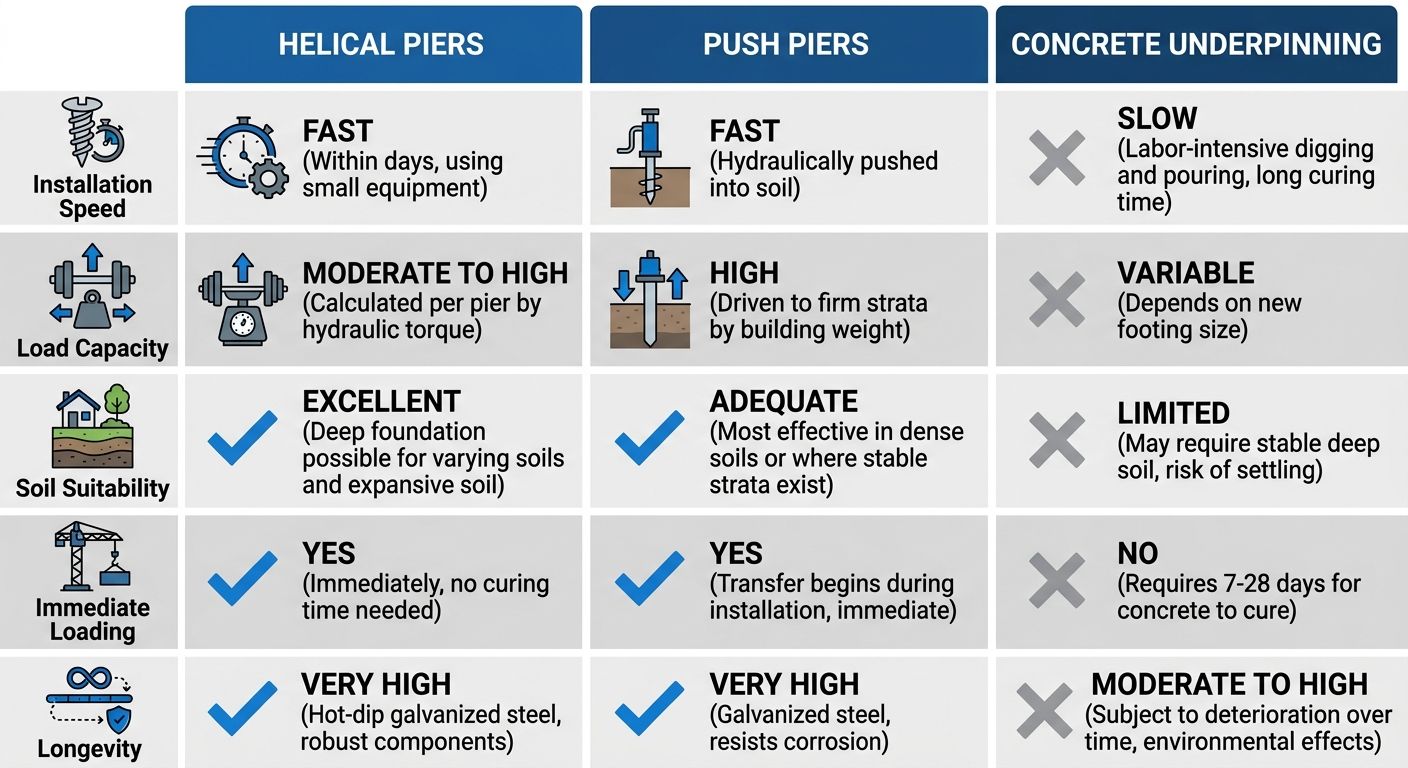 Three-column cost factor comparison for foundation repair methods.
Helical Piers vs. Push Piers: Which Offers Better Value?
When comparing helical piers to push piers, value extends well beyond the initial equipment and labor costs. According to our Denver comparison guide, helical piers often deliver more predictable performance in the expansive clay and variable soils common across the Front Range because their screw-in installation minimizes soil disturbance. In contrast, push piers rely on skin friction at the tip and may require denser, more stable soils to achieve comparable load-bearing capacity. For a more detailed breakdown, see our FAQ on push piers vs helical piers.
Our experience as a family-owned and operated company since 1996 has shown that helical pier systems provide superior performance in installation of helix pier systems, especially where wet or loose soils are present. Because helical piers can be installed up to 66 percent faster in poor soils and accept loads immediately without concrete cure time, projects often finish ahead of schedule and with less site disturbance. While push piers remain a viable choice for heavy commercial loads in stable ground, the helical pier vs push pier comparison for residential and light commercial projects in the Denver area frequently favors the predictability and speed of helical piers.
When to Choose Helical Piers Over Alternatives
We typically recommend helical piers in Denver when specific project conditions demand the unique advantages they offer.
- Poor soil conditions such as loose fill, expansive clay, or high groundwater make the screw-in method more reliable than driving push piers or pouring concrete.
- The need for immediate load transfer after installation eliminates cure-time delays and keeps construction on a fast track.
- Limited site access or a desire to minimize landscape disruption favors the compact equipment and clean installation of helical systems.
- A long-lasting solution is essential, and our hot-dip galvanized helical piers routinely provide a service life of 50 years or more with predictable, reliable performance.
Ultimately, the right foundation repair method depends on a thorough on-site evaluation by a qualified professional. Consult a licensed structural engineer for definitive foundation repair recommendations. Ready to start your construction project? Contact the Experts in Steel Piers today for a custom quote tailored to your site’s specific conditions and load requirements.
How to Get an Accurate Helical Pier Installation Quote for Your Denver Property
Once you understand the advantages of helical piers, the next step is getting an accurate quote for your Denver property. The helical pier installation cost varies based on several factors, from soil conditions to the engineering required for a stable foundation. We believe a transparent quote is the first sign of a trustworthy contractor, and understanding what goes into your estimate will help you make a confident decision for your structure in Denver.
What a Comprehensive Quote Should Include
A thorough quote for helical piers foundation repair or new construction should be detailed and transparent, leaving no room for surprise costs. For a solid foundation in Denver, you should expect a complete breakdown that starts long before any equipment arrives on site.
First, a site inspection is essential. Denver’s clay and expansive soils can vary significantly, and an on-site visit allows a specialist to assess the actual load requirements and soil conditions. The quote should then be supported by an engineering report. This document will specify the exact load capacity needed and the design of the helical pier system, often costing between $500 and $1,500. According to Rocky Mountain Steel Piering (RMSS), a comprehensive quote must also clearly list material specifications, such as hot-dip galvanized steel, and a labor breakdown. Typically, material costs are bundled into a per-pier price. Finally, the warranty details covering both workmanship and materials should be explicitly stated, ensuring you know the terms and coverage period before the project begins.
Hidden Fees to Watch for in Helical Pier Quotes
When evaluating a helical pier quote, it is crucial to look beyond the per-pier price and identify potential extra costs. We always advise property owners in Denver to ask their contractor to clarify every line item so that the final project aligns with the initial estimate.
| Cost Factor | Typical Range | Notes |
|---|---|---|
| Site inspection fee | $100–$300 | Often waived if you proceed with the contract |
| Mobilization | $200–$600 | Some contractors include it. Ask upfront. |
| Engineering review | $500–$1,500 | Required for structural load design |
| Permit costs | $100–$400 | Varies by municipality |
| Installation per pier | Included in per-foot cost | Confirm what’s included |
| Galvanization | Included in material cost | Hot-dip galvanization is standard at RMSS |
These figures represent industry-standard estimates from an experienced local contractor, and they highlight why the final helical pier installation cost can differ from a base estimate. A mobilization fee, ranging from $200 to $600, covers the transport of equipment and crew. It is a standard charge, though some companies may incorporate it into the overall project cost. Similarly, permit costs for Denver municipalities typically fall between $100 and $400.
To avoid surprises, confirm whether the site inspection fee is refundable or waived upon contract signing. Other factors that can affect pricing include site preparation, such as clearing or leveling an area for equipment access. Asking your contractor to commit these fees to writing is the best way to protect your budget.
Questions to Ask Before Signing a Contract
Before you commit, preparing a list of pointed questions will help you verify the contractor’s process and avoid misunderstandings. Getting detailed answers upfront is the best way to ensure you are comparing proposals fairly.
- Is load testing included? Ask whether they use a torque indicator or a physical load test, and verify that this is a standard part of the installation process.
- What galvanization standards do you follow? The industry standard for steel corrosion protection is hot-dip galvanization per ASTM A123. You should ask for certification to confirm your piers meet this specification.
- What is your installation timeline? Make sure the contractor addresses how weather or unforeseen soil conditions in Denver could delay the project, and how change orders are managed.
- Which pier type is right for my site? Don’t forget to ask about push piers vs helical piers to determine which solution fits your soil conditions. According to RMSS, helical piers are often preferred for lighter loads or when immediate loading is needed.
After gathering quotes and asking the right questions, you will be ready to compare proposals and choose a contractor with confidence. Ensuring every detail is documented creates a clear path from the initial estimate to the completed repair. In the next section, we will cover what to expect during the installation process itself.
Engineering and Site Considerations That Affect Helical Pier Installation Costs
Beyond the general cost drivers, engineering and site-specific variables have a significant impact on helical pier installation cost. No two projects are alike, and a combination of design requirements and ground conditions ultimately determines the scope and expense of your underpinning solution. Understanding these factors clarifies why professional inspection and engineered planning are essential.
Engineering and Design Variables
Engineering parameters shape both the technical performance and the project budget. The required load capacity—dictated by structure weight, soil interaction, and local code—determines the number of piers, their diameter, shaft thickness, and helix configuration. Higher loads demand larger, more robust pier assemblies and deeper embedment, which increases material and installation time.
Corrosion protection compounds engineering complexity. We hot-dip galvanize pier components per ASTM standards for longevity, and in aggressive soils, additional coatings or cathodic protection may be specified. This protective layering introduces engineering review, specialty materials, and quality-control steps that influence overall pricing.
As with any deep-foundation system, helical pier vs push pier comparisons frequently arise in repair discussions. Push piers rely on structure weight for advancement, whereas helical piers are torque-driven, providing predictable capacities on installation with minimal vibration. The engineering rationale behind this choice—informed by soil investigation and structural needs—has a direct bearing on installation time, mobilization, and cost structure.
Soil Conditions and Site Accessibility
Soil bearing capacity and classification are among the most decisive factors. Dense, competent ground allows for shorter, more economical pier depths, while weak clay, loose sand, or buried organics require deeper embedment to reach load-bearing strata. Deeper installation increases the number of extensions, labor hours, and equipment wear, all of which affect helical pier installation cost.
Site accessibility can be equally consequential. Confined workspaces, steep slopes, low overheads, and extended travel distances from the staging area may necessitate smaller, specialized machinery or additional mobilization efforts, raising equipment and crew-time requirements. As with custom-quote pricing, these logistical variables are quantified only after an on-site evaluation.
Existing Concrete Conditions
A thorough engineering site evaluation also examines the condition of existing concrete. Following International Concrete Repair Institute (ICRI) guidelines, we assess slab integrity, crack propagation, and signs of deterioration. According to the International Concrete Repair Institute (ICRI), a proper inspection of concrete structures before underpinning is an industry best practice. Hidden defects—such as delamination, rebar corrosion, or insufficient thickness—may require structural repair or replacement prior to pier installation. Addressing these findings introduces additional labor and material costs but is critical for long-term performance.
Project Advantages and Professional Review
While site conditions introduce cost variables, a helical-pier approach avoids concrete curing time, which can compress the schedule compared to poured footings. This immediate loading capability often reduces general-condition expenses and disruption, especially in helical piers foundation repair applications where speedy stabilization matters to owners.
All of the factors discussed underscore a fundamental truth: site-dependent variables cannot be reliably priced from a desk. Our free, on-site evaluation—conducted by trained, certified installers—provides the field data needed for a written, engineered quote. As a family-owned and operated since 1996 company serving Littleton and the broader Front Range, we strongly encourage clients to consult a licensed structural engineer for definitive design recommendations. By combining professional engineering review with precise installation, we deliver a solution tailored to your site’s unique demands.
Please note that all preliminary estimates are not binding until confirmed in writing after our inspection, and we do not guarantee specific outcomes without a comprehensive site evaluation. For a personalized assessment, contact our team to schedule your free quote.
Answers to Your Helical Pier Cost Questions
We often hear the following questions about helical pier installation cost and how our pricing works. Since every foundation is unique, the total expense depends on factors like soil bearing capacity, the depth required to reach stable load-bearing strata, the number of piers needed, and site access challenges. In foundation repair, helical piers usually provide immediate load capacity with no cure time—cutting down project site time and related costs.
Regarding helical pier vs push pier comparisons, helical piers are often cost-competitive or more efficient in poor soils because of faster installation and the ability to load right away. Our team reviews each situation separately to recommend the most practical solution. The best way to understand pricing for your project is to request a custom quote after an on-site inspection. Call +1 303-471-1155 or visit our contact page to schedule yours today.
Get a Custom Helical Pier Installation Quote from Rocky Mountain Steel Piering
Ready to get started? When you need clarity on helical pier installation cost in your area, we begin every project with a thorough on-site inspection. As a family-owned and operated company since 1996, Rocky Mountain Steel Piering holds an A+ BBB accreditation and brings specialized expertise to every residential or commercial assessment. Our helical pier systems require no cure time and allow immediate loading, which can significantly reduce overall project timelines.
Whether you need helical piers foundation repair for your settling structure or pricing for new construction tiebacks, our certified installers will evaluate your soil conditions and provide a straightforward, custom proposal. Contact us today to schedule your inspection—your preliminary estimate is not binding until confirmed in writing after we complete the on-site evaluation. Ready to start your construction project? Fill out the form below or call our team to take the next step with The Experts in Steel Piers.
Resources
- Contact RMSSCO for Foundation Repair Consultation
- Get RMSSCO Contact Information to Schedule Consultation
- Schedule a Consultation for Construction Projects
- Compare Push Piers vs Helical Piers for Foundations
- Contact RMSSCO for Construction Project Consultation
- Find RMSSCO Contact Details for Repairs
- Schedule a Construction Consultation with RMSSCO
- Access ICRI Concrete Repair Institute Resources