
Helical Pile Lateral Load Capacity: ICC-ES Standards Guide
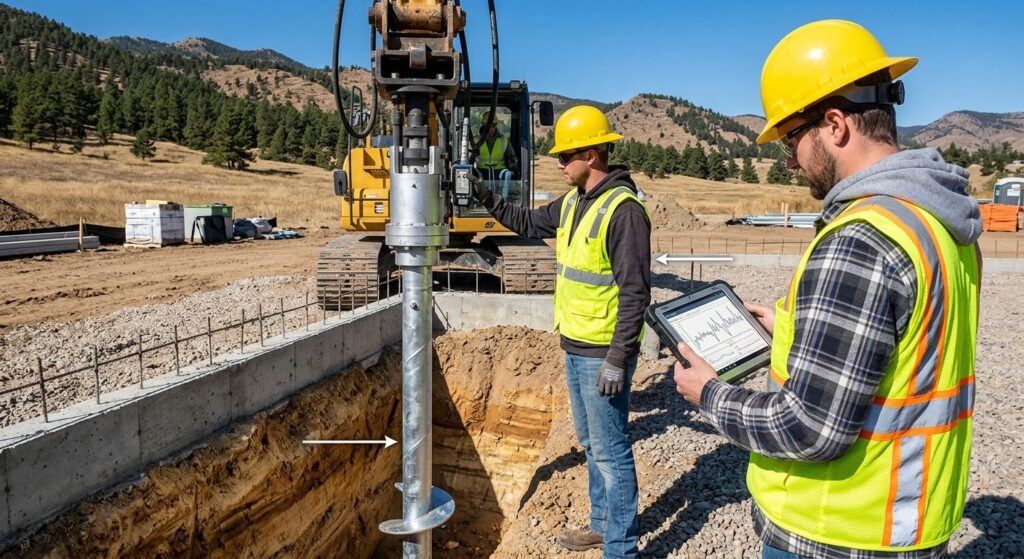
Table of Contents
- Helical Pile Lateral Load Capacity Fundamentals
- Shaft Diameter Influence on Lateral Resistance
- Fixed-Head Connections and Lateral Capacity Gains
- ICC-ES AC358 Standards and Lateral Load Compliance
- Torque-to-Capacity Correlation in Lateral Design
- 2026 Code Updates and ASCE 7-22 Deflection Criteria
- Advancing Helical Pile Lateral Design Expertise
Helical Pile Lateral Load Capacity Fundamentals
When engineers evaluate helical pile lateral load capacity, they assess the maximum horizontal force a pile can resist before excessive deflection or soil failure occurs. Unlike axial loads, which act along the pile’s axis in compression or tension, lateral loads stem from wind, seismic events, lateral earth pressure, hydrostatic pressures, and surcharge loads, added weight from nearby structures or fill. The primary variables that govern lateral resistance include shaft diameter, embedment depth, soil stiffness and strength, and the pile-to-structure connection. In many designs, serviceability limits — the allowable lateral deflection — are the controlling factor rather than the ultimate soil failure point. as the experts in steel piers, we emphasize that actual lateral capacity always hinges on site-specific soil conditions and must be evaluated by a professional engineer; no capacity can be guaranteed without an on-site inspection. Among these variables, shaft diameter stands out as one of the most consequential for lateral resistance.
Shaft Diameter Influence on Lateral Resistance
When we evaluate lateral load performance, the shaft’s cross-section stands out as one of the most influential geometric factors. Two physical mechanisms support the observation that a larger diameter shaft provides greater lateral resistance.
- Greater flexural stiffness: A larger diameter increases the section’s moment of inertia, making the shaft stiffer and better able to resist the bending moments that lateral loads produce.
- Larger projected area: A wider shaft pushes against a broader zone of soil, mobilizing more passive soil resistance in the upper layers where lateral forces are highest.
Diameter is important, but wall thickness determines the section modulus of the shaft and affects bending resistance. Of two shafts of the same outer diameter, if one shaft has a thicker wall, it will provide greater resistance to bending. The relationship between wall thickness and outer diameter affects the design of helical piles to resist lateral loads. Our installers are aware of this and select shaft sections accordingly for laterally loaded projects.
In Colorado’s variable soils, including expansive clays and other types of granular soils, shaft diameter often contributes more to lateral capacity than in uniform soil profiles. Since passive resistance near the surface governs lateral behavior, a larger diameter shaft can mobilize more soil resistance. This is particularly true for the metro Denver area and the Front Range of Colorado.
Larger diameters require higher installation torque. ICC-ES AC358 provides a framework to define and establish an accepted level of assurance that installed torque validates the pile’s intended performance. Measuring torque during installation gives our certified installers the confidence the shaft has achieved the required bearing and structural integrity to support the design loads, including lateral loads.
The pile-head connection must also provide a means for transferring lateral loads. The International Concrete Repair Institute Professional Guideline, Advisory Note 2, states that only a sound and properly repaired concrete can be relied upon to transmit the lateral loads. We evaluate the full load path during every on-site inspection to match the system to the structure’s lateral needs. This judgment and assessment are critical to meet the intent of the design requirements.
Fixed-Head Connections and Lateral Capacity Gains
Building on the influence of shaft diameter on lateral load distribution, the connection type at the pile head determines how effectively that resistance is realized. A helical pile can be installed with a free-head (pinned) connection or a fixed-head connection, and the difference fundamentally changes how lateral forces travel through the structure.
In a free-head connection, the pile top is allowed to rotate; lateral loads are transferred primarily as shear, and the pile offers limited resistance to sideways movement. A fixed-head connection, by contrast, restrains rotation and forces the pile to resist lateral loads through bending and soil interaction along its embedded length. When a helical pile is encased in a reinforced concrete cap, the cap locks the pile head, converting it into a moment-resisting joint. Lateral loads applied to the structure above are distributed as moment and shear down the pile shaft, engaging deeper soil layers and significantly improving the system’s lateral capacity.
Achieving this fixed-head condition most often involves a reinforced concrete pile cap, a steel bracket, or a grouted sleeve. The detailing of the concrete—placement, compaction, and preparation of the pile surface—is critical. Following the International Concrete Repair Institute (ICRI) guidelines for concrete repair and surface preparation helps ensure the connection performs as engineered. As a family-owned and operated company since 1996, we pay close attention to this detailing because even small imperfections in the cap connection can reduce the fixity and compromise the intended load path.
Fixed-head piles can resist higher lateral loads than free-head piles of the same shaft diameter, but the actual gain depends on soil conditions, installation torque, and embedment length. That’s why we rely on the torque-to-capacity correlation during installation: monitoring the torque achieved provides an immediate verification that the pile has reached the required bearing and lateral resistance in the on-site soils. No two sites are identical, so a thorough inspection is always necessary to determine the precise lateral capacity for a specific project.
Engineering standards such as ICC-ES AC358 provide a framework for evaluating and verifying lateral load compliance, ensuring that fixed-head connections meet code requirements and perform as expected under service conditions.
ICC-ES AC358 Standards and Lateral Load Compliance
ICC-ES AC358 is an acceptance criteria published by ICC Evaluation Service that governs the evaluation of helical pile systems for code compliance. Full-scale testing of helical pile systems to AC358 is evaluated by accredited laboratories and provides data for both axial and lateral capacities. Unlike manufacturer produced design tables, AC358 evaluation reports are based on results from full-scale testing. The failure mechanism in fixed-head connections is lateral loading, and the lateral capacity in AC358 compliant reports is validated based on actual connection testing and the interface of the pile to the supported structure.
In AC358, lateral capacity of a helical pile is determined through full-scale testing under controlled conditions, and evaluated against accepted standards. Connection assemblies are also assessed for their ability to transfer lateral loads from the pile to the supported structure.
Evidence of AC358 compliance means lateral load values for a manufacturer’s helical pile system are evaluated and reported by an independent party and published. In Colorado, many jurisdictions accept AC358 reports as evidence for satisfying code for lateral resistance. We provide this documentation with our project-specific engineering because AC358 reports determine the tested limits of the product, but final installed capacity always depends on site-specific soil conditions. A licensed structural engineer must confirm that the selected helical pier configuration meets the project’s actual lateral demands.
When the helical pier installation alters or recovers elements of the lateral load path of concrete structures, such as grade beams, pile caps, or foundation walls, the International Concrete Repair Institute (ICRI) issues repair guidelines. The ICRI’s position on the repair of distressed structures includes the requirements of the repair and the assurances that the repaired elements of the structure are capable of transferring the lateral loads.
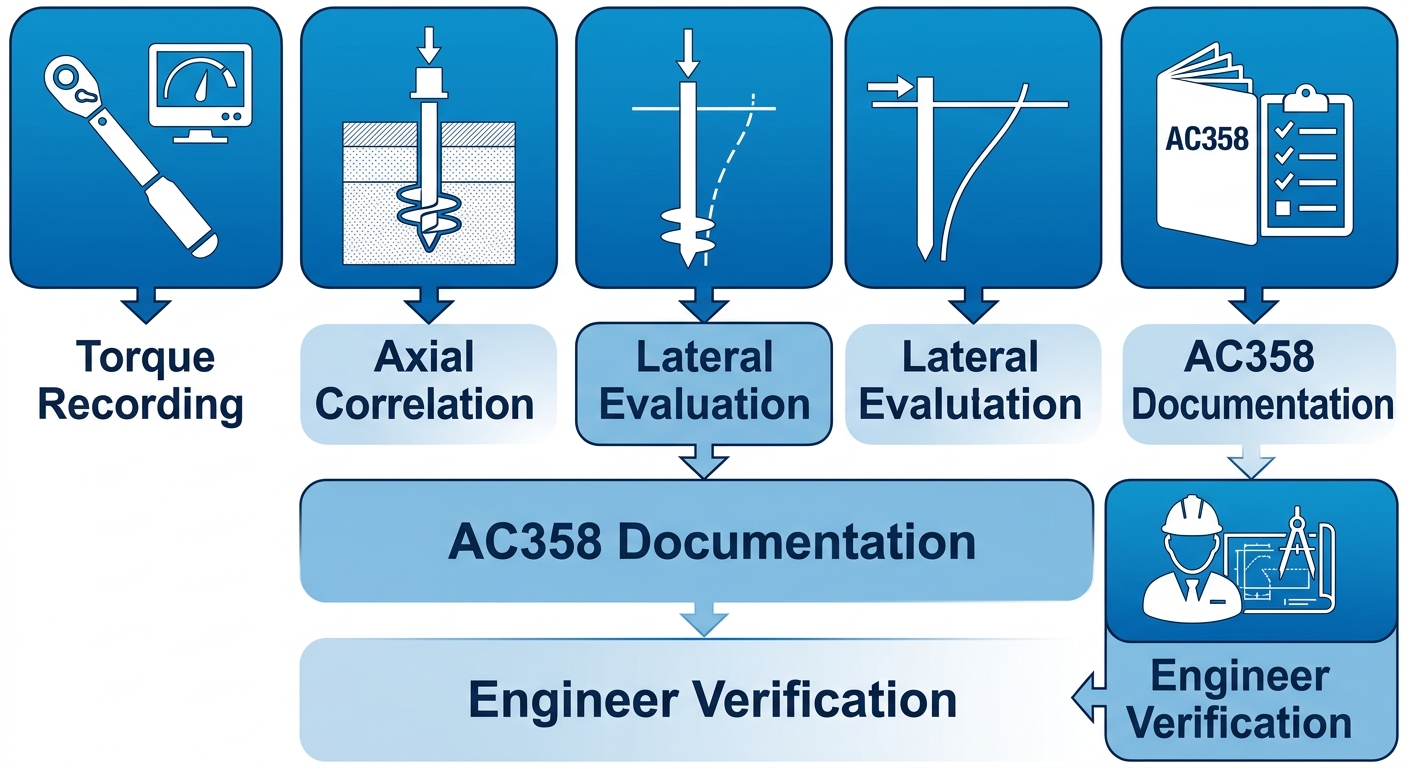
Upon the completion of an AC358 evaluation establishing a code-compliant foundation, field installation torque records serve as the practical link between the designed lateral capacity of the helical piles and the as-installed helical piles. These torque records serve as a permanent record of construction (QA/QC) and demonstrate that the piles engaged the soil to the extent necessary to achieve the required lateral capacity. They provide a compliance link between the laboratory evaluation and the installed element of the foundation.
Torque-to-Capacity Correlation in Lateral Design
In accordance with ICC-ES AC358, field verification demonstrates that helical piles achieve the design capacities specified by the engineer of record. The main tool to support field verification is the empirical relationship known as torque-to-capacity correlation. Based on the manufacturer’s ICC-ES evaluation report, this correlation provides us a field check on axial capacity; however, this correlation is not a design document and should not replace the engineered designs for a project.
Axial capacity is validated by the torque correlation, while lateral capacity is determined by the stiffness of the near surface soils, the shaft depth, and the bending resistance of the steel shaft.
Upper lateral pressures from wind and earthquake loads, as well as loads from soil cover and frost heave, are resisted by the sides of the pile bearing against the surrounding soil. In such cases, we record torque readings at final depth, in accordance with AC358. These torque readings are reported in the project compliance package, and lateral resistance is verified by the structural engineer through a site-specific soil evaluation.
The International Concrete Repair Institute (ICRI) publishes numerous technical guidelines, including the 110.1R-2026 “Guide Specification for Repair of Structural Concrete,” which describe the techniques for surface preparation, removal of rust from reinforcing steel, and other best practices for repair of structural concrete.
Expansive soil conditions in Colorado are very common and tend to be very site-specific, particularly along the Front Range. Lateral soil stiffness can vary with the moisture content. Therefore, a torque reading in August that indicates adequate axial capacity says nothing about lateral resistance in March. We coordinate load testing with the engineer of record whenever field conditions warrant it, recognizing that newer code editions are tightening deflection and lateral displacement criteria and making verified documentation a permanent part of the structural record. As such, load testing and the associated documentation becomes part of the permanent record of the structure.
2026 Code Updates and ASCE 7-22 Deflection Criteria
While torque-to-capacity correlations give us a useful starting point for lateral resistance, code-cycle shifts are reshaping how a helical pile performs under real-world lateral loads. The 2026 International Building Code (IBC) references ASCE 7-22, and understanding those criteria matters for helical pile performance.
ASCE 7-22 introduces updated seismic design category triggers and wind load provisions that directly affect lateral load demands on foundation systems. Colorado jurisdictions such as in Littleton, across Denver, and throughout Douglas County adopt the code on their own timelines, so project teams must confirm which edition governs the permit application. These lateral provisions require foundation systems to handle combined axial and lateral loads while staying within defined drift and deflection limits.
For helical pile designs, serviceability criteria—often prescribed as a fraction of the pile diameter or a proportion of the supported grade-beam span—control the allowable lateral displacement. Exceeding those limits can generate enough stress to cause visible cracking in grade beams, slabs-on-grade, and concrete foundation walls. Engineers set these thresholds based on geotechnical recommendations, aiming to hold movement low enough that concrete elements remain sound over the structure’s service life. This serviceability-driven approach means that lateral capacity design often starts with the deflection target rather than ultimate strength alone, directly linking code compliance to the everyday performance of helical piles under lateral loads.
When lateral movement does produce cracking, the International Concrete Repair Institute (ICRI) provides industry-recognized repair guidelines. ICRI technical publications, such as the 110.1R-2026 guide specifications for structural concrete repair, outline proven methods for surface preparation, crack repair technique selection, and material application. Following those standards helps ensure repairs restore long-term structural function. Even so, final compliance with ASCE 7-22 and any local amendments must be verified by a licensed structural or geotechnical engineer. Our installation teams provide as-installed capacity data to support that review, and the responsible engineer determines whether the foundation meets all applicable drift and deflection thresholds.
Staying current with the 2026 code cycle and the ASCE 7-22 deflection criteria strengthens our approach to lateral design. By understanding these evolving standards, we help projects deliver foundations that perform reliably under lateral loads.
Advancing Helical Pile Lateral Design Expertise
Understanding helical pile lateral load capacity goes beyond the installation process. It involves engineering-based lateral design to integrate the latest 2026 code updates and ASCE 7-22 deflection criteria to predict and ensure code-compliant performance of foundations. True lateral expertise is verified through a thorough review of the geotechnical conditions on the site. Such review is the only way to determine the actual lateral capacity of the foundations prior to the placement of the steel in the soil. We align design and verified geotechnical review and certified field installation. As a family-owned helical pier specialist since 1996, we provide trained, certified, and experienced field crews from the Littleton and Denver area, to every job. We invite you to request a custom quote for your next project, recognizing that actual outcomes depend on site conditions and on-site inspections. For site-specific design recommendations and balance of the load considerations, we suggest you contact a licensed structural engineer.
Request Your Lateral Load Assessment
Now that you understand the key factors influencing helical pile lateral load capacity—from shaft diameter to fixed-head connections—you recognize that site-specific design is critical. ICC-ES AC358 compliance and torque-to-capacity correlation provide the performance benchmarks, but Colorado’s variable soils mean proper installation makes all the difference. At Rocky Mountain Steel Piering, our certified installers bring over 28 years of family-owned experience to every job, following ICRI concrete repair guidelines for sound connections. We stay current with 2026 code updates and ASCE 7-22 deflection criteria to ensure your foundation meets the latest standards.
Request Your Lateral Load Assessment