
Foundation Crack Repair Denver Front Range: Expert Local Services
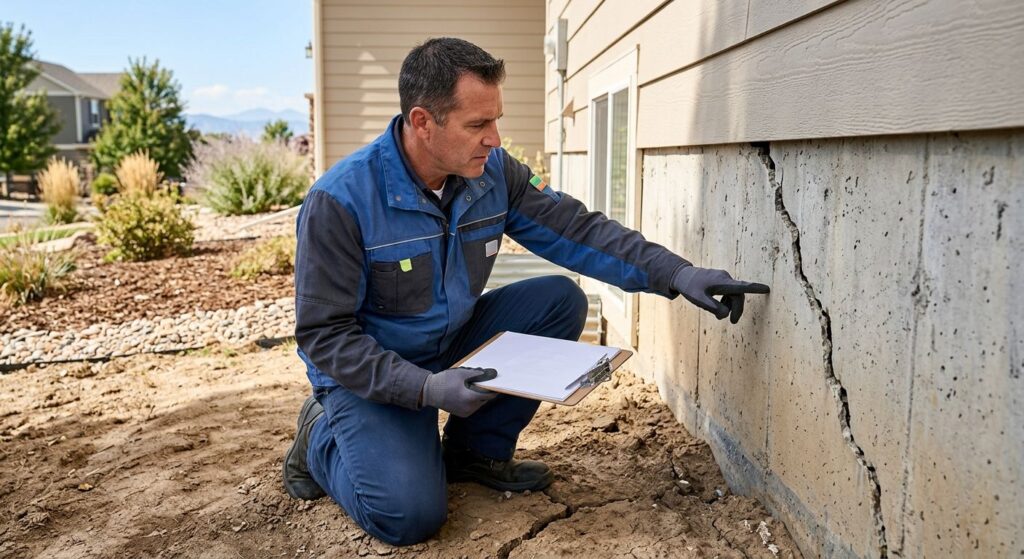
Table of Contents
Foundation Crack Repair: Quick Answers for Denver Homeowners
Foundation crack repair in the Denver Front Range always begins with an on-site engineering inspection to identify the cause and appropriate solution, because costs and methods depend on crack type and soil conditions. Denver’s expansive clay soils undergo significant seasonal movement, often causing foundation cracks that demand professional evaluation. Our team, family-owned since 1996, uses structural epoxy injection to restore concrete strength and helical piers for stabilization, but the right method depends on what the inspection reveals. Recognizing early warning signs of foundation cracks is the next logical step for homeowners who want to protect their property.
Key Takeaways
- According to Rocky Mountain Steel Piering, Inc., in the Denver region, expansive clay soils that swell up to 10% in volume when wet are the main cause of foundation cracks in homes.
- Accurate assessment of foundation crack repair along the Denver Front Range begins with a thorough evaluation of the crack by one of our trained, certified staff.
- In repairing a crack in a Denver-area home, the method chosen will depend on the crack’s characteristics and the homeowner’s main objective, that is, to either stop a water leak or restore structural integrity.
- Selecting an effective repair strategy for basement cracks begins with understanding the unique soil conditions beneath Denver-area homes.
- Foundation crack repair costs in the Denver Front Range depend on local geology and regulatory requirements.
Recognizing Foundation Crack Warning Signs
According to Rocky Mountain Steel Piering, Inc., in the Denver region, expansive clay soils that swell up to 10% in volume when wet are the main cause of foundation cracks in homes. Some signs of foundation problems are sticky doors and windows, uneven floors and cracks in walls. Early recognition of these signs allows less invasive repairs, such as epoxy injections, while ignored cracks can progress to requiring helical pier installation. If these cracks are ignored, foundation problems can get worse and lead to a loss in the value of your home. Our recommendation is to have your home evaluated at the first sign of these problems. Our trained and certified installers can evaluate your home before minor cracks become a major structural problem.
Our Foundation Crack Repair Process
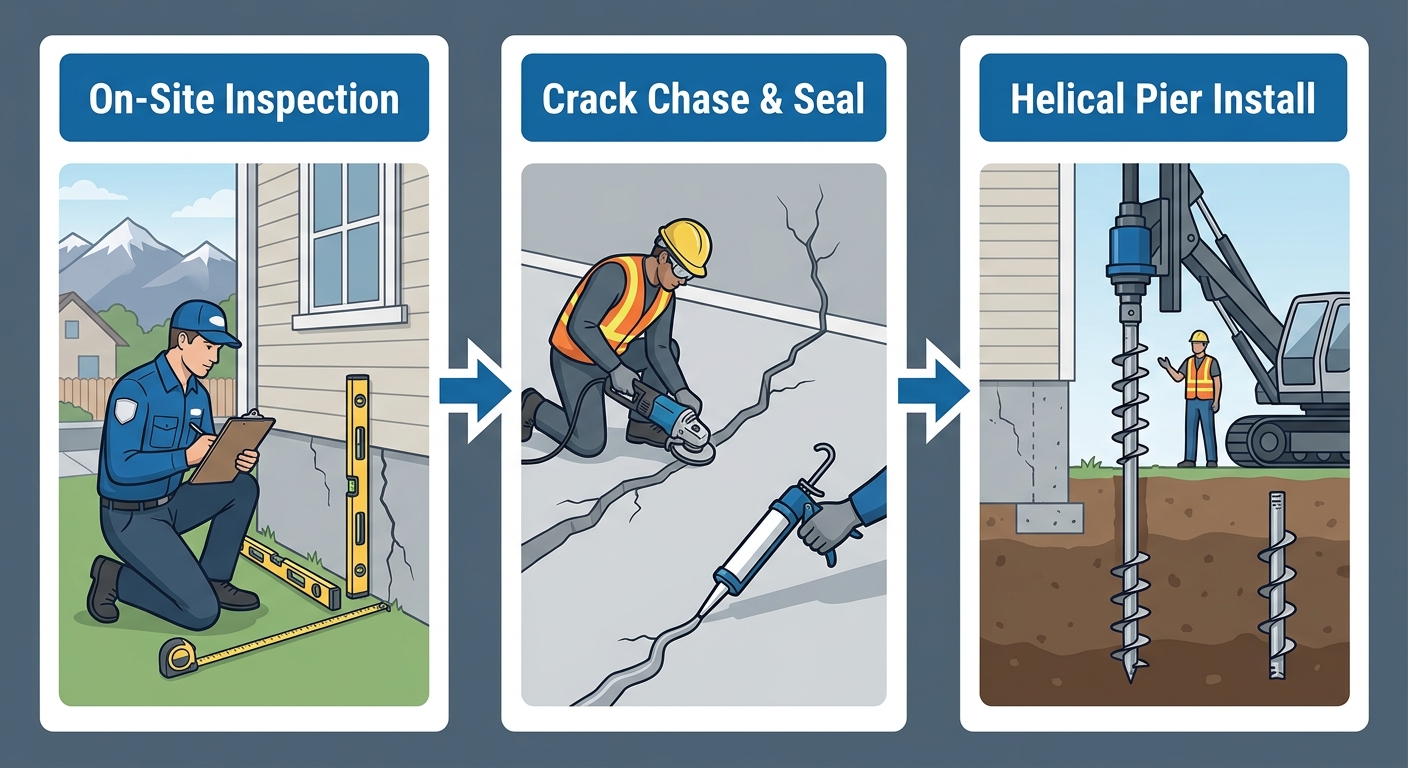
Accurate assessment of foundation crack repair along the Denver Front Range begins with a thorough evaluation of the crack by one of our trained, certified staff. Non-structural cracks can usually be repaired by mechanically chasing the crack open and filling it with a high-performance, flexible sealant that withstands Colorado’s freeze-thaw cycles to block water intrusion. Helical steel piers are installed to depths in the average range of 17 feet, and a reinforced concrete wall is attached to the foundation using steel C-Channels to stabilize the structure. If the crack does not show signs of instability, then flexible high performance sealants may be the correct repair method to use. Keep in mind the following factors to help you decide which repair method fits your situation.
Deciding on the Right Crack Repair Solution
In repairing a crack in a Denver-area home, the method chosen will depend on the crack’s characteristics and the homeowner’s main objective, that is, to either stop a water leak or restore structural integrity.
Epoxy injection restores concrete’s original structural bond and load-bearing strength, making it suitable for cracks that affect a foundation’s stability. Polyurethane foam is intended primarily to seal active leaks and does not provide structural repair.
The use of do-it-yourself crack repair kits is discouraged because they lack specialized injection tools and access to professional expertise. Every job begins with an on-site evaluation to measure crack dimensions, assess accessibility, and confirm the repair objective. These allow us to provide a binding proposal.
Depending on the soil composition and moisture patterns along the front range, one solution may be more effective than the other.
Denver Front Range Soil and Local Building Factors
Selecting an effective repair strategy for basement cracks begins with understanding the unique soil conditions beneath Denver-area homes. The Front Range is underlain by expansive bentonite clay derived from Cretaceous Pierre Shale, which can swell by 4 to 8 percent between dry and saturated states. The U.S. Geological Survey classifies the Denver metropolitan area as a moderate-to-high hazard zone for expansive soils.
Proper foundation grading requires at least 6 inches of downward slope over the first 10 feet. Compromised drainage allows irrigation and downspout water to saturate the clay, triggering perimeter heave that often appears as foundation cracks in Denver basements. Unpermitted structural repairs further complicate matters; undocumented foundation work can jeopardize financing and resale value in Colorado real estate transactions.
At a Greenwood Village project, we installed helical steel piles to an average depth of 17 feet, penetrating beyond the active clay to provide enduring stability.
Understanding Foundation Crack Repair Costs
Foundation crack repair costs in the Denver Front Range depend on local geology and regulatory requirements. Expansive clay and bentonite soils drive deeper stabilization needs, influencing expense. Colorado typically requires structural engineering plans and municipal permits, adding to costs. When helical piers are used, the depth required to reach stable soil, over 50 feet, affects per-pier investment, and installation specifications are evaluated under ICC-ES AC358 criteria. We provide lender-ready documentation, though standard insurance policies rarely cover settlement-related repairs. Because site conditions vary widely, accurate pricing requires an on-site evaluation by a professional. After cost factors are understood, attention turns to how long the repair process takes.
Typical Foundation Crack Repair Timeline
In the Denver Front Range, repairing cracks in foundations can take anywhere from a single day for quick sealing to multiple days for structural repairs such as helical piers and sister walls. Our Greenwood Village project took a few days, as it required the installation of helical piers and sister walls. There are many factors that influence repair timelines, and the conditions of the soil and Colorado’s freeze-thaw climate are at the forefront. We will need to do a site evaluation for each individual project to create an accurate schedule, and provide a warranty for our work.
Warranty and Long-Term Assurance
Timely repairs establish long-term stability, supported by our engineered, tested helical piers with immediate loading. No absolute guarantee applies; outcomes vary by site, and estimates are preliminary. Warranty questions arise naturally, which we address during a site visit.
Common Questions About Foundation Cracks
What happens if I ignore foundation cracks? Ignoring foundation cracks may allow water to penetrate through the cracks and lead to failure of the entire structure as the expansive clay soil continues to move and put pressure on walls.
Why are foundation repairs in Denver more expensive than elsewhere? Repair costs in Denver are higher since expansive clay soil requires more sophisticated deep foundation systems like helical piers.
How are foundation cracks typically repaired in the Denver Front Range? We installed helical steel piles to an average of 17 feet and a reinforced concrete sister wall tied to counterfort walls to resist lateral movements and stabilize the foundation of a residence in Greenwood Village.
Start Your Foundation Crack Repair Today
Family-owned since 1996, Rocky Mountain Steel Piering brings expertise to foundation crack repair in Littleton, Denver, Greenwood Village, Centennial, Douglas County. Start your foundation crack repair in Denver and the Front Range, call +1 303-471-1155 or visit rmssco.com. Information on this site is general and may change; estimates are preliminary, subject to on-site inspection, and we cannot guarantee specific outcomes. For a definitive diagnosis, consult a licensed structural engineer. By contacting us, you consent to our Privacy Policy and communications.