
Foundation Repair Cost Per Pier in Littleton: 2026 Comparison Guide
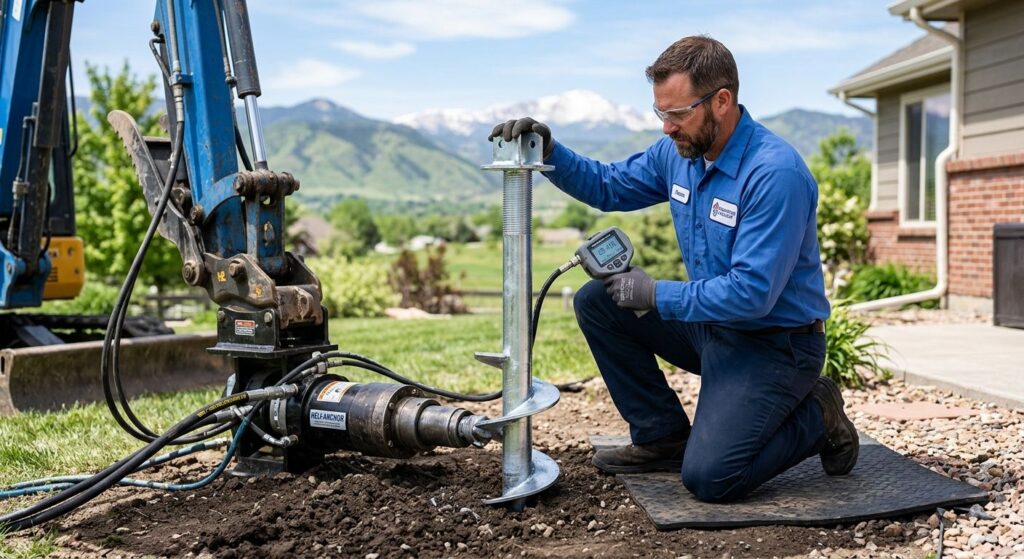
Table of Contents
- Understanding Foundation Repair Cost Per Pier
- Helical Piers vs. Push Piers: Core Cost Comparisons
- Key Factors That Influence Piering Costs in Colorado
- Evaluating Quotes for Foundation Pier Installation
- Long-Term Value of Steel Pier Foundation Repair
- Frequently Asked Questions About Foundation Piering Costs
- Secure Your Home’s Foundation with Expert Pier Installation
Understanding Foundation Repair Cost Per Pier
Foundation repair cost per pier is not a one-size-fits-all figure — it depends entirely on unique site conditions. At Rocky Mountain Steel Piering, Inc., we determine pricing only after a thorough geotechnical evaluation of your property. We base recommendations on site-specific data and engineered design criteria.
Several variables influence your final quote. Helical pier installation cost often varies with soil friction and torque requirements, while the steel push pier cost depends on end bearing capacity and driving depth. Soil bearing capacity, pier depth, and equipment accessibility also play critical roles. Even neighboring properties can have vastly different subsurface profiles, making each project distinct. Factors such as existing foundation condition and nearby utilities also influence the installation approach.
As The Experts in Steel Piers, we rely on foundation repair engineering resources from the authoritative American Society of Civil Engineers (ASCE) to guide our designs. This rigorous approach ensures your foundation repair cost per pier aligns with actual structural demands, not generic estimates. A final quote requires an on-site inspection to verify soil conditions and depth requirements. We review options with you. Understanding these cost factors helps explain why a custom quote is essential — which we walk through next in our inspection process.
Helical Piers vs. Push Piers: Core Cost Comparisons
When evaluating foundation repair cost per pier in the Front Range, the choice between helical and push pier systems is often the primary factor influencing your project budget. At Rocky Mountain Steel Piering, Inc., we find that while both solutions effectively stabilize structures, their distinct installation methods directly shape the total expense. The key lies in understanding how labor, materials, and on-site conditions drive the cost differences between these two proven technologies.
Helical piers are typically screwed into the soil using hydraulic rotary equipment, a process that minimizes excavation and eliminates the need for concrete curing time. This allows for immediate loading after installation, which means our team can often move directly to the next phase of work without the expense of temporary shoring. The reduced labor hours and faster project timelines make helical pier installation cost a more predictable and often more economical variable in your repair budget. In many residential applications, this translates directly to a lower total installed cost.
Push piers, in contrast, are hydraulically driven into the ground until they reach competent load-bearing strata. This method typically requires more extensive excavation, heavier equipment, and the placement of concrete footings that must cure before loading. These additional steps contribute to a higher labor component and extended project duration, which are primary reasons steel push pier cost often trends upward in competitive bids. For sites where deep bearing layers are present, however, push piers remain a necessary and effective solution, and their cost is highly dependent on the specific soil profile encountered.
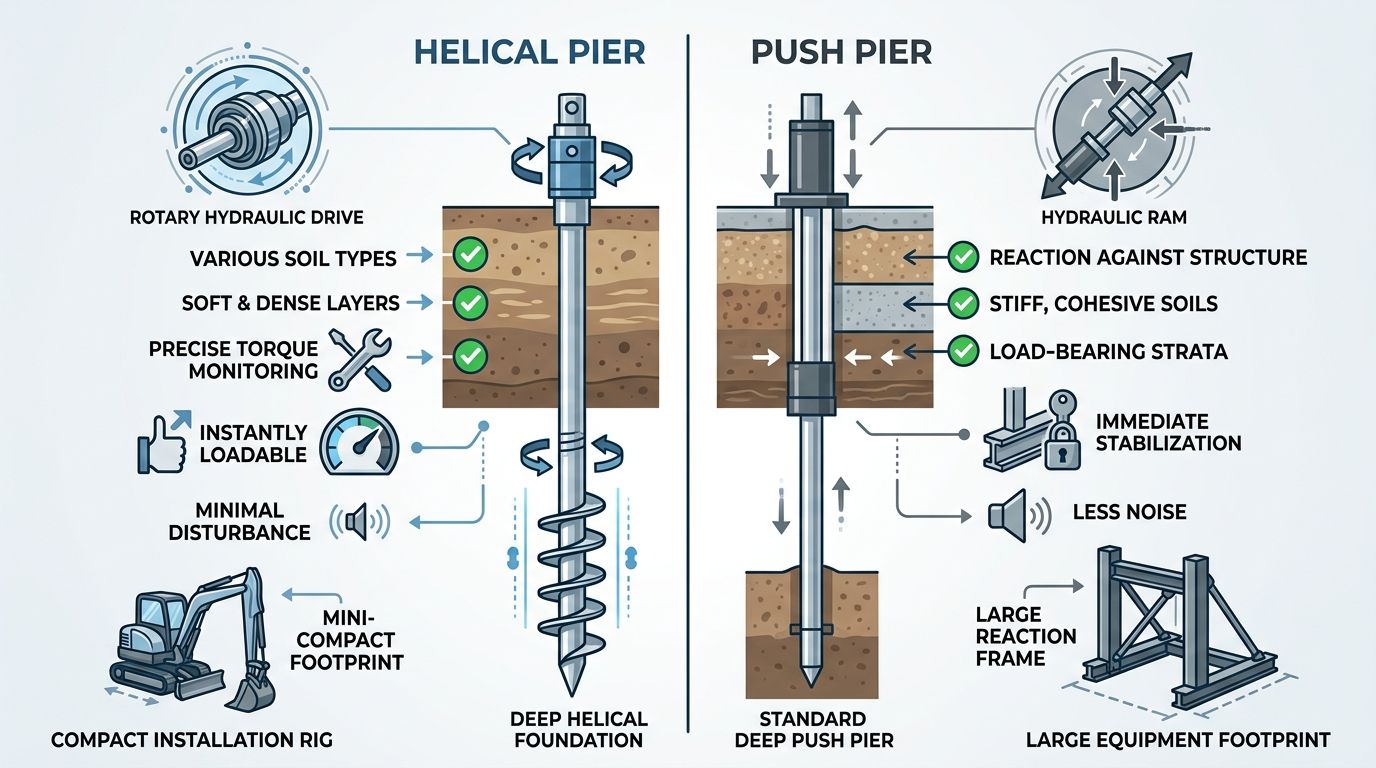
Helical piers vs push piers cost and performance comparison
Both helical and push pier installations must comply with rigorous ASTM foundation standards to ensure structural integrity and long-term performance. These industry-wide benchmarks govern material specifications, load testing procedures, and installation quality. According to ASTM International, adherence to these universally recognized standards confirms that the pier systems meet strict safety and durability requirements. While this compliance can slightly influence material costs, it is a non-negotiable element of a quality repair that protects your investment and eliminates the risk of substandard work.
Cost is only one piece of the puzzle. Our experience as a family-owned and operated business since 1996 has shown that soil conditions remain the most critical variable in selecting the right pier type. As we have seen, each system has distinct installation processes that directly affect project costs. Next, we examine how specific geotechnical factors determine the best pier choice and ensure a stable, lasting solution for your foundation.
Key Factors That Influence Piering Costs in Colorado
When homeowners search for “foundation repair cost per pier,” they quickly learn that no single price fits every project. Our team at Rocky Mountain Steel Piering, Inc. — family-owned and operated since 1996 — has seen how Colorado’s unique conditions make every job different. Understanding the key drivers behind piering costs helps you prepare for a professional inspection and custom quote.
Soil Conditions and Their Effect on Installation Costs
Colorado’s geology varies dramatically from expansive clay soils in the Denver basin to sandy loam along the Front Range and shale bedrock in the mountains. Each soil type interacts differently with pier systems, directly affecting installation method and overall expense. The helical pier installation cost in Colorado is closely tied to soil bearing capacity — soils that are loose or prone to movement require a system that can anchor securely without relying solely on end-bearing resistance.
Helical piers, with their screw-shaped bearing plates, excel in these conditions because they cut through disturbed or shifting soils and reach load-bearing strata with minimal vibration and immediate capacity. In contrast, push piers rely on driving steel into dense, stable ground; in loose fills or expansive clays they may not achieve reliable capacity without deeper driving or supplementary measures, which can increase labor and material requirements. Because we at Rocky Mountain Steel Piering have installed screw piles across the region for nearly three decades, we know firsthand that soil evaluation is the first step in providing an accurate quotation.
Depth and Engineering Requirements
The required pier depth is determined by a licensed structural engineer using soil borings and geotechnical data, taking into account design loads and local frost depth. Colorado’s frost line typically reaches 3 to 4 feet, but the real bearing strata often lie much deeper. Helical piers can be extended to depths of 10 to over 40 feet, while push piers generally install between 10 and 30+ feet, limited by the resistance of the surrounding soil. For steel push pier cost in Colorado, depth becomes a critical variable because deeper installations demand more steel tube sections and longer hydraulic push time, raising both material and labor expense.
Industry standards set by the National Society of Professional Engineers guide our design approach — for authoritative engineering guidelines, consult NSPE foundation engineering resources. Every project requires a stamped engineer’s plan, which adds a modest design fee but ensures the pier system matches the actual subsurface conditions. At Rocky Mountain Steel Piering, we have found that investing in thorough engineering early prevents future problems and keeps the overall foundation repair predictable.
Logistics, Accessibility, and Permitting
Site accessibility can significantly influence the final installation cost. Tight residential backyards, steep slopes, or limited overhead clearance may require compact equipment or even hand-installation techniques, increasing labor hours. Colorado municipalities such as Denver, Colorado Springs, and Boulder typically require a building permit and a stamped engineer’s plan for pier systems. Based on our own decades of local experience, the permitting process adds 1 to 3 weeks and fees that generally range from $200 to $600. As an internally developed reference, our own RMSSCO FAQ reinforces that permitting complexity is greater for push piers, which often need structural engineer approval with longer lead times, while helical piers usually involve a simpler, optional engineering review. Because we handle the permit coordination in-house, we help our clients navigate these requirements smoothly, but it’s important to budget for the associated time and fees.
The following table summarizes how key factors differ between helical and push piers in Colorado.
| Factor | Helical Piers | Push Piers |
|---|---|---|
| Soil type sensitivity | Works well in loose or shifting soils; faster installation | Requires stable, dense soil; may struggle in loose fills |
| Installation depth range | 10–40+ feet, adjustable with extensions | 10–30+ feet, limited by soil resistance |
| Equipment requirements | Rotary drive head on mini-excavator; lower vibration | Hydraulic rams with reaction weight; more site disruption |
| Permitting complexity | Usually straightforward; optional engineering review | Often requires structural engineer approval; longer lead time |
Understanding these cost drivers helps set realistic expectations, but every foundation is unique. Actual outcomes depend on site conditions and inspections. For a precise, written quotation on your Colorado property, contact our team — The Experts in Steel Piers since 1996 — to schedule an evaluation.
Evaluating Quotes for Foundation Pier Installation
Once you understand the type of pier your home needs, the next step is carefully evaluating quotes from different providers. Many homeowners begin their research by searching for foundation repair cost per pier, but a responsible decision requires looking beyond a single number. As a family-owned and operated since 1996 company serving homeowners across the Front Range, we have seen how site-specific conditions, material quality, and warranty terms separate a lasting repair from a short-term fix. This section explains what to look for when comparing proposals so you can invest confidently in your home’s structural future.
The Value of an On-Site Investigation
An accurate estimate for helical pier installation cost or steel push pier cost cannot be determined from a phone call or aerial photograph. Soil composition varies dramatically across neighborhoods in Littleton and throughout the Denver metro area, where expansive clay soils are notorious for causing foundation movement. Access constraints, existing landscaping, buried utilities, and the actual load requirements of your structure all influence how many piers are needed and how deep they must be driven to reach competent bearing strata.
Remote quotes that skip this critical step often rely on worst-case assumptions — or worse, best-case scenarios that lead to change orders mid-project. We provide fixed quotes only after completing a thorough on-site investigation, during which our team evaluates soil conditions, measures foundation displacement, and identifies any obstructions that could affect installation. This hands-on approach allows us to calculate the precise number of helical piers required and confirm the installation depth needed to transfer structural loads below the active soil zone. Without this level of detail, any estimate remains preliminary and subject to revision once real conditions are exposed.
According to our internal inspection process, factors such as the presence of sandy loam or mixed gravel lenses can significantly alter pier specifications and the overall helical pier installation cost. Homeowners who receive multiple proposals should ask each provider whether their estimate is based on an actual site visit or generalized assumptions. The difference in accuracy is often measured in thousands of dollars — and in the long-term performance of the repair.
Comparing Proposals: What Matters Most
When reviewing proposals, the foundation repair cost per pier is only one piece of the puzzle. A lower per-pier price may reflect thinner steel, inferior corrosion protection, or a warranty that excludes labor and transferability. We encourage homeowners to evaluate four factors side by side: the type of pier being specified, the warranty duration and scope, the material certifications backing the product, and the installation methodology.
Warranty terms deserve particularly close scrutiny. Some national firms advertise lengthy warranties but exclude labor costs after the first year or void coverage if the home is sold. Our warranties extend 25 years and beyond, backed by a company that has been serving Colorado families for nearly three decades. When you compare proposals, ask each contractor to clarify what is covered, for how long, and whether the warranty transfers to a new owner. These details directly affect the long-term value of your investment.
Beyond the initial quote, consider other services such as crawl space encapsulation cost, which may be bundled with foundation repair to address moisture issues that contributed to soil movement in the first place. A comprehensive approach often delivers better outcomes than treating foundation settlement in isolation. As you weigh your options, remember that the lowest bid rarely reflects the lowest total cost of ownership when factoring in durability, warranty protection, and the likelihood of future repairs.
Why Material Standards Matter
The steel that holds up your home must resist corrosion for decades while buried in potentially aggressive soils. This is why we specify ASTM-compliant materials and subject every pier component to hot-dip galvanizing — a process that bonds a thick zinc layer to the steel surface, providing sacrificial protection against rust. Piers fabricated without these standards may initially appear cost-competitive, but corrosion can compromise structural integrity years before the warranty expires.
The Experts in Steel Piers understand that material specifications are not interchangeable. ASTM certification ensures that the steel meets minimum yield strength, elongation, and dimensional tolerance requirements verified by independent testing. Combined with hot-dip galvanizing performed to ASTM A153 or A123 standards, the resulting helical pier system delivers predictable load capacities and corrosion resistance that cheaper alternatives cannot match. When a contractor cannot produce mill certifications or galvanizing compliance documentation, the long-term reliability of their installation remains an open question.
The table below compares typical cost estimates from different provider types.
| Provider | Pier Type | Estimated Cost per Pier | Warranty | Standards Used |
|---|---|---|---|---|
| National Firm | Typically push piers | $$$ – $1,200–$1,800+ | Limited; often excludes labor | Varies; may not specify |
| Local Contractor | Often helical piers | $$ – $1,000–$1,500 | Typically 25-year / 30-year | May not provide ASTM certification |
| Rocky Mountain Steel Piering | Helical piers (hot-dip galvanized) | Competitive fixed quotes after on-site inspection | 25+ years; backed by family-owned company | ASTM-standard certified, hot-dip galvanized |
These ranges are illustrative and reflect general market observations rather than binding prices. Actual costs depend entirely on the site conditions identified during an on-site investigation. The key takeaway is that providers who invest in certified materials and thorough inspections tend to deliver proposals that hold up over time — both structurally and financially.
Before deciding, consider whether the provider’s process includes a licensed structural engineer’s assessment. While we coordinate with engineering professionals to ensure every installation meets load requirements, we always recommend that homeowners consult a licensed structural engineer for definitive foundation diagnoses. For projects beyond foundation repair — such as a master bath remodel in Highland Ranch — our team provides the same commitment to quality and transparency that has defined our work since 1996.
Long-Term Value of Steel Pier Foundation Repair
Beyond the initial investment, the true value of steel pier foundation repair becomes clear over time. While the foundation repair cost per pier is a common starting point, the real measure is the decades of stability and savings that a properly installed steel pier system delivers.
Steel piers permanently transfer a structure’s load to stable, load-bearing soil. As we detail in our own technical resources, helical piers provide a permanent fix that typically lasts the life of the building—eliminating the cycle of recurring crack repairs and slab leveling that temporary solutions generate. For commercial property owners considering the helical pier installation cost in their area, it’s helpful to weigh that single expense against a future without repeated foundation work.
The financial benefits extend to property value. Our internal customer-evidence data shows that a stabilized foundation can significantly enhance resale value and marketability. When you evaluate the steel push pier cost for commercial projects, the lifetime savings from avoided repairs quickly outpace the initial outlay. With a custom-quote approach, you pay only for what your site actually requires—no inflated estimates, no unnecessary work.
To protect that investment, we recommend proper yard drainage to direct water away from the foundation, preventing soil movement that could compromise the repair. This simple addition helps ensure your steel pier system delivers its full, multi-decade value. Regular inspections and routine maintenance checks further protect that investment over time and preserve structural integrity consistently.
In the end, a modest upfront custom quote delivers decades of zero-maintenance stability—peace of mind that’s hard to match. That long-term confidence is why we stand behind our work, and why property owners across the Front Range trust us to solve their foundation challenges once and for all.
Frequently Asked Questions About Foundation Piering Costs
Below are answers to common questions about foundation piering costs.
How much does foundation repair cost per pier?
The foundation repair cost per pier in your area varies with site conditions. As RMSSCO’s FAQ notes, no fixed per-pier price exists; we provide custom quotes after an on-site inspection.
What factors affect helical pier installation cost?
Helical pier installation cost depends on pier quantity, engineering requirements, and local codes. Site access and soil conditions also influence pricing. Our team assesses these variables during a custom evaluation.
Is there a standard price for steel push piers?
Steel push pier cost varies similarly; no standard price applies. Each project is unique, requiring our inspection for an accurate estimate. All estimates are preliminary until confirmed in writing after inspection.
For a precise estimate tailored to your project, contact The Experts in Steel Piers, family-owned and operated since 1996.
Secure Your Home’s Foundation with Expert Pier Installation
When foundation settlement threatens your home’s structural integrity, professional pier installation is not an area to trust to general contractors. We are The Experts in Steel Piers, family-owned and operated since 1996 with an A+ BBB accreditation, delivering superior performance in installation of helix pier systems. Our trained, certified installers evaluate site-specific soil conditions to ensure predictable load capacities, minimal site impact, and immediate loading with no concrete cure time required. This expert approach helps prevent yard drainage problems that often accompany foundation movement. Helical piers can be installed up to 66% faster in poor soils compared to concrete alternatives, reducing disruption to your property. For foundation repair cost per pier in your area, our custom on-site assessments account for your unique conditions—just as helical pier installation cost depends on soil and depth requirements, and steel push pier cost varies by project scope. We never present generic pricing because every foundation deserves a tailored solution. Ready to start your construction project? In the next section we explain the helix pier systems we install and why they outperform traditional methods.
Resources
- Improve Home Energy Efficiency with Crawl Space Encapsulation
- Get Expert Foundation Stabilization Services in Denver
- Protect Your Foundation with Proper Yard Drainage
- Choose the Right Crawl Space Vapor Barrier Thickness
- Find a Qualified Structural Engineer in Denver
- Compare Foundation Settlement and Heaving Repair Methods
- Resolve Contractor Disputes with Expert Foundation Guidance
- Explore ASCE Resources for Civil Engineering Professionals
- Access ASTM International Standards for Engineering Compliance
- Discover NSPE Resources for Professional Engineers