
Foundation Settlement vs Heaving: Key Differences Explained
Table of Contents
Foundation Settlement vs Heaving: Understanding Ground Movement
Understanding the difference between foundation settlement vs heaving is the first step in diagnosing structural issues. Settlement occurs when the soil beneath a foundation compresses or consolidates, causing the structure to sink downward. Heaving, by contrast, is the upward movement of a foundation, most often triggered when expansive soils absorb moisture and swell.
Both types of ground movement can produce cracks in walls, sticking doors, and uneven floors, but their underlying causes are distinct. Homeowners in Denver experiencing foundation settlement or heaving should consult a professional. For more information on pricing, see our guide to foundation repair cost in Denver.
According to the International Concrete Repair Institute, proper diagnosis is critical because the repair strategy for settlement differs fundamentally from the strategy for heaving. In the following sections, we will explore each condition in detail, helping you understand how we assess and correct these ground movement challenges.
1. Foundation Settlement Explained
To understand foundation settlement vs heaving, it helps to first define each. Foundation settlement is the downward movement of a building’s foundation into the soil beneath it. We see this condition across residential and commercial structures throughout Colorado, and it often stems from three common causes: poor soil compaction during original construction, expansive clay soils that shrink and swell with moisture changes, and significant fluctuations in water content caused by drought or excessive rain.
Visible signs of settlement include cracks in interior and exterior walls, uneven or sloping floors, and doors or windows that begin to stick or develop gaps around their frames. When movement is even across the entire footprint the structure may remain largely undamaged, a condition known as uniform settlement. Differential settlement, however, occurs when one section drops more than another, concentrating stress and often leading to more serious structural damage.
In contrast to settlement, which is downward foundation movement, heaving pushes the foundation upward—typically driven by expansive soils absorbing water. When settlement requires intervention, homeowners may need to compare options such as push piers vs helical piers. We will explore heaving and its unique challenges in the next section. For a definitive diagnosis of foundation movement, consult a licensed structural engineer.
2. Foundation Heaving Explained
While settlement involves downward movement, heaving is its upward counterpart. Understanding foundation settlement vs heaving is critical for proper diagnosis. Foundation heaving is the upward displacement of a slab or footing caused by soil expansion beneath the structure, a phenomenon distinct from settlement, which occurs when soil compresses and the foundation sinks.
We see heaving most often in regions with expansive clay soils. These soils swell when they absorb moisture from rainfall, snowmelt, or plumbing leaks and shrink during dry periods. This cycle of expansion and contraction creates significant vertical pressure that can lift foundation elements unevenly, resulting in cracked slabs, misaligned doors and windows, and structural distress.
The primary driver of this movement is expansive clay, and its behavior is well-documented in industry standards from ASTM International, which classify these soils and outline testing methods to evaluate swell potential. When we discuss expansive clay foundation heaving, we are referring to a geotechnical condition that demands careful assessment. The mechanics are straightforward: increased soil volume pushes upward, whereas settlement results from soil compression pulling the structure downward.
Once heaving is identified, stabilizing the soil and foundation becomes the focus. Helical piers are one effective solution we tailor to site conditions, but accurate diagnosis by a licensed structural engineer or foundation specialist is essential to determine the right repair strategy.
Consult a licensed structural engineer for a definitive assessment.
3. Visual Signs of Settlement vs Heaving
When comparing foundation settlement vs heaving, the visual clues each condition leaves behind are distinct yet sometimes overlapping. These conditions manifest in different crack patterns, floor movements, and door or window behaviors. Recognizing the signs of foundation movement helps homeowners understand what they are seeing before a professional arrives.
Settlement indicators include diagonal or stair-step cracks in brick and masonry, which are often wider at the top. Floors may slope noticeably toward the center of the home or a specific corner, and doors or windows can begin to stick or sag as frames shift out of square.
Heaving indicators, by contrast, typically appear as horizontal or vertical cracks in concrete floors. Walls may bulge or bow inward, and slab sections can lift, creating upward displacement. Doors often jam at the top rather than sagging, and cracks may be wider at the bottom — the reverse of the settlement pattern.
According to the International Concrete Repair Institute’s article on foundation performance and distress, stair-step cracks and horizontal breaks follow predictable patterns tied to the direction of soil movement. Interior drywall cracks, however, can appear in both settlement and heaving scenarios, so a visual assessment alone is not definitive.
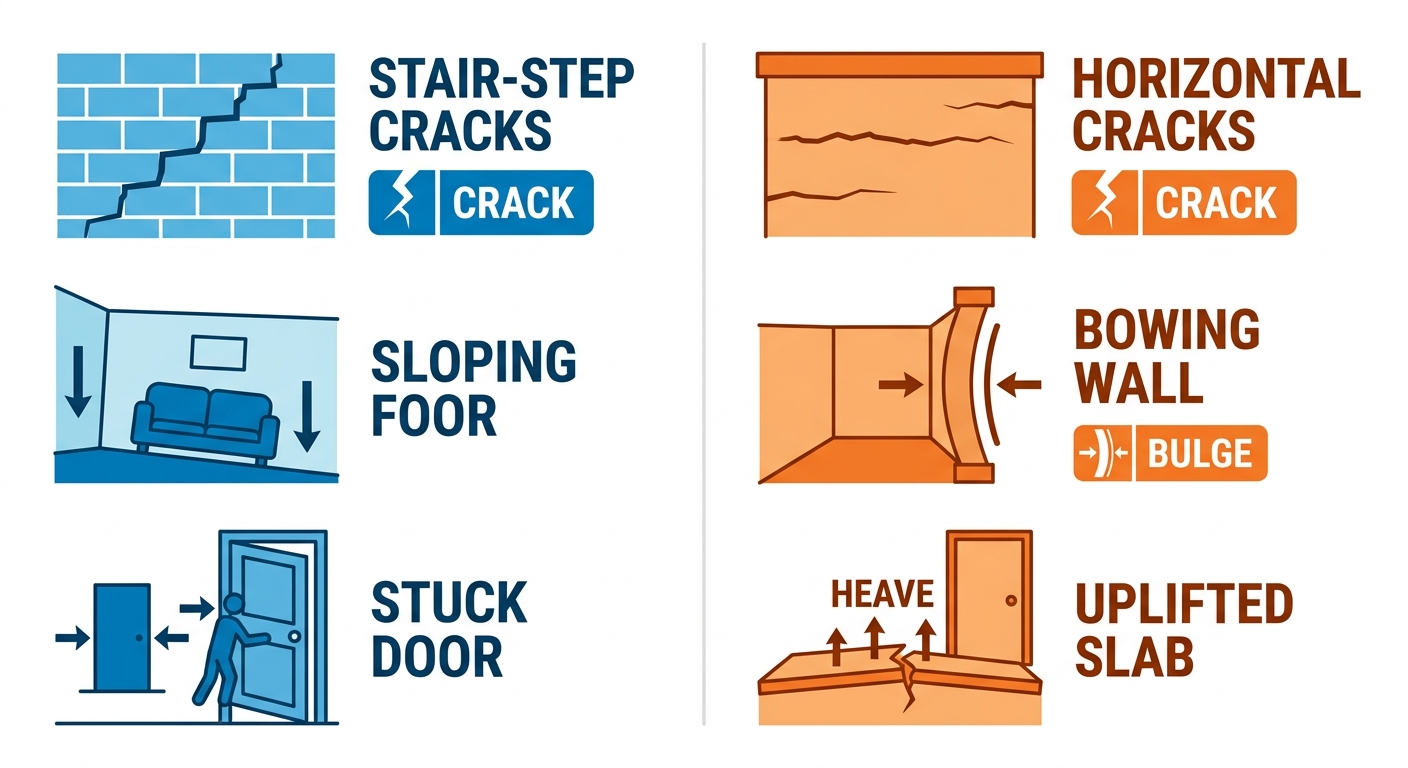
Visual comparison of settlement and heaving signs for homeowners.
Because these signs overlap, we at Rocky Mountain Steel Piering, Inc. recommend having any concerning crack patterns or floor movements evaluated by an experienced foundation specialist. A professional inspection can confirm which movement pattern is present and determine the appropriate repair approach. Consult a licensed structural engineer or qualified professional for a definitive diagnosis and repair recommendations.
4. Expansive Clay: The Front Range Factor
But in Colorado’s Front Range, a different force is at work: expansive clay. Understanding the difference between foundation settlement vs heaving is essential for diagnosing structural movement in our region. While settlement occurs when soil consolidates and sinks under weight, heaving is the upward movement caused by swelling clay beneath a foundation.
Our local geology contains extensive deposits of highly expansive clay, including Denver Blue Shale. According to ASTM International, these expansive soils are classified by their swelling potential and capacity for volume change. When moisture infiltrates the clay, it expands with tremendous force that pushes slabs and footings upward. During our semi-arid summers the clay then dehydrates and shrinks, creating a cyclical movement pattern that relentlessly stresses foundations year after year.
Expansive clay can also cause uplift in decorative flatwork such as stamped concrete in Denver, Colorado, where seasonal moisture swings are especially pronounced. Addressing heaving typically requires deep foundation systems that extend below the active clay zone to reach stable soil — a topic we cover next. The Experts in Steel Piers, we have seen firsthand how helical piers restore lasting stability to Front Range homes.
5. Diagnosing Movement: Sinking or Rising?
Identifying the type of movement is equally important. In foundation settlement vs heaving, distinct visual clues reveal whether a structure is sinking or being pushed upward. Recognizing these signs helps determine the next steps.
When settlement is the dominant force, we can observe vertical gaps opening at the top corners of doors and windows. This creates diagonal cracks that are noticeably wider at the bottom than the top. Gaps may also appear at the bottom of exterior siding as the structure pulls away. Settlement often results in floors that slope downward toward the center or perimeter of the home.
In contrast, heaving causes cracks that are wider at the top and can create floors that slope or bulge upward. According to the International Concrete Repair Institute (ICRI), soil or concrete buildup around the base of a foundation is a strong visual indicator of heaving. Walls may also bow inward as expansive soils press against them. It is important to remember that settlement and heaving can occur on the same foundation. As The Experts in Steel Piers, we recommend consulting a licensed structural engineer for a definitive diagnosis. Once the type of movement is determined, targeted repair options can be explored — presented in the next section.
6. Repair Methods for Foundation Settlement
Understanding the difference between foundation settlement vs heaving is key to choosing the right repair method. Settlement involves downward movement of a structure, typically requiring underpinning systems like steel piers to transfer loads to stable strata. Heaving, by contrast, results from soil expansion and demands different mitigation approaches. Once settlement is diagnosed, the appropriate repair method depends on soil conditions and structural needs.
Push piers are steel piers hydraulically driven to load-bearing strata beneath a foundation. These systems provide immediate load transfer and may be suitable for heavier commercial structures where stable soils can support high compression loads. Helical piers, by comparison, are screwed into the ground using hydraulic torque, allowing for faster installation with minimal site disruption. As The Experts in Steel Piers, we specialize in helix pier systems, which often prove effective in Colorado’s expansive clay soils.
For interior slab settlement where access is limited, floor stabilizer post kits offer an adjustable steel support solution. These posts create an alternative load path from a deflecting beam down to a solid bearing surface, with installation typically completed within 30 to 60 minutes per post. This method addresses sagging floors by bypassing compromised original elements.
After repairs, ongoing monitoring ensures long-term stability. All methods require a professional, on-site inspection to determine the most effective solution. Consult a licensed structural engineer for definitive diagnosis and design recommendations.
7. Repair Methods for Foundation Heaving
Understanding the difference between foundation settlement vs heaving is critical for selecting an effective repair strategy. While settlement repairs often focus on underpinning, heaving—typically driven by expansive clay soils or frost action—demands moisture control as the first and most important corrective step.
When water accumulates around a foundation, perimeter drainage systems such as French drains and surface grading intercept groundwater before it reaches the footing. According to our own yard drainage resource, a positive slope of at least 5% within 10 feet of the foundation, paired with a properly installed French drain at footing depth, removes the hydrostatic pressure that swells expansive soils. Addressing excess moisture at the source can halt ongoing movement and create stable conditions for any additional structural work.
Once soil moisture is managed, structural stabilization using helical piers or screw piles can lift and support heaved foundation elements. Because site conditions vary widely, The Experts in Steel Piers at Rocky Mountain Steel Piering, Inc. recommend that a licensed structural engineer evaluate the damage and design a repair plan before any method is chosen. In severe cases, removing and replacing the offending expansive soil—with helical pier reinforcement—may be warranted, although specific outcomes should never be granted without a thorough on-site inspection.
8. When Settlement and Heaving Occur Together
While settlement and heaving are often treated as independent problems, they can—and sometimes do—occur together in the same structure. When considering foundation settlement vs heaving, homeowners rarely expect both to affect the same foundation, yet combined movement is possible and creates complex structural challenges.
This co-occurrence of settlement and heave typically arises from differential soil conditions beneath a single foundation. Heaving often develops in areas with expansive clay soils exposed to moisture, while settlement may occur in adjacent zones with poorer soil bearing capacity or improperly compacted fill. According to the International Concrete Repair Institute (ICRI), foundation distress patterns can vary significantly based on soil heterogeneity and moisture distribution. For example, a foundation with one side on expansive soil may experience upward movement while the opposite side on fill material settles downward.
Combined movement can produce diagonal cracking, racking of doors and windows, and structural torsion that is more severe than either condition alone. Distinguishing simultaneous settlement and heave from uniform movement requires expert assessment by a licensed structural engineer. Repairs must address both conditions simultaneously; treating only one mechanism may worsen the other.
The complexity of combined foundation movement demands professional diagnosis. We recommend consulting a licensed structural engineer for definitive evaluation and design recommendations tailored to specific site conditions.
Protecting Your Foundation from Ground Movement
In the end, protecting your foundation from ground movement requires understanding the forces at play and choosing the right solution. The difference between foundation settlement and heaving lies in direction—settlement involves downward movement from soil compaction or moisture loss, while heaving pushes the foundation upward due to expansive soils absorbing water. Both conditions, as identified by the International Concrete Repair Institute (ICRI), can compromise structural integrity if left unaddressed.
Professional intervention through helical pier systems can address both settlement and heaving by transferring structural loads to stable soil strata. Our trained, certified installers at Rocky Mountain Steel Piering, Inc.—family-owned and operated since 1996 with an A+ BBB rating—specialize in helix pier systems and tiebacks that provide immediate loading with minimal site impact. An on-site inspection helps ensure the root cause is properly diagnosed before we design a solution tailored to your property’s specific conditions. Consult a licensed structural engineer for a definitive assessment. To protect your foundation, contact us for a custom quote and inspection.
Resources
- Schedule a Consultation with RMSSCO Construction Services
- Compare Push and Helical Piers for Denver Foundations
- Contact RMSSCO Now to Discuss Construction Services
- Contact RMSSCO for Your Construction Project Needs
- Install Floor Stabilizer Post Kits with This Complete Guide
- Get in Touch with RMSSCO Construction Experts Today
- Learn How to Improve Yard Drainage with French Drains
- Get Access to ICRI Membership and Technical Resources
- Find ASTM International Standards and Membership Info