
Helical Pile Inspection Requirements IBC 2026: Complete Guide
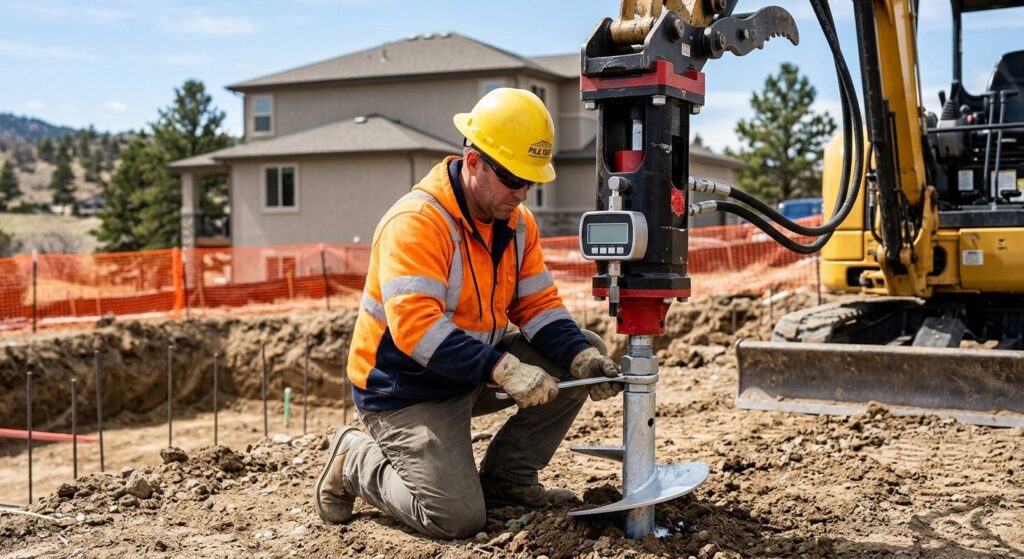
Table of Contents
- Helical Pile Inspection Requirements Under IBC 2026
- IBC 2026 Chapter 18 and Helical Pile Compliance
- Submittal Documentation Essentials for 2026 Helical Pile Projects
- Continuous Special Inspection Protocols for Helical Installations
- Torque-to-Capacity Correlation Ratios and Verification
- Best Practices for Helical Pile Project Documentation and Compliance
- Approaching IBC 2026 Helical Pile Compliance with Confidence
Helical Pile Inspection Requirements Under IBC 2026
Helical pile inspection requirements IBC 2026 establish the standards that govern how deep-foundation systems are verified. Helical piles play a central role in foundation repair and new construction. At Rocky Mountain Steel Piering, we install helical piles for helical pile foundation repair and rely on industry evaluation criteria to ensure every installation meets code. The International Code Council’s AC358 acceptance criteria serve as the benchmark for helical pile inspection, outlining minimum performance and quality control expectations. AC358 provides rigorous third-party validation that helical pile products can perform as intended under IBC 2026 Chapter 18. These criteria are directly referenced by building officials, ensuring that every inspection addresses AC358 benchmarks. By aligning with IBC 2026, we help homeowners and contractors understand the compliance pathway before a project begins. In the following section, "IBC 2026 Chapter 18 and Helical Pile Compliance," we dive deeper into the specific code provisions that shape the inspection process.
IBC 2026 Chapter 18 and Helical Pile Compliance
The inspection requirements for helical piles under IBC 2026 that we explored earlier draw their authority from one well-defined code chapter: Chapter 18, Soils and Foundations. This chapter establishes the geotechnical investigation, foundation design, and on-site verification framework that any deep foundation system—including helical piles—must satisfy for code compliance. Understanding the scope of IBC 2026 Chapter 18 helps property owners in Littleton, in Denver, in Douglas County, in Greenwood Village, and in Centennial appreciate what goes into a compliant helical pier installation.
Chapter 18 requires that structures be supported on foundations designed for the expected subsurface conditions. For helical piles, a site-specific geotechnical report typically identifies the soil layers, bearing capacities, and depth to competent strata that govern pile selection. The helical pile design then translates those values into an installation plan with target torque, depth, and load capacity. IBC 2026 also requires continuous special inspection protocols to verify helical pile installation, ensuring torque readings and penetration depth are monitored throughout the process. RMSSCO’s trained, certified installers follow these protocols on every project, recording installation data that links each pile’s behavior to the geotechnical expectations.
We gather torque logs, depth penetration records, and load verification during installation across all our service areas—from foundations in Littleton to commercial projects in Denver, and residential repairs in Douglas County, in Greenwood Village, and in Centennial. This on-site documentation demonstrates that the installed helical piles meet the code’s prescriptive and performance provisions, without guaranteeing specific outcomes beyond what the code prescribes as acceptable. Compliance evidence is compelling because it shows the foundation was installed in accordance with a recognized standard, not because it eliminates all risk.
The data we collect during installation—torque readings, depth logs, and load verification—becomes the core of the submittal documentation that is the subject of the next section. Every compliance touchpoint recorded at this stage feeds directly into the paperwork that owners and building officials rely on to confirm that a helical pile foundation aligns with IBC 2026 Chapter 18. Ready to start your construction project? Contact us for a project-specific compliance quote, and we’ll carry that documentation forward into the complete submittal package we detail next.
Submittal Documentation Essentials for 2026 Helical Pile Projects
Building on the compliance framework introduced in our look at IBC 2026 Chapter 18, proving that a helical pile system meets code starts with a thorough submittal package. As a family-owned and operated business since 1996, we’ve learned that a well-organized set of documents not only streamlines plan review but also sets the stage for successful continuous special inspection. Central to that package is ICC AC358 — the acceptance criteria helical pile products must satisfy.
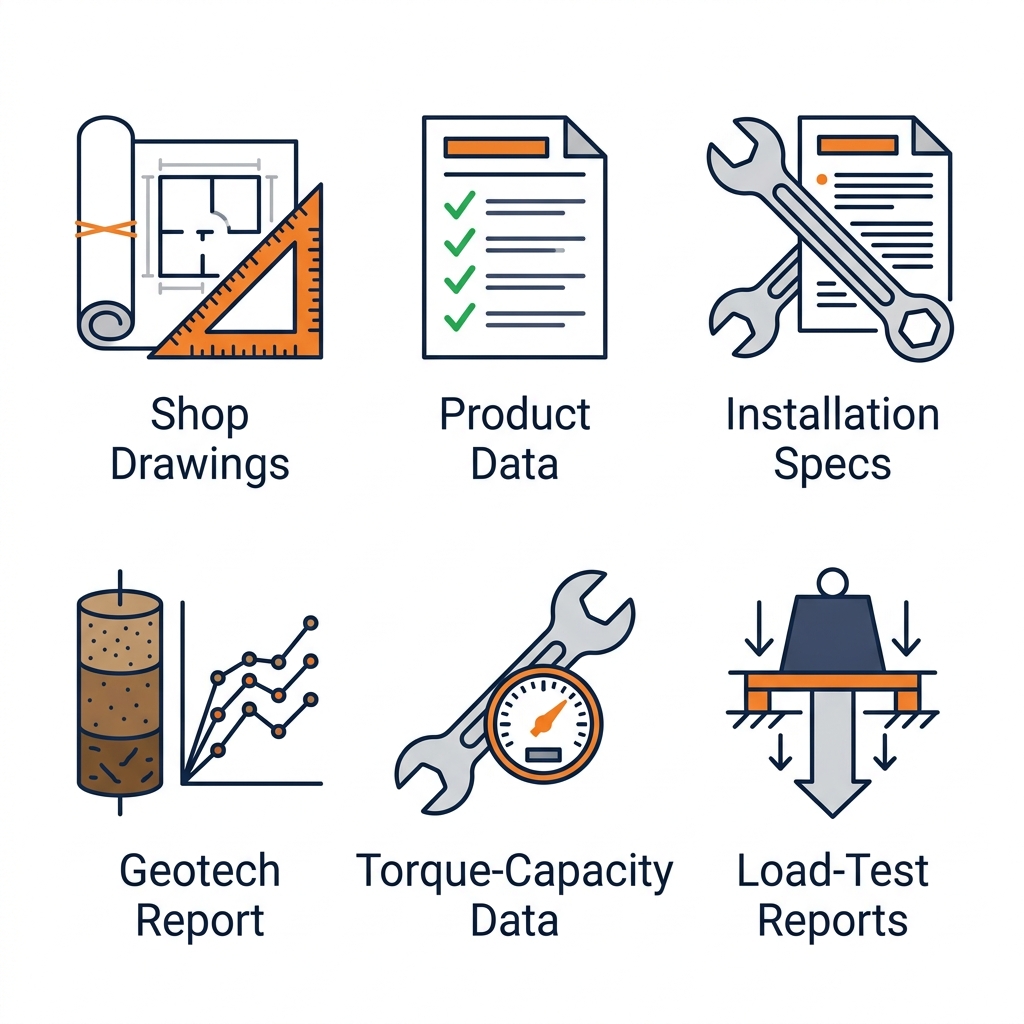
The core submittal documents we help our clients assemble include the following items, each tailored to the specific project rather than pulled from generic manufacturer literature.
- Shop drawings and stamped foundation plans — These engineered drawings detail the helical pile layout, pile type, shaft diameter, helix configuration, embedment depth, corrosion protection, and design torque rating. They must be prepared under the responsible charge of a licensed professional engineer.
- Product data and AC358 evaluation report references — Submittals should include manufacturer product data sheets and reference the relevant ICC AC358 evaluation report.
- Installation specifications — Project-specific instructions covering drilling or rotary installation techniques, torque monitoring, and quality-control hold points.
- Torque-to-capacity correlation ratios — They must be developed and sealed by a licensed professional engineer; our role is to coordinate with the project’s engineer so the values are properly integrated into the submittal package.
- Geotechnical report — When a site-specific geotechnical investigation is available, its data on soil stratigraphy and bearing layers anchors the design assumptions.
- As-built installation records and load-test reports — After installation, final torque logs, pile cut-off elevations, and any required static or dynamic load-test results become part of the permanent submittal record.
A complete, well-documented submittal gives the special inspector the baseline needed to verify that field work matches the approved engineering. For jurisdiction-specific documentation questions in Littleton, Denver, or across Colorado’s Front Range, our team is happy to perform a custom, on-site review before installation begins.
Continuous Special Inspection Protocols for Helical Installations
While the approved submittal provides the project blueprint, continuous special inspection is how we verify that the installation follows that blueprint in the field. A qualified special inspector oversees the entire helical pier placement, observing every step rather than performing isolated spot checks.
During installation, the inspector records key field data:
- Depth of penetration and the final tip elevation.
- Torque readings at each foot of advancement to gauge soil resistance.
- Centerline coordinates and as-built position.
- Plumbness of the pier shaft against specified tolerances.
- Helical plate embedment depth relative to the bearing stratum.
- Any splices or extensions and the torque applied when they were added.
These observations are documented in a field report that becomes part of the project’s permanent record.
This continuous monitoring directly verifies that the as-built pier matches the approved submittal and engineered design. If a torque trend deviates from expectations or a pier shifts out of alignment, the inspector can flag the issue while we are still on site, allowing real-time adjustments. The process also defines hold points — at final depth or before attaching termination hardware — where our crew pauses so the inspector can confirm readings, alignment, and plate position. In the Denver metro area, these hold-point protocols have become a standard part of our helical pier installations, ensuring consistent verification across every project. By coordinating these hold points in advance, we help keep the installation moving while still respecting the inspection protocol.
Our team works alongside the special inspector throughout the project, documenting every installation step and producing organized records for the design engineer’s review. While final acceptance always rests with the engineer, our disciplined coordination and thorough documentation support superior performance in installation of helix pier systems.
The torque values recorded during inspection are not just quality-control metrics; they are the same data used for torque-to-capacity correlation. In the next section, we examine how those readings translate into verified pier capacity.
Torque-to-Capacity Correlation Ratios and Verification
As we discussed in the previous section, verifying installation torque is essential during special inspections. That verification relies on the torque-to-capacity correlation, an empirical relationship that converts measured installation torque into estimated ultimate pile capacity using a factor typically called k. This relationship is grounded in physics and must be established or verified in accordance with ICC AC358, as outlined in our plain-language guide.
Our AC358 overview explains that the factor k depends on helix plate geometry, shaft size, and the specific soil conditions at the site. AC358 requires calibration against load test data before production use. In other words, the torque-to-capacity relationship is valid only when it has been proven for the pile configuration and ground conditions encountered. This ensures that the correlation is specific to the site and not a generic assumption.
Field verification follows a defined procedure: our installers record torque at consistent depth intervals using a calibrated torque indicator that meets AC358 accuracy standards. The critical reading is the maximum torque achieved during the final revolution of the pile, which is entered into the correlation formula. This process is reliable only when the equipment is properly calibrated and readings are taken accurately; inaccurate data invalidates the correlation, so we emphasize rigorous, documented measurement on every project.
The correlation has strict scope limits. AC358 specifies that the torque-to-capacity relationship applies only within the pile sizes, soil conditions, and installation tooling for which it was established. Extrapolation beyond those parameters—for instance, using a correlation developed for a certain shaft diameter on a significantly different pile—is not permitted. This safeguard prevents overestimation of capacity and keeps verification grounded in tested evidence.
Ultimately, torque-based verification provides real-time quality control, but it cannot substitute for a licensed engineer’s final review. Acceptance hinges on documented torque records and correlation calculations aligned with the project design. This approach aligns with the 2026 IBC framework for helical pile acceptance, demanding transparent, site-specific validation. These records are exactly what we will cover in the next section on best practices for helical pile project documentation and compliance.
Best Practices for Helical Pile Project Documentation and Compliance
While the previous section explained how torque readings translate into load capacity, this section focuses on how those readings—along with the full project record—must be documented and managed for code compliance.
The documentation set that every homeowner should receive and retain includes the following items:
- Stamped engineered drawings
- Sealed calculations
- A helical pile installation log capturing torque, depth, and final capacity for each pile
- Load-test reports
- As-built records
Our helical pier and screw pile installations supply this entire package as part of the project record.
The acceptance criteria ICC AC358 provides the standardized framework that Denver-area building departments rely on when reviewing helical pile installations for code compliance. As we explain in our own educational materials on the subject, AC358 establishes the evaluation and testing benchmarks that a helical pile system must meet—and the corresponding documentation that must accompany an installation. Building departments in Littleton, in Denver, and across Douglas County, for example, generally require the engineered design package plus the installation records before granting approval, with final sign-off remaining the responsibility of the licensed structural engineer—not a contractor’s verbal assurance.
A single-source documentation workflow starts before the first pile goes in. We recommend that a pre-installation submittal package—including the engineered drawings and sealed calculations—be submitted for review and approval before work begins. During installation, we capture torque, depth, and final capacity per pile, tying those field measurements to the torque-to-capacity correlation discussed previously. After completion, we compile the field logs, any load-test results, and as-built observations into a final as-built package that the homeowner should store with the property’s records.
As always, any questions about specific project sign-off should be directed to the licensed structural engineer and the local building official; the contractor’s role is to perform and document the installation according to the approved plan.
A complete, well-organized documentation package is the foundation that lets you approach IBC 2026 compliance with confidence. In the next section, we explore practical strategies for navigating those requirements smoothly.
Approaching IBC 2026 Helical Pile Compliance with Confidence
Successfully meeting helical pile inspection requirements ibc 2026 is achievable when you implement the documentation best practices we detailed earlier—thorough recordkeeping, load test reports, and ICC-AC358 product certification. As our own ICC AC358 guide explains, this product-level standard underpins IBC 2026 acceptance, so integrating it into your submittal package builds inspector confidence from the start.
Our family-owned firm, serving Denver, Littleton, and Douglas County, Colorado since 1996, gives us a practical understanding of how local authorities interpret these requirements. Because every site is different, we customize every solution: the first step is an on-site evaluation that lets us provide a tailored, no-obligation quote.
Please remember: we do not guarantee specific results for every project; actual outcomes depend on your unique soil, access, and inspection conditions. We always recommend consulting a licensed structural engineer for definitive design recommendations.
To discuss your project and take the next step, contact us today.
Request Your Custom Foundation Quote
Now that you understand the IBC 2026 inspection requirements for helical piles, the next step is a site-specific evaluation. Thorough documentation of torque readings, depth logs, and compliance records is the foundation of a successful project. Our team brings decades of local expertise across Denver, Littleton, and Douglas County to navigate these complex requirements. Contact Rocky Mountain Steel Piering, Inc. for a custom quote tailored to your property’s unique conditions. As a family-owned and operated company since 1996, we prioritize clear communication and reliable support. Call us at +1 303-471-1155 or visit our website to schedule your consultation today. Take the first step toward confident compliance with a partner you can trust.