
Home Addition Planning Guide: Essential Steps for Colorado
Table of Contents
- Navigating Your Home Addition Planning Guide for the Denver Area
- Core Concepts of Home Addition Planning in Denver
- Structural and Design Considerations for Denver Home Additions
- Step-by-Step Guide to Planning Your Home Addition in the Denver Area
- Advanced Engineering Solutions for Complex Home Additions
- Frequently Asked Questions About Home Addition Planning in Denver
- Start Your Home Addition Project with Confidence
Navigating Your Home Addition Planning Guide for the Denver Area
A well-structured home addition planning guide is essential before breaking ground on any residential expansion in the Denver area. Without proper preparation, homeowners risk costly delays, code violations, and structural complications that could compromise the entire project. Rocky Mountain Steel Piering, Inc. has been family-owned and operated since 1996, and we have seen firsthand how thorough planning separates successful additions from problematic ones.
The typical home addition construction phases begin with zoning research and site evaluation, followed by design development, permit acquisition, foundation work, framing, and final completion. In the Denver area, residential building permit requirements demand careful attention — the City and County of Denver reviews plans for structural integrity, setback compliance, and soil condition suitability before issuing approval. Understanding Denver home addition zoning requirements early in the process prevents expensive redesigns and keeps your timeline on track.
Our team specializes in the foundation and structural components that anchor every addition. We recommend consulting qualified professionals who can assess load-bearing capacity, soil stability, and piering needs before construction begins. With this groundwork established, the next logical step is examining how Denver’s zoning code shapes what you can build and where for your specific neighborhood and lot conditions.
Core Concepts of Home Addition Planning in Denver
Planning a home addition in Denver starts with a solid home addition planning guide to help you understand the foundational decisions that shape your project. Before you begin any construction, you need to evaluate whether building up or building out best suits your property, budget, and long-term goals. This decision influences everything from structural complexity to zoning compliance and overall timeline.
Build Up vs. Build Out: What Denver Homeowners Should Know
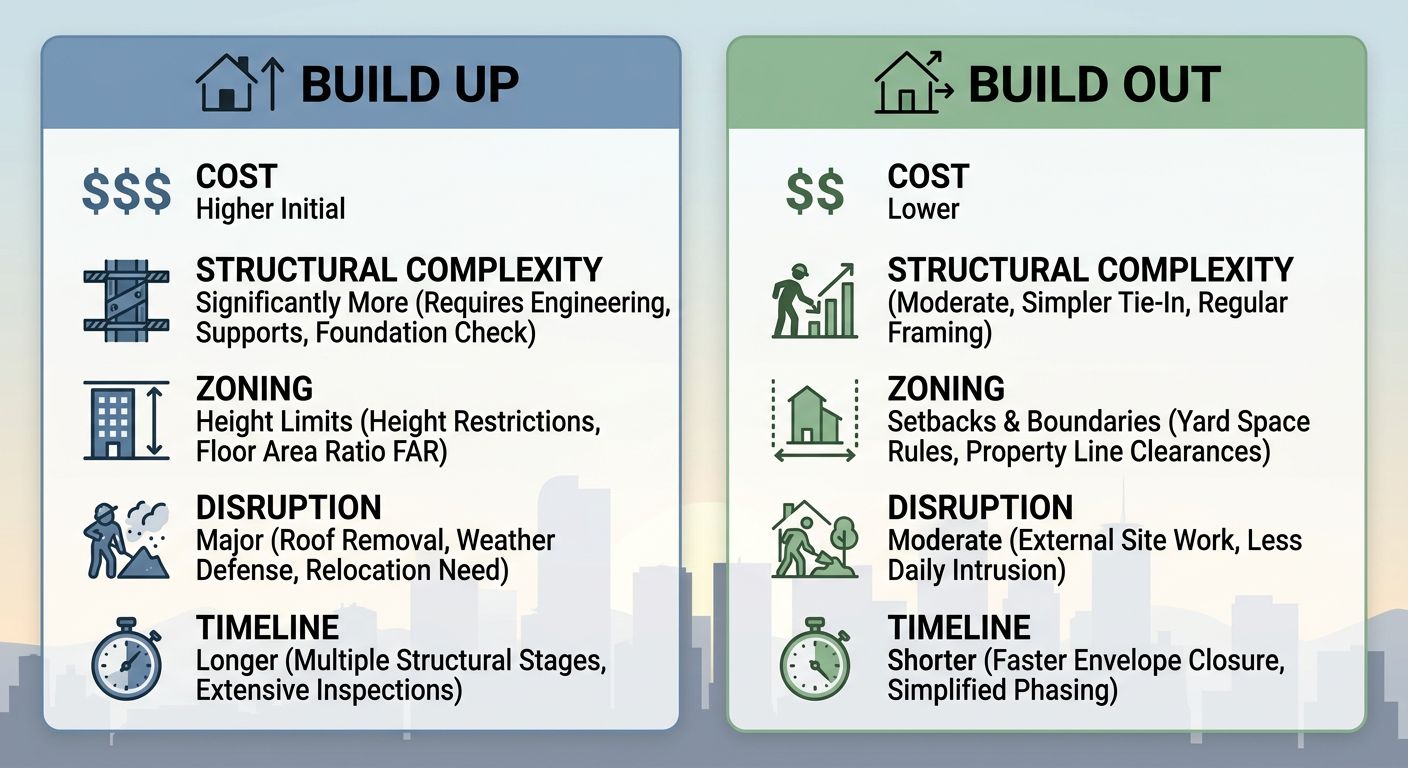
A build-up addition adds a second story to your existing home, while a build-out addition expands the ground floor footprint. Each approach brings distinct advantages and challenges. Building up preserves yard space and works well on smaller lots, but it demands significant structural reinforcement to support the added weight. Building out avoids the complexities of working above living spaces but reduces outdoor space and must respect setback requirements.
Our experience shows that these foundational choices determine not only the scope of work but also how smoothly the remaining home addition construction phases will proceed. The following table provides a quick-reference overview of these key differences.
| Factor | Build Up | Build Out |
|---|---|---|
| Cost per sq ft | Higher | Lower |
| Structural complexity | Requires reinforcement | Moderate |
| Zoning restrictions | Height limits | Setback limits |
| Disruption | Major | Moderate |
| Timeline | Longer | Shorter |
Building upward typically costs more per square foot because the existing foundation and framing must be evaluated and often reinforced to carry additional stories. The structural complexity of a build-up project requires careful engineering analysis, particularly in Denver where expansive clay soils demand deep foundation support. Building outward generally involves less structural reinforcement, though new foundation work is still required and must comply with residential building permit requirements.
Zoning and Permits in Denver
Denver’s zoning code imposes specific restrictions that influence whether you can build up or out. Height limits may cap how tall your addition can be, while setback requirements dictate how close you can build to property lines. Before finalizing your plans, you must obtain the necessary permits from the City and County of Denver, whose official site provides authoritative guidance on zoning permits and building codes applicable to residential additions.
Build-up vs. build-out comparison for Denver home additions
Understanding these restrictions early prevents costly redesigns and delays. We recommend consulting with professionals who can interpret Denver’s zoning requirements and confirm that your vision aligns with what the city allows.
Alternative Addition Options
Beyond traditional build-up and build-out projects, some Denver homeowners consider adding an Accessory Dwelling Unit (ADU). ADUs provide flexible living space that can serve as a rental unit, guest house, or home office. Denver’s zoning laws for ADUs include specific requirements for structural safety, frost protection, and soil stability, as outlined by RMSSCO. If you are exploring this option, understanding the ADU conversion cost in Denver helps you budget realistically. Each project is unique, and actual outcomes depend on site conditions and professional inspections.
We recommend consulting with a licensed engineer or qualified contractor before finalizing any home addition plans. Taking time to understand these core concepts positions you to make informed decisions as you move toward the detailed design and permitting stages.
Structural and Design Considerations for Denver Home Additions
A successful home addition starts long before framing begins — it starts underground, with structural decisions that affect everything above. A detailed home addition planning guide should account for Denver’s unique soil conditions, varying from expansive clay to sandy loam, and the engineering requirements those soils demand. At Rocky Mountain Steel Piering, Inc., we’ve been family-owned and operated since 1996, bringing decades of foundation expertise to projects across the Front Range. Whether you’re building a sunroom in Littleton or a second-story addition in Greenwood Village, understanding structural and design considerations will help you navigate your project confidently, from the first soil test to the final inspection.
Foundation Options for Home Additions in Denver
Denver’s diverse geology means there is no one-size-fits-all foundation solution. Three primary systems stand out: helical piers, concrete footings, and slab-on-grade foundations. Each has distinct advantages depending on your soil conditions, budget, and timeline.
Helical piers are steel shafts with helical bearing plates that screw into stable soil strata below the surface. Because they reach past poor, expansive near-surface soils and bear on denser material, they deliver predictable load capacity immediately. Installation is typically completed same-day, with no concrete curing time required, and minimal site disturbance — an important consideration when you are adding onto an occupied home. We have found that in poor soil conditions common around the Denver metro, helical piers can be installed up to 66% faster than conventional concrete footings.
Concrete footings are a traditional cast-in-place foundation system. They require excavation below the frost line, forming, steel reinforcement, and concrete pouring. Once poured, concrete footings need one to two weeks of curing before construction can proceed. They perform well on stable, well-draining soils but can be problematic in expansive clay conditions if not properly designed.
Slab-on-grade systems consist of a concrete slab poured directly on a prepared subgrade. They are the least expensive option but offer limited load capacity and are sensitive to soil movement. A proper compacted base is essential, and in areas with significant frost heave potential or expansive soils, slab-on-grade may not be the best choice.
| Factor | Helical Piers | Concrete Footings | Slab-on-Grade |
|---|---|---|---|
| Installation time | Same-day | 1-2 weeks curing | 1 week curing |
| Soil suitability | Excellent for poor soil | Good for stable soil | Requires proper base |
| Cost per sq ft | Higher initial | Moderate | Lower |
| Load capacity | Predictable | Design-dependent | Limited |
| Site disturbance | Minimal | Moderate | Moderate |
The table above illustrates why many Denver homeowners and contractors choose helical piers for additions in areas with challenging soil conditions. The predictable capacity and minimal site impact align well with the realities of building in established neighborhoods where access is often tight and existing landscaping needs protection. Foundation system selection should always follow a geotechnical investigation and structural engineering analysis — these comparisons are for general informational purposes, and site-specific recommendations must come from a qualified professional.
Integrating New Structures with Existing Foundations
Connecting a new addition to your existing home’s foundation requires careful engineering to address two critical challenges: load transfer and differential settlement. As you move through the home addition construction phases, the point where old meets new is often the most technically demanding.
Load transfer involves ensuring that the new foundation can support the weight of the addition and transmit those forces safely to the ground without overloading the existing foundation. Structural engineers typically design connections using steel dowels epoxied into the existing concrete, or mechanical connectors that allow for some controlled movement while maintaining structural integrity. The American Society of Civil Engineers (ASCE) provides foundation design guidelines that are the industry standard for these connections.
Differential settlement is the unequal movement between the old and new foundations. Your existing home has likely completed most of its settlement over years or decades, while a new foundation will settle as soil consolidates beneath it. Without proper accommodation, differential settlement can cause cracking at the interface, sticking doors, and other structural issues. Helical piers are particularly effective for minimizing differential settlement because they transfer loads to deeper, more stable soil that is less prone to movement, and because they can be installed to a specified torque that correlates directly with bearing capacity — a technique we employ routinely at Rocky Mountain Steel Piering, Inc.
Permitting and Engineering Requirements
Navigating residential building permit requirements in Denver requires early coordination with the city’s Building Department. Home additions typically need a building permit, and depending on scope, you may also need separate permits for electrical, plumbing, and mechanical work. The permit package must include stamped structural drawings and calculations prepared by a licensed professional engineer home addition specialist.
According to the National Society of Professional Engineers (NSPE), professional engineers hold the licensure required to design structural systems and certify that designs comply with building codes and safety standards. Denver requires this PE stamp for foundation design, lateral analysis, and connection details. Your architect or design-build firm will typically coordinate with a structural engineer, but you should verify that a licensed professional is providing the stamped documents before construction begins.
The permit review process involves plan submittal, review cycles, and eventually, inspections during construction. Inspectors will verify that the foundation installation matches the approved plans — including checking pier depths, concrete strength, and reinforcement placement. The Experts in Steel Piers at Rocky Mountain Steel Piering, Inc. can assist with helical pier installation and provide the necessary documentation for your engineer’s permit package, though all structural designs must be reviewed and stamped by a licensed professional engineer. The information in this section is for general informational purposes; consult a licensed structural engineer for definitive design recommendations for your specific project.
With the structural foundation decisions in place, your attention can shift to the more visible aspects of your project — design aesthetics, material selection, and the finishes that will make your new space feel like an integral part of your home.
Step-by-Step Guide to Planning Your Home Addition in the Denver Area
Embarking on a home addition in the Denver area requires careful preparation and an understanding of local building conditions. This home addition planning guide outlines the critical steps you need to take, from establishing a realistic budget to managing the construction timeline. By following a structured approach, you can navigate the complexities of a home expansion planning project with greater confidence and clarity.
Budgeting and Cost Estimation for Your Project
Estimating costs for your Denver addition project steps accurately is the first crucial stage. In the Denver area, the final price is influenced by a unique combination of expansive clay soils, local labor rates and material availability. According to RMSSCO, a family-owned Denver foundation and construction company, site-specific geological conditions frequently determine a significant portion of the budget. Stabilizing foundations on Denver’s expansive soils may require specialized solutions like helical piers which directly impact your initial cost estimates.
Several primary factors shape your overall budget. The scope of the addition, the quality of interior finishes and the complexity of tying new systems into your existing plumbing and electrical infrastructure all play major parts. Understanding these variables early will help you create a more accurate financial plan and avoid unexpected expenses as the design progresses.
The following table provides a typical cost allocation breakdown to help you understand where your investment goes during a standard project.
| Cost Category | Percentage of Total Budget | Notes |
|---|---|---|
| Design and Engineering | 10-15% | Architect and structural engineer fees |
| Foundation | 10-20% | Varies with soil and type |
| Framing and Structure | 15-20% | Lumber, steel, labor |
| Permits and Fees | 2-5% | Denver permit fees |
| Interior Finishes | 20-30% | Flooring, cabinets, fixtures |
| Plumbing and Electrical | 15-20% | Upgrades to existing systems |
| Landscaping and Exterior | 5-10% | Restoration and site work |
Foundation and framing costs can fluctuate significantly, often consuming a larger portion of the budget if unexpected soil complications arise during excavation. We recommend allocating a contingency fund of 10-15% beyond these general percentages to cover unforeseen conditions that are commonly discovered once construction begins in the Denver area.
Selecting a Contractor and Structural Engineer
Choosing the right team is essential for a successful project. You should seek out a contractor who performs a variety of services, including the installation of helical piers, as Denver’s soil conditions often demand this specific expertise. Family-owned since 1996, RMSSCO exemplifies the experience and stability you should look for in a partner. Verify that your contractor holds proper licensing, carries liability insurance and can provide local references for work similar to your planned addition.
Equally important is hiring a licensed structural engineer to evaluate your existing foundation and design the new structural elements. The engineer’s analysis ensures your current foundation can handle the new loads and that the design meets all local codes. We strongly advise against moving forward with construction without a stamped set of engineered plans, as this documentation is critical for obtaining your permits and ensuring the long-term safety of your home.
Navigating the Permit Process in Denver
Securing the correct residential building permit requirements is a non-negotiable element of any legal addition in the Denver area. The permitting process ensures your project meets safety standards and zoning regulations. Start by preparing your site plan, engineered structural drawings and a detailed scope of work. You will submit these documents to the City of Denver’s building department for review.
The typical permit process follows these steps:
- Submit application and construction documents for plan review
- Receive comments from the city and revise plans as required
- Obtain permit approval and pay associated fees
- Display the permit card prominently at the job site
- Schedule mandatory inspections at designated milestone points
Rather than navigating the complexities of local bureaucracy alone, many homeowners find that a qualified contractor manages this submission process on their behalf. For official requirements, visit the Colorado home building permits page to confirm current state and municipal codes. This proactive step helps prevent costly delays and ensures your addition is fully compliant from the ground up.
Timeline and Project Phases
A realistic timeline turns a vision into a manageable schedule. The typical home addition construction phases in Denver span several months, with the pre-construction phase often taking longer than expected. Your project will begin with design and engineering, which can last four to eight weeks, followed by the permit review period that may require an additional two to six weeks depending on the city’s current case load.
Once you break ground, the major phases include site excavation, foundation work, framing, rough-in of plumbing and electrical and finally the installation of insulation, drywall and interior finishes. Weather can influence this timeline, as Colorado’s freeze-thaw cycles occasionally affect concrete pouring schedules. A final inspection and walk-through mark the official completion, where we review every detail with you before demobilizing the site. With the plan in place, you are ready to move into the active management of your construction journey.
Advanced Engineering Solutions for Complex Home Additions
Once you have a vision for your addition, the next critical step is understanding the engineering challenges beneath the surface. A well-developed home addition planning guide should always account for Denver’s unique soil conditions, as they dictate the foundation solution your project requires. At Rocky Mountain Steel Piering, Inc., we have spent nearly 30 years mastering the structural techniques needed to build successfully on our region’s most demanding terrain.
The home addition construction phases involving foundation work must begin with a geotechnical report. This on-site analysis identifies the soil profile beneath your property and informs every subsequent engineering decision. Expansive clay, sandy loam, and bedrock each present distinct challenges that require specific foundation strategies, and skipping this step can compromise the entire structure.
The following table illustrates how different soil conditions encountered across the Denver metro area influence our foundation recommendations.
| Soil Type | Challenge | Recommended Foundation | Benefits |
|---|---|---|---|
| Expansive Clay | Shrink-swell cycles cause movement | Helical piers to stable load-bearing strata | Anchored below active zone |
| Sandy/Loam | Poor bearing capacity | Concrete footings or helical piers | Distributes load |
| Bedrock | Requires excavation | Spread footings on bedrock | Excellent support |
Helical piers are a steel shaft with helical bearing plates that we install deep into the earth, bypassing unstable surface soils. For expansive clay, this approach anchors your addition below the active moisture zone, effectively neutralizing the shrink-swell risk that plagues many Colorado foundations. In sandy or loamy soils, where the ground lacks the strength to support a heavy structure, helical piers transfer loads downward until they reach competent strata, much like an auger pulling itself into solid material. When bedrock is present, spread footings cast directly on the excavated rock surface provide exceptional bearing capacity.
These engineering decisions directly influence residential building permit requirements, as Denver and neighboring jurisdictions like Littleton, Greenwood Village, and Centennial require stamped structural drawings that reflect site-specific soil data. The National Society of Professional Engineers establishes the professional standards and ethical guidelines that govern this design work, underscoring why a licensed structural engineer should validate every complex addition plan.
As a family-owned and operated company since 1996, RMSSCO brings extensive local experience to these challenges. Our certified teams specialize in helical pier and tieback systems that provide predictable installation capacities while minimizing site impact, often completing work up to 66% faster in poor soils compared to traditional concrete alternatives. We have applied these solutions to everything from residential foundation repairs to municipal boardwalk projects throughout the Front Range.
These engineering solutions form the backbone of a successful addition—discover how they influence your project timeline and budget when evaluating ADU conversion cost in Denver. Consult a licensed structural engineer for definitive diagnosis and design recommendations.
Frequently Asked Questions About Home Addition Planning in Denver
Here are answers to common questions homeowners have during the planning stage of a home addition in Denver.
What are the key steps in planning a home addition in the Denver area?
A solid home addition planning guide begins with design, then moves through structural evaluation and permitting. We recommend a foundation assessment early—especially before finalizing architectural drawings—because Denver-area soils can shift and must support the new load safely.
How do residential building permit requirements affect my addition project?
Residential building permit requirements in Denver typically call for site plans, structural drawings, and sometimes a geotechnical or soils report. Permit review can take 4–8 weeks, so building this step into your timeline helps avoid delays later in the construction phases.
How much does an ADU conversion cost in Denver?
For a detailed look at costs for converting an existing structure, see our page on ADU conversion cost in Denver. If you are planning a home addition that involves a garage or basement conversion, starting with a foundation inspection lets you plan a realistic scope and budget. As The Experts in Steel Piers, we can help you evaluate existing footings and recommend a helical pier solution where soil conditions demand it.
Consult a licensed structural engineer for load-bearing decisions and foundation design. Ready to start your construction project? Contact our team for a professional assessment.
Start Your Home Addition Project with Confidence
With the blueprint in hand and permits secured, you’re ready to move forward with confidence — you now have the foundation laid out in your home addition planning guide. From excavation to final trim, understanding each home addition construction phase helps you set realistic expectations. Securing residential building permit requirements early prevents costly delays and keeps your project on schedule. We’re ready to put our 30 years of experience to work for you. As The Experts in Steel Piers, our family-owned and operated team — serving Colorado since 1996 — can provide a custom quote for your project. Let’s build your vision together.
Resources
- Discover Growing Popularity of Garage ADU Conversions in Denver
- Understand Structural Requirements for Denver ADU Conversions
- Discover Denver’s 2026 Zoning Laws for ADU Conversions
- Explore Sustainable Home Remodeling Solutions in Colorado
- Discover Energy-Efficient Remodeling Upgrades for Denver Homes
- Learn Cost Factors for Basement ADU Conversion in Denver
- Get Fast Pricing Estimates for ADU Conversions in Denver
- Discover Professional Engineering Resources for Home Additions
- Access Denver Government Resources for Home Addition Zoning
- Find Colorado Home Building Permit Resources on State Portal
- Explore ASCE Resources for Home Expansion Structural Engineering