
ADU Regulations Colorado 2026: Essential Guide for Homeowners
Table of Contents
- Colorado’s 2026 ADU Regulations and Your Foundation Plans
- ADU Regulations Across the Denver Metro: Key Differences and Foundation Impacts
- Foundation Services for Compliant ADU Construction in Colorado
- Local Soil and Zoning Factors for Your Denver ADU in 2026
- Steps to Begin Your ADU Project: From Regulations to Foundation Installation
- Building Your ADU With Confidence in 2026
Colorado’s 2026 ADU Regulations and Your Foundation Plans
Understanding new adu regulations colorado 2026 is crucial as you plan your accessory dwelling unit. Under HB24-1152, certain building standards for ADUs take effect in 2026, and these can directly influence your foundation design. While Colorado ADU laws set statewide minimums, keep in mind that Denver metro ADU codes may impose additional foundation specifications.
Colorado’s variable soil conditions, including expansive clay, frequently require deep foundation solutions for ADU additions. Engineered pier systems, particularly helical piers, offer minimal site impact and immediate loading — an advantage for builders seeking efficient installations. A custom site inspection by a licensed structural engineer determines the right solution for your project, ensuring your plans align with the new requirements.
Consult a licensed structural engineer or qualified professional for definitive diagnosis and design recommendations.
ADU Regulations Across the Denver Metro: Key Differences and Foundation Impacts
While ADU regulations Colorado 2026 vary across the Denver Metro, each city’s size restrictions and foundation mandates differ significantly. Denver permits up to 800 sq ft with a 5-ft setback and requires an engineered foundation. Littleton caps ADUs at 750 sq ft with a 10-ft side setback and recommends helical piers for expansive clay soils. Centennial allows the largest units at 850 sq ft but demands a 7-ft setback and a geotechnical report coupled with a deep foundation system. The following table summarizes these critical requirements.
| City | Max ADU Size | Setback Requirement | Foundation Requirement |
|---|---|---|---|
| Denver | 800 sq ft | 5 ft from property line | Engineered foundation required |
| Littleton | 750 sq ft | 10 ft from side lot | Helical piers recommended for expansive soils |
| Centennial | 850 sq ft | 7 ft setback | Requires geotechnical report and deep foundation system |
Under Colorado HB24-1152 implementation mandates, Denver metro ADU development codes promote uniform safety while addressing local soil challenges. In Littleton, expansive clay soils make helical piers a natural choice—they reach load-bearing strata below the 36-inch frost line without extensive excavation, providing stable support with minimal disruption. RMS Structural Solutions has installed hundreds of helical pier foundations across the metro area, and our team can assess your site’s needs. As The Experts in Steel Piers, we recommend a licensed engineer’s evaluation before you proceed.
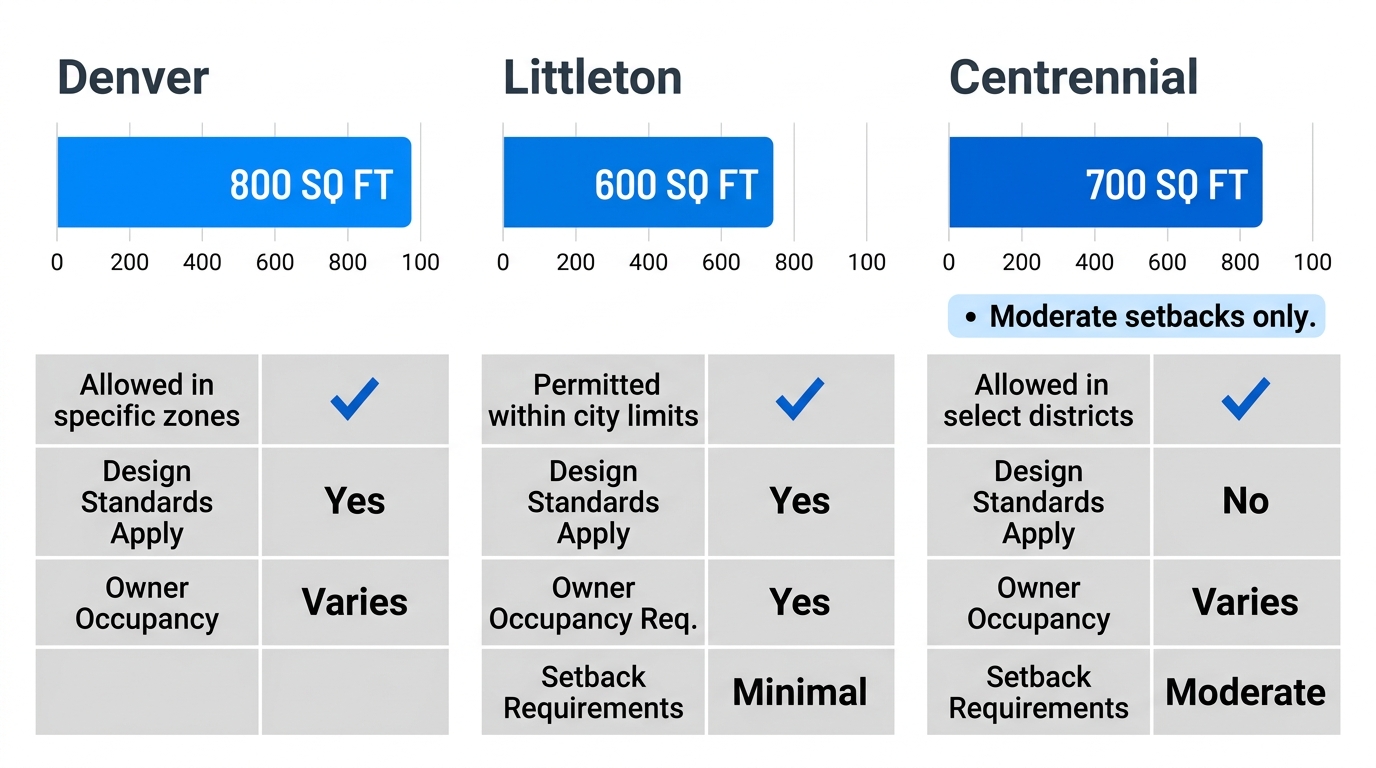
ADU size comparison across Denver Metro cities
For a detailed ADU conversion cost in Denver tailored to your property, request a quote from our team. Understanding these local rules is the first step; next we explore the foundation solutions that meet each city’s requirements. Remember, all recommendations depend on site conditions—consult a licensed structural engineer for definitive design guidance.
Foundation Services for Compliant ADU Construction in Colorado
With new adu regulations in Colorado for 2026 taking shape, foundation systems must meet structural and code requirements for accessory dwelling units. At Rocky Mountain Steel Piering, we focus on helical pier solutions that comply with modern standards.
The ICC-ES AC358 acceptance criteria, as outlined in our technical guide, provides rigorous evaluation of design capacity, corrosion protection, and installation methods for helical piles. Colorado HB24-1152 implementation mandates call for foundations to adhere to these certified benchmarks. ASTM International standards—like ASTM A500 for steel tubing and ASTM A123 for hot-dip galvanizing—govern material quality and corrosion resistance, ensuring long-term performance in Colorado’s expansive soils.
In Denver metro area ADU development codes often specify engineered foundation systems with documented load capacities. By using AC358-certified helical piers, we eliminate the need for site-specific load testing, accelerating permit approvals while maintaining compliance.
As The Experts in Steel Piers, we are a family-owned and operated business since 1996, delivering superior performance in installation of helix pier systems. For a detailed look at how foundation choices affect overall ADU conversion cost in Denver, see our FAQ page or contact us for a custom estimate. Consult a licensed structural engineer or qualified professional for definitive design recommendations for your specific property and conditions.
Local Soil and Zoning Factors for Your Denver ADU in 2026
With new ADU regulations Colorado 2026 taking effect, Denver homeowners are navigating both soil constraints and updated zoning rules. Denver’s expansive clay soils demand foundation systems like helical piers or screw piles to avoid movement, and according to RMS Foundation Solutions, the city’s 36-inch frost depth must be considered for any habitable structure.
Denver metro ADU development codes set clear parameters: they identify allowable zones, impose lot coverage limits, and mandate minimum setbacks and height restrictions. The City and County of Denver updates these standards regularly, so a review is essential before design starts.
The HB24-1152 law, under Colorado HB24-1152 implementation mandates, streamlines approvals and may override local parking requirements, making ADUs on existing lots more feasible. Still, a site-specific soil analysis by a licensed geotechnical engineer remains critical to determine bearing capacity and recommend pier specifics.
As experts in steel piers since 1996, we have installed foundations across Denver’s varied soils and can help evaluate your site. Understanding these soil and zoning factors helps you anticipate ADU conversion cost in Denver and plan realistically.
Steps to Begin Your ADU Project: From Regulations to Foundation Installation
Now that you understand the advantages of adding an ADU, let’s look at the essential first steps, from navigating local Colorado ADU regulations to laying a solid foundation. Before you break ground, careful planning around zoning and site requirements is crucial for a smooth build in the Denver area.
The first step is researching and understanding the specific adu regulations colorado 2026 that apply to your property. With the colorado hb24-1152 implementation mandates coming into effect, property owners must consult their local planning department to review the latest Denver metro ADU development codes. This review will clarify your property’s zoning, allowable lot coverage, setback rules from property lines and other structures, and any local occupancy restrictions. Getting this information early prevents costly redesigns and ensures your project concept is viable from the start.
Before foundation work can begin, you need a plan for required utility services. We recommend consulting with your municipality on what sewer, water, gas, and electrical upgrades your design may trigger. As noted in our planning FAQ, a new electrical service panel or water line extensions are common considerations that should be addressed during this early research phase to align your budget and timeline.
With regulations clarified, it’s time to focus on the critical step of foundation selection. Denver’s expansive clay soils make foundation engineering a primary concern. Options like a standard concrete slab may be suitable in some areas, but a helical pier system often provides a superior solution in poor soils. Helical piers offer minimal site impact and immediate loading with no concrete cure time, making them an efficient choice for ADU projects.
Once you have a design and foundation strategy, the high-level sequence to construction looks like this:
- Research local zoning and regulation codes to confirm project viability
- Consult with an architect and a licensed structural engineer to create detailed plans
- Secure the required Denver ADU permitting approvals and construction permits
- Prepare the site with any needed excavation or utility location
- Install the engineered foundation system
Rocky Mountain Steel Piering specializes in helical pier systems and tiebacks, providing a reliable foundation with an A+ BBB rating. As your project moves forward, remember to consult a licensed structural engineer for a definitive foundation design; every site has unique soil conditions that dictate the best approach. For a custom quote on foundation work, we encourage you to reach out for a personalized assessment.
Once the foundation is installed, the next stage involves finalizing permits and coordinating with contractors — topics we’ll cover in the following section.
Building Your ADU With Confidence in 2026
When building an accessory dwelling unit in Colorado, following ADU foundation standards from ASTM International ensures your project meets industry benchmarks for structural reliability and long-term performance. Our family-owned and operated team, serving Colorado since 1996, brings certified installers and an A+ BBB rating to every project, delivering proven reliability through ASTM-compliant helical pier systems. With evolving regulations like Colorado’s HB24-1152, consulting a licensed professional ensures your ADU foundation aligns with current requirements. Contact us for a free estimate.
Resources
- Get Expert Guidance on Denver’s 2026 ADU Zoning Requirements
- Get Expert Cost Estimates for Denver Basement ADU Conversion
- Get Expert Guidance on Garage ADU Conversions in Denver
- Get Expert Guidance on Denver ADU Structural Requirements
- Get Expert Insights on Denver Basement ADU Construction Costs
- Get Accurate Cost Estimates for Denver ADU Conversion
- Get Comprehensive Guide to ICC-ES AC358 Helical Piers
- Discover Colorado’s Online Government Services Portal
- Get Expert Guidance on Denver ADU Permitting
- Learn About ASTM Standards for ADU Foundations