
Polyurethane Foam Foundation Lifting Reviews: Cost vs Durability 2026
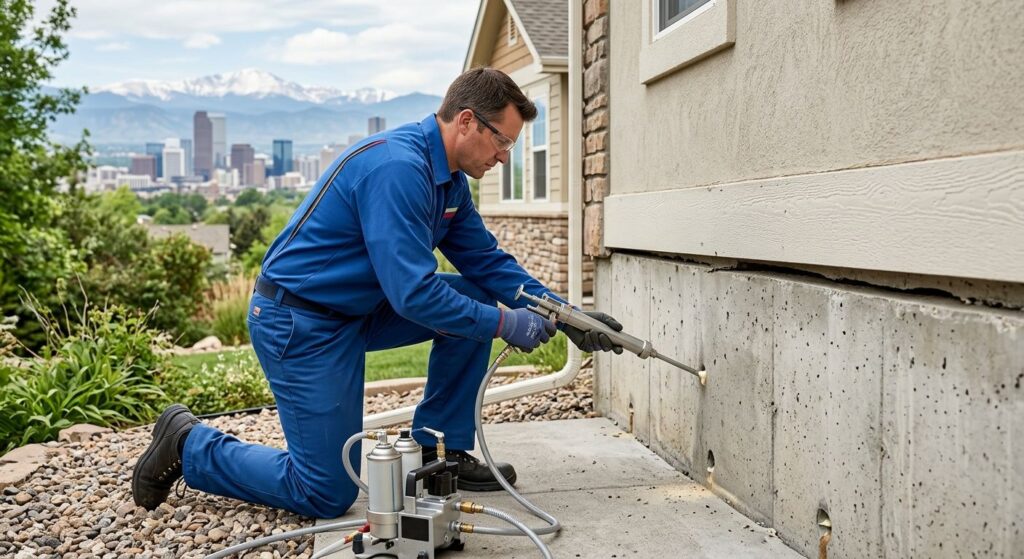
Table of Contents
Polyurethane Foam Foundation Lifting Reviews in Denver: What Homeowners Need to Know
Denver’s expansive clay soils prompt many homeowners to read polyurethane foam foundation lifting reviews in Denver. Feedback frequently notes the process is fast—often finished the same day—and causes little disruption, with no heavy machinery required. Polyurethane concrete leveling durability is a top concern; our internal FAQs and longevity data indicate that most foam lifts deliver many years of stable results under normal conditions. However, reviews also indicate that for severe structural problems, deeper anchoring may be necessary. After reading these reviews, many ask about polyurethane foam vs steel piers foundation repair; our FAQs address that comparison. While polyjacking vs mudjacking cost discussions are common, we provide custom quotes. As a family-owned, A+ BBB-rated company since 1996, we’re ready to assess your foundation.
1. Permanent Fix for Sinking Concrete Slabs?
One of the first questions we hear is whether polyurethane foam offers a permanent fix. Many homeowners searching for polyurethane foam foundation lifting reviews want to know if this approach is truly long-lasting.
Under the right conditions, polyurethane foam injection can provide a durable, long-term solution. As noted in our internal technical resources, the foam can be a permanent fix when the underlying soil is stable and the slab is not exposed to ongoing moisture or erosion. The method is also suitable for structural foundation repair, but its longevity depends on professional installation and a thorough soil assessment.
When evaluating long-term reliability, many homeowners consider polyurethane foam vs mudjacking. Unlike mudjacking, which uses a heavy slurry that can wash out or add weight, polyurethane foam is lightweight, non-porous, and resists erosion. While polyjacking vs mudjacking cost comparisons often favor foam, polyurethane concrete leveling durability in Colorado’s expansive soils is what delivers lasting results.
A permanent fix is never guaranteed without an on-site evaluation. Our family-owned and operated since 1996 team can assess your specific conditions and guide your choice. Contact us to schedule an inspection.
2. Polyurethane Foam vs Mudjacking Cost Comparison
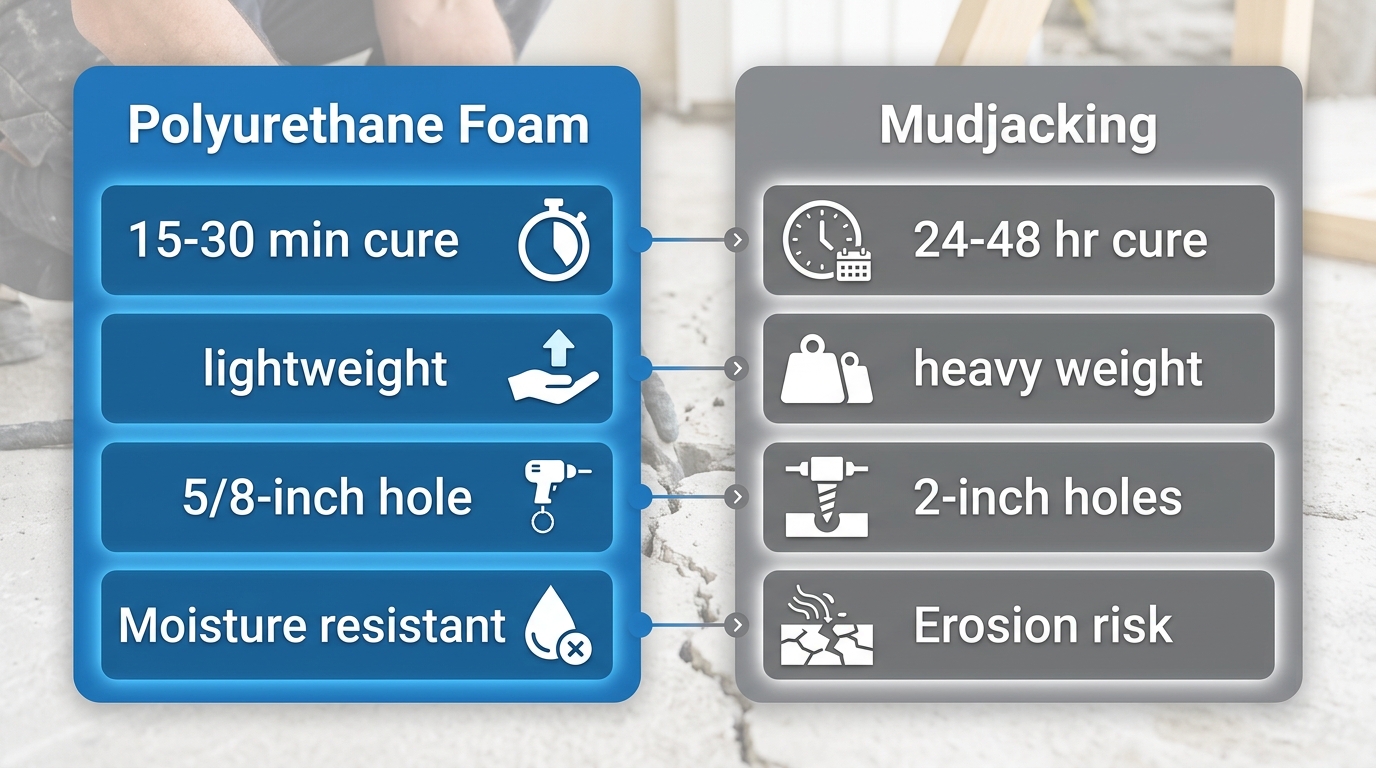
When examining polyurethane foam foundation lifting reviews alongside the polyjacking vs mudjacking cost debate, many commercial property managers in Denver weigh upfront price against long-term performance. Mudjacking typically costs $3–$6 per square foot, while polyurethane foam (polyjacking) ranges $5–$10 per square foot, per RMSSCO’s internal pricing analysis. However, the lower upfront cost of mudjacking brings longer cure times and heavier material loads.
| Feature | Polyurethane Foam Lifting | Mudjacking (Slab Jacking) |
|---|---|---|
| Cost per square foot | Higher upfront cost; typical range $5–$10/sq.ft. | Lower upfront cost; typical range $3–$6/sq.ft. |
| Cure / load-ready time | 15–30 minutes (fast; no delay for loading) | 24–48 hours (slower cure; longer downtime) |
| Weight added to slab | Minimal (lightweight foam adds negligible weight) | Significant (heavy slurry pours can add several tons) |
| Long-term permanence in Denver soil | High; closed-cell foam resists moisture and won’t resettle | Moderate; can erode or resettle over time in wet conditions |
| Ideal use case | Interior slabs, garage floors, and areas with minimal access | Exterior driveways, sidewalks, and curb-and-gutter work |
Despite the higher initial price, polyurethane concrete leveling durability often justifies the investment for commercial projects, as foam resists moisture and won’t resettle in Denver soils. Our family-owned company, operating since 1996, provides custom quotes after an on-site inspection. Contact us today to discuss your specific concrete lifting needs in Littleton and the Denver area.
3. Durability and Longevity of Polyurethane Foam Lifting
In polyurethane foam foundation lifting reviews, durability consistently emerges as the top concern. When properly installed, polyurethane foam lifting can last 10 to 20 years or more, though actual longevity depends on site conditions.
According to RMSSCO, the closed-cell foam is impermeable to water, eliminating freeze-thaw damage and moisture erosion that undermine mudjacking. The material cures in minutes and provides immediate load-bearing capacity, removing settling risk from water content.
This contrasts with mudjacking, where heavy slurry settles over time due to water erosion and soil compaction. The durability of polyurethane concrete leveling in Colorado also depends on soil stability and installation quality. When evaluating polyjacking vs mudjacking cost in Colorado, property owners should weigh the foam’s superior longevity. For public roadway work, reference Missouri transportation resources for compliance standards.
As a family-owned and operated company since 1996 and The Experts in Steel Piers, our crews maximize foam lifespan through proper application. For definitive longevity predictions, consult a structural engineer or on-site inspection.
4. Minimal Disruption During the Repair Process
Beyond the injection mechanics, our process is engineered for minimal disruption, and polyurethane foam foundation lifting reviews consistently confirm this benefit. This minimal disruption starts with the hole size: our internal reference confirms that polyurethane foam injections require only 5/8-inch holes, while traditional mudjacking demands 2-inch openings. The smaller diameter reduces structural impact and simplifies cosmetic patching.
Once injected, the foam cures in minutes and can bear weight immediately, so there is no downtime. Our injection method aligns with modern pavement preservation techniques that prioritize minimal disruption and lasting results.
The process creates minimal mess, with no heavy excavation, and keeps your property looking its best. When evaluating polyjacking vs mudjacking cost, the faster cure time and reduced labor typically make polyurethane the more cost-effective option.
Allowing you to resume normal activities immediately—a convenience that, combined with polyurethane concrete leveling durability, makes polyurethane foam a smart investment.
5. Can Foam Lifting Stabilize Residential Foundation Footings?
When reading polyurethane foam foundation lifting reviews, one common question is whether foam lifting can stabilize residential foundation footings. The answer is yes, provided the settlement is minor to moderate and caused by soil voids.
At Rocky Mountain Structural Solutions (RMS), we use high-density polyurethane foam injection—also known as polyjacking—to fill voids beneath footings and lift settled concrete back into place. The material cures quickly and provides immediate load-bearing capacity, allowing most projects to be completed with minimal disruption and no heavy equipment. For minor to moderate settlement, this approach is often more cost-effective and less invasive than traditional mudjacking. However, when footing settlement signals deeper structural failure, helical piers or full underpinning may be necessary.
When comparing polyjacking vs mudjacking cost, foam lifting often proves more economical due to lighter equipment and faster cure times. We also emphasize polyurethane concrete leveling durability; the closed-cell foam resists water and erosion, providing lasting support when conditions are right. For homeowners in Colorado and throughout the Denver metro area, our team provides free on-site estimates to evaluate the specific condition of your footings. We have been family-owned and operated since 1996, and every project begins with a professional inspection to determine the most appropriate solution.
6. Finding Local Contractors for Polyurethane Foam Leveling
Now that you understand how polyurethane foam works, let’s discuss how to choose a qualified contractor. In Colorado’s expansive clay soils, contractor familiarity with local conditions is critical. When checking polyurethane foam foundation lifting reviews, focus on consistent positive feedback and proven results.
- Look for contractors with dedicated polyurethane foam leveling experience, not just general concrete repair.
- Rely on online reviews: check Google and BBB ratings, and request local references. Our team, family-owned and operated since 1996, maintains an A+ BBB rating and serves the Denver metro area.
- Durability: our field data shows polyurethane concrete leveling durability typically lasts 5–10 years, though actual results depend on soil and load conditions.
- Polyurethane foam is not a structural fix unless engineered; as our technical guidance notes, foam may support loads only when specifically designed and inspected by a licensed professional. Always consult an engineer.
- To compare polyjacking vs mudjacking cost, request custom quotes from multiple contractors that account for site-specific conditions in Colorado.
Prioritize experience and real customer feedback to find a contractor ready to deliver lasting results. Contact us today for a quote.
Choosing the Right Polyurethane Foam Lifting Solution
Evaluating polyurethane foam foundation lifting reviews is essential when choosing a slab lifting solution, because certified installation directly impacts long-term performance. According to our internal data, polyurethane foam slab lifting can last 20 years or more when installed by professionals, as the closed-cell foam resists moisture and soil erosion. In a polyjacking vs mudjacking cost comparison, foam’s lighter weight and faster cure time reduce stress on the soil, and its polyurethane concrete leveling durability offsets the initial expense by avoiding repeat repairs. A provider’s experience matters: family-owned and operated since 1996, we bring decades of hands-on expertise to every project, ensuring reliable results that commercial decision-makers can trust. We recommend consulting a qualified professional for site-specific advice to secure a stable, lasting foundation.