
Causes of Foundation Failure: Essential Homeowner Guide
Table of Contents
Common Causes of Foundation Failure Homeowners Should Know
When homeowners notice signs of foundation distress, understanding the underlying causes of foundation failure is the first step toward a lasting solution. In Colorado, expansive clay soil foundation movement is a primary culprit—these soils swell dramatically with moisture and shrink during dry periods, exerting powerful cyclic stress on concrete and block foundations. Equally concerning is hydrostatic pressure foundation damage, which occurs when poor drainage allows water to saturate the soil around your home, building force against basement and crawl space walls. Other contributing factors include invasive tree roots and undetected plumbing leaks. At Rocky Mountain Steel Piering, Inc., family-owned and operated since 1996, we have seen how ignoring foundation cracks allows minor issues to escalate into major structural problems. Consult a licensed structural engineer for a definitive diagnosis.
1. Poor Drainage and Water Accumulation
Poor drainage is one of the most common causes of foundation failure, especially in regions with aggressive soils and variable weather. When downspouts discharge too close to the structure or when the ground slopes toward the foundation, water can collect around the perimeter. This often originates from improper grading, clogged gutters, or missing downspout extensions that allow roof runoff to pool within ten feet of the foundation walls.
Saturated, waterlogged soil around the foundation exerts hydrostatic pressure foundation damage as the trapped groundwater pushes against basement walls. In Colorado, expansive clay soil foundation conditions amplify the risk because these clays swell dramatically when wet and shrink when dry. Repeated freeze-thaw cycles add further stress, and over time the repeated movement can cause cracks, bowing, or inward deflection of foundation walls.
Homeowners may notice standing water after a storm, damp crawlspaces, efflorescence on basement walls, or uneven floors that signal settlement issues. Prolonged water accumulation can eloquence the supporting soil under footings, compromising the foundation’s support and leading to additional structural concerns. We recommend consulting a licensed structural engineer for a definitive diagnosis of any visible damage.
Addressing drainage early helps prevent extensive repairs down the road. For homeowners concerned about costs, our FAQ on foundation repair cost in Denver provides detailed estimates and outlines what to expect.
2. Expansive Clay Soil Pressures
One of the most common causes of foundation failure along Colorado’s Front Range is expansive clay soil pressure. These soils swell significantly when they absorb moisture and shrink as they dry, creating a persistent cycle of vertical and lateral movement beneath and against a home’s foundation.
Such soils are a primary driver of Colorado foundation problems causing heaving and cracking in houses throughout the region. This cyclic motion exerts lateral force on foundation walls and can create differential settlement under footings, which may lead to visible cracks, uneven floors, or sticking doors.
Hydrostatic pressure foundation damage can intensify these issues when poor drainage allows water to accumulate around the base of a structure. Added moisture trapped in an expansive clay soil foundation accelerates swelling and heightens the stress on walls and slabs. This compounding effect makes proper drainage and a well-designed foundation system essential for long-term stability.
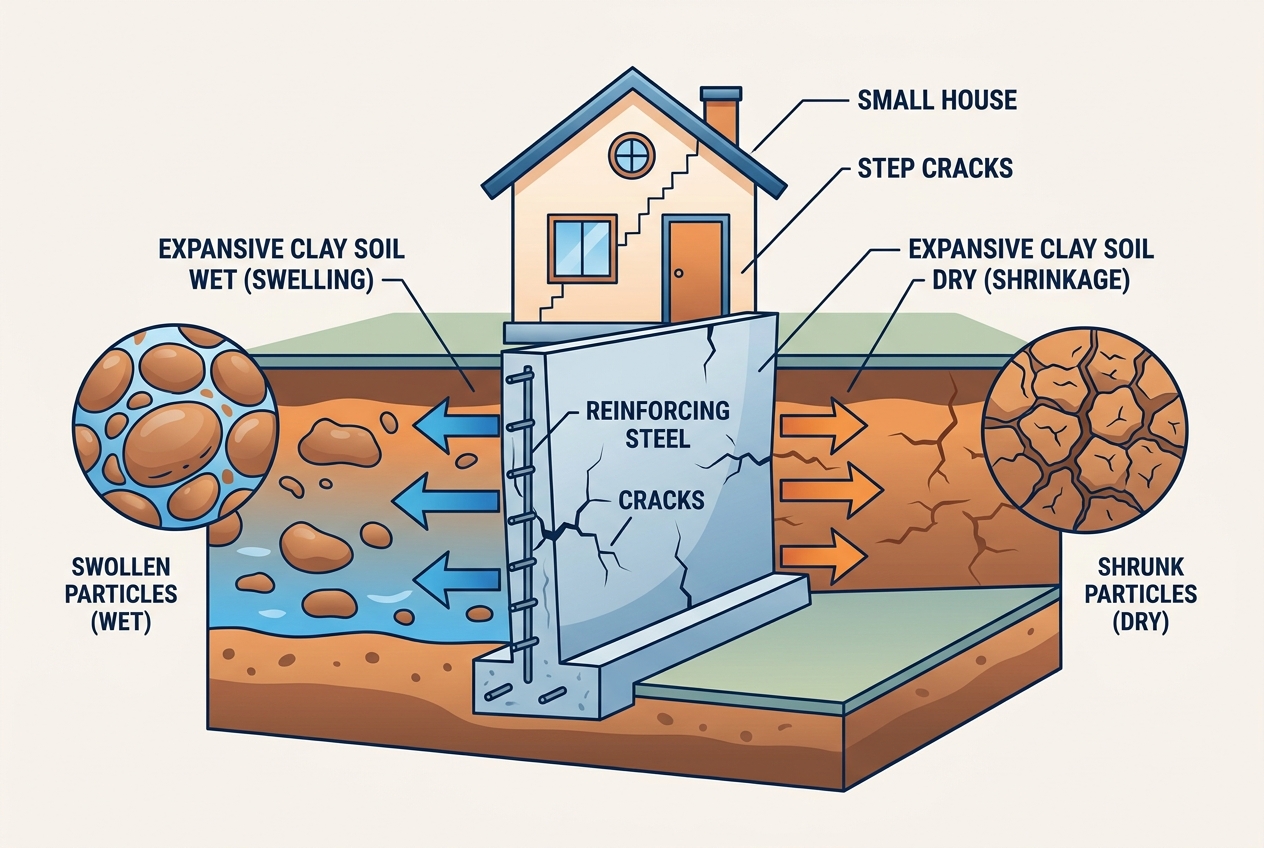
Engineering guidance from the American Society of Civil Engineers underscores the importance of designing foundation elements—such as helical piers—that extend past the zone of seasonal moisture fluctuation. Understanding these soil pressures is essential before evaluating effective foundation repair options. We are family-owned and operated since 1996, and at RMS we are The Experts in Steel Piers for combating these soil pressures. Consult a licensed structural engineer for a definitive diagnosis of soil conditions and foundation design.
3. Inadequate Soil Compaction
Beyond soil composition and moisture, the quality of compaction during construction plays a critical role in foundation performance. Among the common causes of foundation failure, inadequate soil compaction can silently undermine a structure long after the building is complete.
When fill or backfill is placed loosely without proper mechanical densification, it leaves voids within the soil matrix. Over time, the weight of the foundation and building loads compresses these voids, triggering differential settlement that can crack walls, create uneven floors, and cause doors to stick. In expansive clay soil foundation environments, poor compaction amplifies moisture-related movement, and saturated loose fill can accelerate settlement from hydrostatic pressure foundation damage around basements and retaining walls.
According to the American Society of Civil Engineers, proper compaction requires placing soil in thin lifts, controlling moisture within an acceptable range, and verifying density through standardized Proctor tests — typically achieving 95 percent or more of the maximum dry density. In contrast, proper compaction uses layered lifts, adequate moisture conditioning, and appropriate equipment such as sheepsfoot or vibratory rollers specified by a geotechnical engineer.
All information on this website is for general informational purposes only. Actual outcomes depend on site-specific conditions, and we recommend consulting a licensed structural engineer for definitive diagnosis and design recommendations.
4. Tree Roots Invading the Foundation
Tree roots represent a significant cause of foundation failure in residential buildings, often compounding existing soil challenges. As root systems spread laterally, they naturally migrate toward the consistent moisture found in the soil surrounding foundations, a biological drive that can produce two distinct mechanisms of structural distress for the property above.
First, as roots extract moisture from the subgrade, soils dry and contract unevenly, creating voids that lead to differential settlement beneath the slab. Second, large trees planted too close to a structure can physically lift a foundation footing as roots expand in diameter and exert upward pressure on the concrete. The problem intensifies in an expansive clay soil foundation, where cyclical wetting and drying causes pronounced volumetric changes. Root-driven moisture extraction from one zone while another area remains damp produces irregular shrinkage patterns, accelerating foundation cracking and separation at control joints.
Preventive measures include installing root barriers between mature vegetation and the foundation, and siting new trees at a distance equal to at least their expected mature height from the structure. Once root-induced movement is underway, however, root removal alone rarely restores stability, because the compromised bearing soil can continue to settle. Our team addresses this by installing helical pier systems that transfer building loads past the damaged zone and into deep, competent strata, re-leveling and stabilizing the foundation permanently.
Root intrusion and the broader causes of foundation failure demand thorough evaluation, and hydrostatic pressure foundation damage from poor drainage can aggravate root-related distress as well. At Rocky Mountain Steel Piering, Inc., family-owned and operated since 1996, we recommend a professional on-site inspection to determine the extent of the damage and the appropriate repair strategy. Contact The Experts in Steel Piers today to schedule a foundation evaluation and receive a customized quote.
5. Hydrostatic Pressure Buildup
Hydrostatic pressure buildup is one of the most common causes of foundation failure, especially in areas with heavy seasonal moisture. When soil becomes saturated, water can no longer drain naturally and begins exerting force against foundation walls and floor slabs. This subsurface pressure increases with depth and water volume, meaning prolonged rainfall or rapid snowmelt can dramatically intensify the load pushing against your home’s structural components.
In Colorado, the challenge is compounded because many properties sit on expansive clay soil foundation beds that swell when wet. While expansive soil pressure heaves walls upward, hydrostatic pressure pushes inward. The two mechanisms can occur simultaneously but produce distinct damage patterns. We at Rocky Mountain Steel Piering, Inc. often identify three telltale signs of hydrostatic pressure foundation damage during inspections: horizontal cracking along basement walls, inward bowing of foundation walls, and visible heaving of concrete floor slabs.
Prevention centers on keeping groundwater away from the foundation before pressure builds. Perimeter drain systems such as French drains capture subsurface water at the footing level and route it away from the structure, while proper surface grading channels rainfall away from the building. When hydrostatic pressure has already caused damage, polyurethane foam lifting offers a less invasive way to restore settled or heaved concrete slabs by injecting expanding foam beneath them to fill voids and re-level the surface. A professional engineer should always assess site-specific conditions to determine the appropriate combination of drainage and repair measures.
6. Plumbing Leaks Saturating the Soil
One commonly overlooked cause of foundation failure is water from leaking pipes saturating the ground around your home. When supply lines or sewer pipes develop cracks, they release moisture directly into the soil beneath and beside your foundation. This is a particularly urgent concern for a home built on expansive clay soil, where even minor moisture changes can cause significant ground movement.
The accumulating water generates hydrostatic pressure foundation damage over time, pressing against basement walls and forcing moisture through existing cracks. Prolonged saturation can also wash away fine soil particles from under the slab, a process called erosion that creates hidden voids. As the soil washes out, the foundation loses support and begins to settle unevenly.
You might notice pooling water near the foundation, a sudden increase in wall cracks, damp basement walls, or an unexplained spike in your water bill. Even a slow, hidden leak can cause cumulative structural issues over many months. Our team often sees these subtle warning signs during foundation inspections.
Identifying a plumbing leak early can prevent extensive foundation damage. At Rocky Mountain Steel Piering, Inc., we recommend prompt leak detection and repair to safeguard your property, though we always advise consulting a licensed structural engineer for a definitive diagnosis.
7. Seasonal Drought Causing Soil Shrinkage
Seasonal drought is another natural trigger among the common causes of foundation failure we observe along Colorado’s Front Range. In our semi-arid climate, prolonged dry spells are a recurring reality, and they directly influence the stability of the ground beneath homes and commercial buildings.
When rain stops and humidity drops, moisture evaporates from clay-rich soils. Expansive clay soil foundation material naturally contracts as it dries, pulling away from buried concrete and creating voids under footings. The result is uneven support: sections of a foundation lose bearing while others stay in place, which can lead to settlement and cracking. Our experience confirms that these conditions are especially pronounced where native bentonite clays dominate, because their shrink-swell behavior is among the most aggressive in the country.
This process is rarely permanent. Wet seasons often follow drought, rehydrating the soil and producing hydrostatic pressure foundation damage that pushes walls inward and lifts slabs. The back-and-forth movement gradually weakens a foundation’s integrity over many cycles. This cyclical shrinkage and expansion can progressively undermine a foundation’s support—a pattern that is frequently amplified by other site-specific factors discussed next.
8. Substandard Construction Practices
Beyond natural soil and water factors, human construction errors also account for many causes of foundation failure. When builders fail to compact fill soil properly before pouring a foundation, the loose material settles unevenly over time, producing differential movement and cracking in the structure above. This shortcut is one of the most common causes of foundation failure our team encounters across the Front Range.
Using under-strength concrete or omitting sufficient rebar likewise accelerates deterioration. According to the American Society of Civil Engineers, engineered concrete specifications and proper reinforcement are minimum best practices that substandard pours simply ignore. The result is a slab or footing that cannot withstand routine loading or ground movement.
Inadequate drainage compounds these problems. When a builder skips perimeter drains or sump installations, surface and subsurface water collects against foundation walls. This invites hydrostatic pressure foundation damage — that relentless lateral force that bows walls and opens cracks.
In Colorado’s geological setting, ignoring expansive clay soil conditions during site preparation is a frequent oversight. Building on expansive clay soil foundation beds without mitigation can trigger seasonal heaving that lifts and twists entire structures. Our experience also shows that when helical piers or tiebacks are installed without load testing, the support they provide is unverified and may fall short under service conditions.
Identifying these substandard practices is a necessary step toward ensuring a durable foundation. A licensed structural engineer should evaluate any signs of foundation distress and recommend the appropriate corrective measures.
Recognizing and Addressing Foundation Problems
Knowing why foundations fail is only half the battle—spotting the signs early can save you from costly repairs. The causes of foundation failure often trace back to things like expansive clay soil, which can lift and shift your foundation, or hydrostatic pressure from saturated ground pushing against your walls. Even small cracks can worsen over time, leading to structural damage and reduced property value.
- Cracks in interior or exterior walls, especially stair-step patterns in brick
- Doors and windows that stick or won’t close properly
- Sloping or uneven floors
RMSSCO’s family-owned team, The Experts in Steel Piers since 1996, has seen how ignoring small cracks leads to big bills. If you notice any of these problems, professional solutions are available to protect your home.
Resources
- Learn the Consequences of Ignoring Foundation Cracks
- Find Foundation Repair Cost Estimates in Denver
- Learn the Facts About Colorado Foundation Problems
- Find Concrete Repair and Lifting Services in Denver
- Find Trusted Master Bath Remodel in Highland Ranch
- Find Expert Stamped Concrete Services in Denver CO
- Get Expert Yard Drainage Solutions in Colorado
- Explore ASCE Resources for Civil Engineers