
General Contractors in Colorado: Complete Guide for 2026
Table of Contents
- Choosing General Contractors in Colorado
- Colorado’s Construction Landscape: Key Regions for Foundation Work
- Core Services Provided by General Contractors in Colorado
- Colorado-Specific Factors That Influence Foundation Projects
- Steps to Hiring a General Contractor for Foundation Repair in Colorado
- Building with Confidence in Colorado
Choosing General Contractors in Colorado
When choosing general contractors in Colorado, it’s vital to consider foundation conditions unique to the Front Range. Our expansive soils, seasonal moisture changes, and freeze–thaw cycles create ongoing stress on structures. Colorado foundation problems in Front Range stem from these aggressive clay soils—a factor any qualified contractor must address.
We recommend asking potential contractors how they handle foundation concerns and whether they subcontract to specialized firms rather than performing foundation work themselves. For remodeling work, residential remodeling contractors often partner with foundation experts to ensure structural stability. Similarly, custom home builders who understand local soil behavior can prevent costly issues later. While online construction marketplaces help compare reputations, on-the-ground local experience with Colorado soils remains irreplaceable.
Our experts advise verifying licensing, insurance, and pier-installation certifications, and requesting references from comparable Colorado projects. Because site-specific soil and load requirements vary, a custom quote after an on-site inspection is essential. At RMS, The Experts in Steel Piers, we help educate homeowners on what to look for, and we always recommend consulting a licensed structural engineer for definitive diagnosis.
Colorado’s Construction Landscape: Key Regions for Foundation Work
Colorado’s varied geography creates distinct foundation challenges that general contractors in Colorado must navigate carefully when planning construction or renovation projects. The state’s soil composition shifts dramatically from the Front Range to the High Plains and into the Mountain region, meaning residential remodeling contractors and custom home builders must understand these differences to specify appropriate foundation solutions from the outset. Our experience across the Denver metro and Front Range has shown that a one-size-fits-all approach to foundation work leads to repeated failures—each region demands its own strategy.
The following table summarizes the dominant soil conditions, common foundation issues, and typical repair methods across Colorado’s three primary construction regions:
| Region | Soil Conditions | Common Foundation Issues | Typical Repair Methods |
|---|---|---|---|
| Denver Metro Front Range | Expansive clay soils with high shrink-swell potential | Settlement, cracking, uneven floors | Helical piers, push piers, slab jacking |
| High Plains / Eastern Colorado | Sandy loam with moderate moisture variation | Minor settlement, frost heave | Helical piers, concrete underpinning |
| Mountain / Foothills Region | Rocky, shallow soils; high groundwater potential | Frost heave, shifting on slopes | Helical piers, tiebacks, drainage systems |
Common foundation issues in the Denver Metro area include settlement and cracking—understanding the consequences of ignoring foundation cracks is critical for long-term stability. Our team has addressed these problems across all three regions, applying site-specific analysis to determine the most effective repair approach rather than relying on generic fixes.
Each region demands a tailored approach—we combine this regional insight with proven steel pier technology to deliver lasting solutions. Results vary by site conditions; a licensed structural engineer should be consulted for definitive recommendations.
Core Services Provided by General Contractors in Colorado
As a leading general contractor in Colorado, we provide a comprehensive range of structural and foundation services to both residential and commercial clients across the Denver metro and Front Range region. Many residential remodeling contractors and custom home builders in Colorado rely on our specialized expertise to ensure their projects start on solid, stable ground. Beyond general construction support, our core competencies include foundation repair, helical pier installation, concrete work, and perimeter drain systems.
Foundation Repair and Pier Systems
Foundation issues demand precise, engineered solutions. We offer both push piers and helical piers to address varied soil and load conditions. While push piers are hydraulically driven to deeper load-bearing strata, making them suitable for heavier commercial loads, helical piers are screwed into the ground with hydraulic torque. For a deeper understanding of the technical differences, see our comprehensive comparison guide on push piers vs helical piers. As The Experts in Steel Piers, we have specialized in helical pier systems since 1996. These systems offer immediate loading, minimal site impact, and can be installed up to 66% faster in poor soils.
Concrete and Drainage Services
Concrete Removal & Replacement, Crack Chasing & Sealing, and Epoxy Injection are essential for restoring structural integrity. Our Perimeter Drain Systems and Moisture / Vapor Barriers protect against water intrusion, a common challenge for contractors across Colorado dealing with expansive clay soils.
Residential and Commercial Support
We also provide Egress Windows, Screw Piles, and Tiebacks for new construction and historical renovation projects. As a family-owned and operated company since 1996 with an A+ BBB accreditation, we bring proven performance to every job. All our estimates are preliminary and require an on-site inspection for a final binding quote. No matter the project, our team tailors solutions to your site conditions. Next, we’ll discuss how our process ensures quality from inspection to completion.
Colorado-Specific Factors That Influence Foundation Projects
For general contractors in Colorado, understanding local soil behavior is essential to project success. Colorado’s geology and climate create foundation challenges unlike those in other regions, demanding a specialized, informed approach from excavation to final inspection.
Expansive clay soils, particularly bentonite clays widespread across the Denver metro area, are a primary concern. These soils swell dramatically when saturated and shrink when dry, generating pressure that can heave, crack, or settle a foundation over time. Residential remodeling contractors face added complexity when dealing with shifting foundations, as existing structures often hide decades of incremental soil-driven movement.
Colorado’s freeze-thaw cycling compounds these soil issues. With over 200 freeze-thaw cycles annually in many areas, frost heaving exerts additional lateral and uplift forces on foundation walls, causing cracks and structural shifting. At Denver’s mile-high altitude, concrete curing is also affected; if not properly managed, slabs and walls can develop lower-than-design strength, weakening the entire structural envelope.
Local building codes in cities such as Denver, Colorado Springs, and Boulder often impose stricter foundation design requirements to address these soil and seismic conditions. Custom home builders must account for expansive clays during site preparation, frequently working with geotechnical engineers to specify deeper, engineered support systems. The interplay of arid conditions, irrigation, and varied mountain geography—from shallow bedrock to decomposed granite—can cause uneven soil moisture levels, leading to differential settlement under a foundation.
These Colorado-specific factors demand proven solutions, such as the helical pier systems we install. As The Experts in Steel Piers and a family-owned and operated company since 1996, we understand Colorado’s unique soil conditions and deliver engineered stabilization that mitigates the effects of expansive soils and freeze-thaw cycles.
Infrastructure investment further underscores the importance of reliable foundation solutions. State-level infrastructure grants, similar in scale to the I-5 bridge replacement grant, can also fund large foundation and structural projects throughout Colorado.
Consult a licensed structural engineer for definitive foundation diagnosis.
Steps to Hiring a General Contractor for Foundation Repair in Colorado
To avoid these risks, it is crucial to hire the right contractor. When seeking general contractors in Colorado for foundation repair, you need to follow a structured process. While many residential remodeling contractors and custom home builders are excellent for their respective trades, structural foundation work demands a specialist with targeted expertise and specific equipment. As a family-owned and operated company since 1996, we recommend these essential steps to ensure you select a qualified professional for this critical investment.
- Research and Gather Options. Begin your search using online construction marketplaces, which Engineering News-Record notes are making it easier to vet and find contractors. We also recommend checking ratings and reviews on the Better Business Bureau, where our A+ rating since 2003 reflects a commitment to quality. This initial research builds a shortlist of candidates to investigate further.
- Verify Licensing and Insurance. Always confirm that any contractor you consider is properly licensed for structural work in Colorado. You should request and review certificates for both general liability insurance and workers’ compensation coverage. Hiring an uninsured contractor exposes you to significant financial risk, a precaution that cannot be overstated with structural projects.
- Obtain Multiple Detailed Quotes. Request at least three written estimates. Each quote should be itemized and clearly outline the total scope of work, the specific materials and pier systems to be used, the project timeline, and a detailed payment schedule. Comparing these line items side-by-side ensures you understand exactly what each proposal includes.
- Check References and Past Work. Ask each bidder for references from previous clients who had similar foundation repair projects. Reputable specialists will gladly provide examples of their past work. Reviewing these projects gives you insight into their quality of workmanship and reliability in completing jobs on schedule.
- Insist on an On-Site Inspection. A contractor cannot provide an accurate, binding estimate over the phone. Per our own terms and industry best practice, any quote is preliminary until a thorough on-site inspection is completed. This assessment allows the professional to evaluate soil conditions, measure crack patterns, and determine the true extent of the structural movement before finalizing a plan.
- Confirm Specialized System Expertise. Foundation repair often requires deep-pier systems. The Experts in Steel Piers should verify that the contractor has documented training and certification for installing solutions like helical piers and tiebacks. These engineered systems, when properly installed into competent bearing strata, provide a permanent stabilization solution.
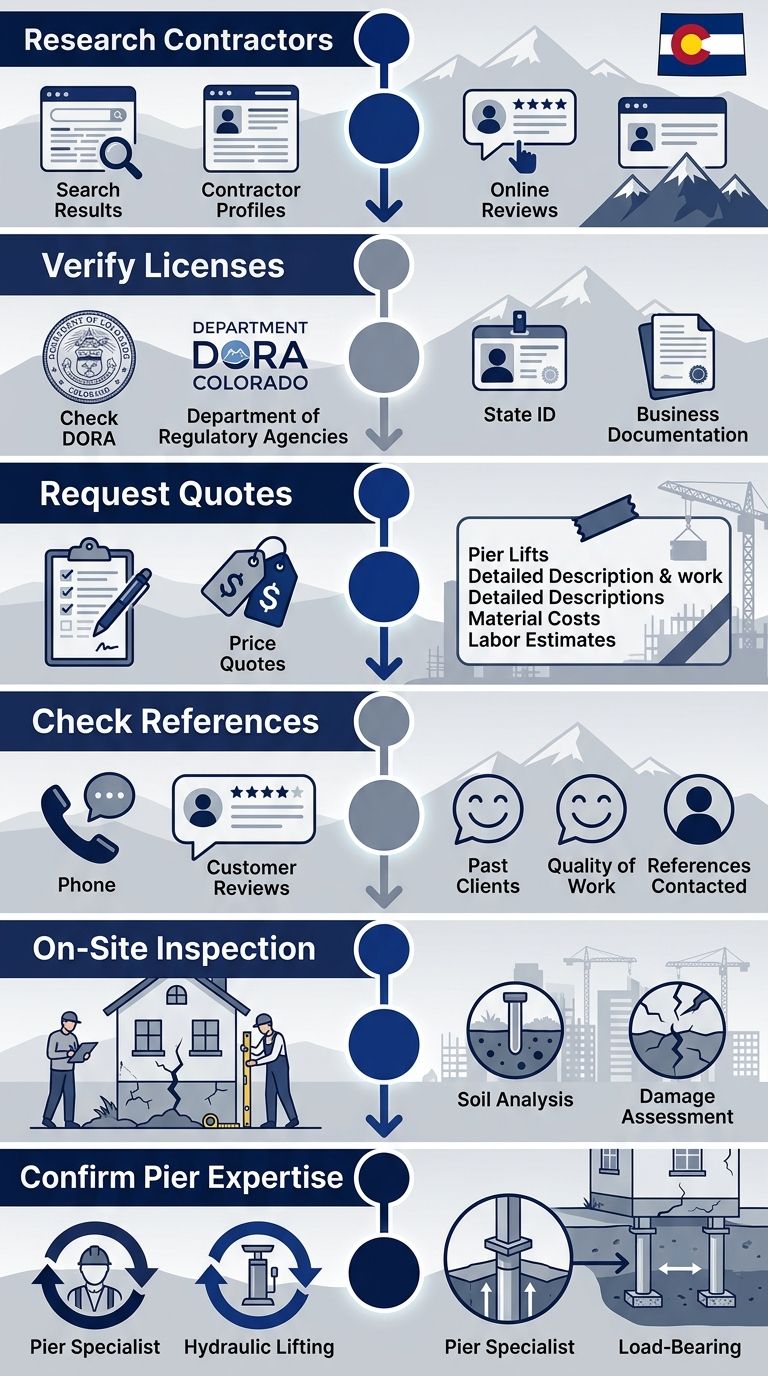
Six essential steps for hiring a foundation repair contractor in Colorado.
Following these steps protects your home and your investment. Once you have selected a qualified contractor, they will begin the detailed repair process outlined in the next section.
Consult a licensed structural engineer or qualified professional for definitive diagnosis and design recommendations.
Building with Confidence in Colorado
When searching for general contractors in Colorado, you need a team that understands the region’s expansive clay soils and their impact on foundations. That is where we come in — with our proprietary helical pier systems engineered for immediate loading and predictable capacities in these challenging conditions. As a family-owned and operated since 1996 company with A+ BBB accreditation, we bring decades of Front Range expertise to every project. custom home builders and residential remodeling contractors alike trust our trained, certified installers for reliable pier installations that stand up to Colorado’s shifting soils. The Experts in Steel Piers deliver proven solutions so you can build with confidence.
Resources
- Discover Expert Foundation Repair Solutions in Colorado
- Discover the Cost of Ignoring Foundation Cracks
- Schedule Your Foundation Repair Consultation Today
- Get in Touch with RMSSCO Foundation Experts
- Compare Push Piers vs Helical Piers in Denver
- Find Foundation Repair Experts in Colorado
- Get Expert Foundation Repair in Littleton, CO
- Explore the $1.5 Billion I-5 Bridge Replacement Project