
Top Foundation Drainage Systems Denver: 2026 Expert Guide
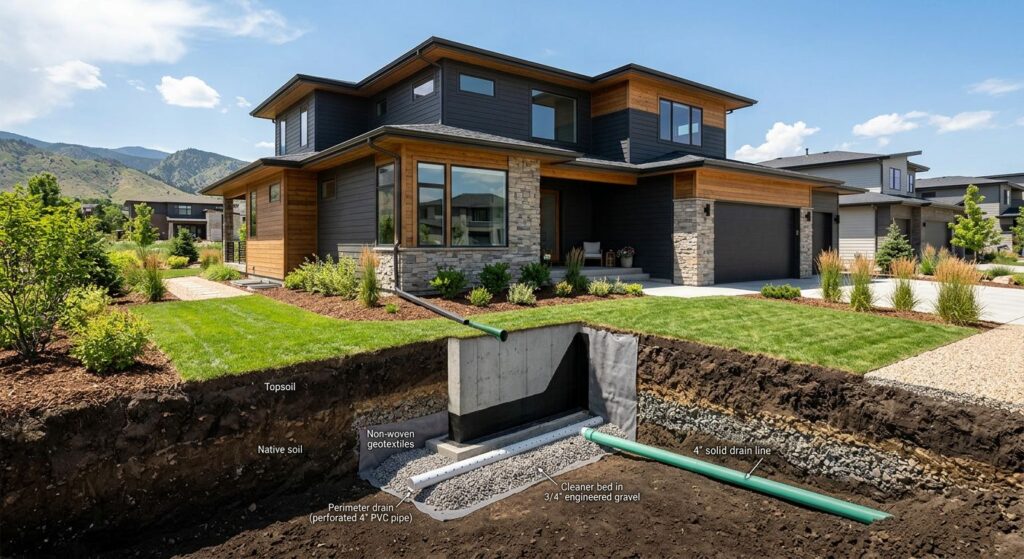
Table of Contents
- Foundation Drainage Systems in Denver: The Engineered Solution for Your Home
- How Poor Drainage Leads to Foundation Settlement in Denver
- Perimeter Drains vs. French Drains vs. Sump Pumps vs. Vapor Barriers
- How to Choose the Right Foundation Drainage System for Your Denver Home
- Installation Methods and Materials for Denver Drainage Systems
- Frequently Asked Questions About Foundation Drainage in Denver
- Final Steps to Protect Your Foundation with Pro Drainage
Foundation Drainage Systems in Denver: The Engineered Solution for Your Home
When considering foundation drainage systems in Denver, we recognize that the region’s expansive, clay-heavy soils present a persistent challenge to structural integrity. These soils absorb and retain significant moisture after rainfall or snowmelt, expanding against foundation walls and generating substantial hydrostatic pressure. Without an effective drainage strategy, this relentless pressure can lead to cracks, bowing walls, and long-term damage that compromises the safety and value of your home.
An engineered drainage system is not merely a trench with a pipe; it is a carefully designed solution that actively manages groundwater around your entire foundation. We incorporate both interior and exterior perimeter drain systems, which work in concert to collect water before it can exert force against your basement walls. These systems are designed in accordance with established civil engineering standards and practices that account for soil composition, seasonal water tables, and the specific grading of your property. By channeling water to a sump pump or a gravity-fed outlet, the system maintains a stable, dry environment around your foundation year-round.
A common and highly effective component of many drainage plans is the French drain, which directs water through a perforated pipe encased in gravel. This approach is valued not only for its performance but also because project data from industry analyses, including benchmarks reviewed by Engineering News-Record, shows that french drain installation cost in construction is consistently reasonable when compared to complex structural alternatives. While the semi-arid Denver climate may seem low-risk, the combination of freeze-thaw cycles and rapid snowmelt makes reliable drainage essential for every home.
We believe a well-designed drainage system is a foundational investment in your property’s future. Consult a licensed structural engineer for a definitive diagnosis and design recommendations tailored to your specific site conditions.
How Poor Drainage Leads to Foundation Settlement in Denver
Poor drainage is one of the most significant, yet often overlooked, causes of foundation damage for homes throughout the Denver metro area. When water isn’t properly directed away from your home, it accumulates in the surrounding soil, creating conditions that directly threaten your foundation’s structural integrity. In Denver, where effective foundation drainage systems are essential due to our unique soil composition, understanding this connection is the first step toward protecting your home. At Rocky Mountain Steel Piering, Inc., we have seen firsthand how inadequate drainage can lead to serious structural problems that require professional intervention.
The Role of Hydrostatic Pressure on Foundation Walls
Hydrostatic pressure is the force exerted by water-saturated soil against your foundation walls. After heavy rain or snowmelt, the ground becomes soaked. Instead of draining away, this water fills the spaces between soil particles, dramatically increasing its weight and volume. This saturated soil then presses relentlessly against foundation walls, a force that can exceed the design limits of residential concrete. Over time, this constant pressure causes walls to crack, bow inward, or even shift. For a Denver homeowner, the result is often visible cracking in basement walls and a compromised structural envelope that invites further water intrusion.
Denver’s Expansive Clay Soils: A Unique Challenge
The soil beneath many Denver homes is predominantly expansive clay, a material notorious for its dramatic volume changes with moisture content. When wet, these clays can swell considerably, exerting powerful upward and lateral pressure on slabs and footings. When they dry out during arid periods, they shrink, leaving voids and uneven support that causes foundations to settle differentially. This cycle of swelling and shrinking creates a constant, destabilizing movement. Proper drainage must incorporate measures like effective moisture barriers meeting moisture barrier standards ASTM to limit soil moisture fluctuation around the foundation. Without such protections, Denver-area drainage solutions are simply incomplete, allowing the destructive shrink-swell cycle to continue unabated.
From Poor Drainage to Foundation Distress: The Connection
The connection between poor drainage and structural distress becomes visible through classic warning signs: uneven or sloping floors, doors that stick or won’t latch, and cracks appearing in drywall or brick veneer. These symptoms indicate that differential settlement—the uneven sinking of a foundation—has already begun. The root cause is often chronically wet soil near the foundation from downspouts that discharge too close to the house or improper yard grading. Addressing the drainage issue is always the critical first step to prevent further damage. However, if settlement has already occurred, simply fixing the drainage won’t reverse it. In such cases, the foundation may need to be underpinned with helical piers. While the helical pier installation cost varies based on each home’s specific needs, it represents a permanent solution. As a family-owned and operated company since 1996 with an A+ BBB accreditation, we provide a custom quote only after a thorough, on-site inspection. Please remember that all information is for general purposes, and actual outcomes depend on site conditions and a professional evaluation.
Perimeter Drains vs. French Drains vs. Sump Pumps vs. Vapor Barriers
Now that we understand the causes of foundation moisture, let’s compare the systems designed to manage it. Denver homeowners often face a choice among foundation drainage systems, and the right solution depends on your specific site conditions, foundation type, and water management goals. We’ll examine four primary systems—perimeter drains, French drains, sump pumps, and vapor barriers—explaining how each works, where they excel, and how they complement one another in a comprehensive moisture control strategy.
How Perimeter Drains Keep Your Foundation Dry
Perimeter drains, also called foundation drains, are installed at the base of the foundation footing—typically 4 to 8 feet deep—and use a perforated pipe surrounded by a gravel bed and filter fabric to collect groundwater before it reaches your basement walls. This system channels water to a sump pump or daylight outlet, relieving hydrostatic pressure directly at the foundation base. For Denver-area homes with basements or crawlspaces experiencing high water tables, a perimeter drain system often forms the backbone of foundation water management. We install perimeter drains with careful attention to slope and discharge, ensuring that the collected water moves efficiently away from your structure rather than pooling against it. When connected to a sump pump, the system provides active, year-round protection against foundation seepage and structural damage.
French Drains: Surface Water Management for Your Property
In contrast to perimeter drains, French drains primarily address surface and shallow subsurface water. Installed 1 to 3 feet deep, a French drain consists of a trench filled with gravel and a perforated pipe that redirects water away from low-lying areas and foundation perimeters. They are particularly effective for yards with poor drainage or localized pooling after heavy rains. While they reduce surface water, French drains offer only moderate effectiveness against deep hydrostatic pressure at the footing level. For residential projects, french drain installation cost in construction benchmarks from Engineering News-Record (ENR) indicate actual costs vary by site conditions and project scope. French drains work best as a complement to perimeter systems—handling the surface water load while the foundation drain manages below-grade moisture.
The Role of Sump Pumps in Preventing Basement Flooding
Sump pumps actively remove water from a sump basin, making them essential for basements and crawlspaces with high water tables. Two primary types exist: pedestal pumps, where the motor sits above the basin, and submersible pumps, which operate fully inside the basin. Submersible models tend to be quieter and less obtrusive, while pedestal designs offer easier maintenance access. For Colorado homeowners, battery backup systems are critical—our region experiences power outages during severe storms, and a sump pump without backup power leaves your basement vulnerable precisely when water intrusion risk peaks. When paired with a properly installed perimeter drain, a sump pump creates an active, reliable defense against basement flooding, discharging collected groundwater to a safe distance from the foundation.
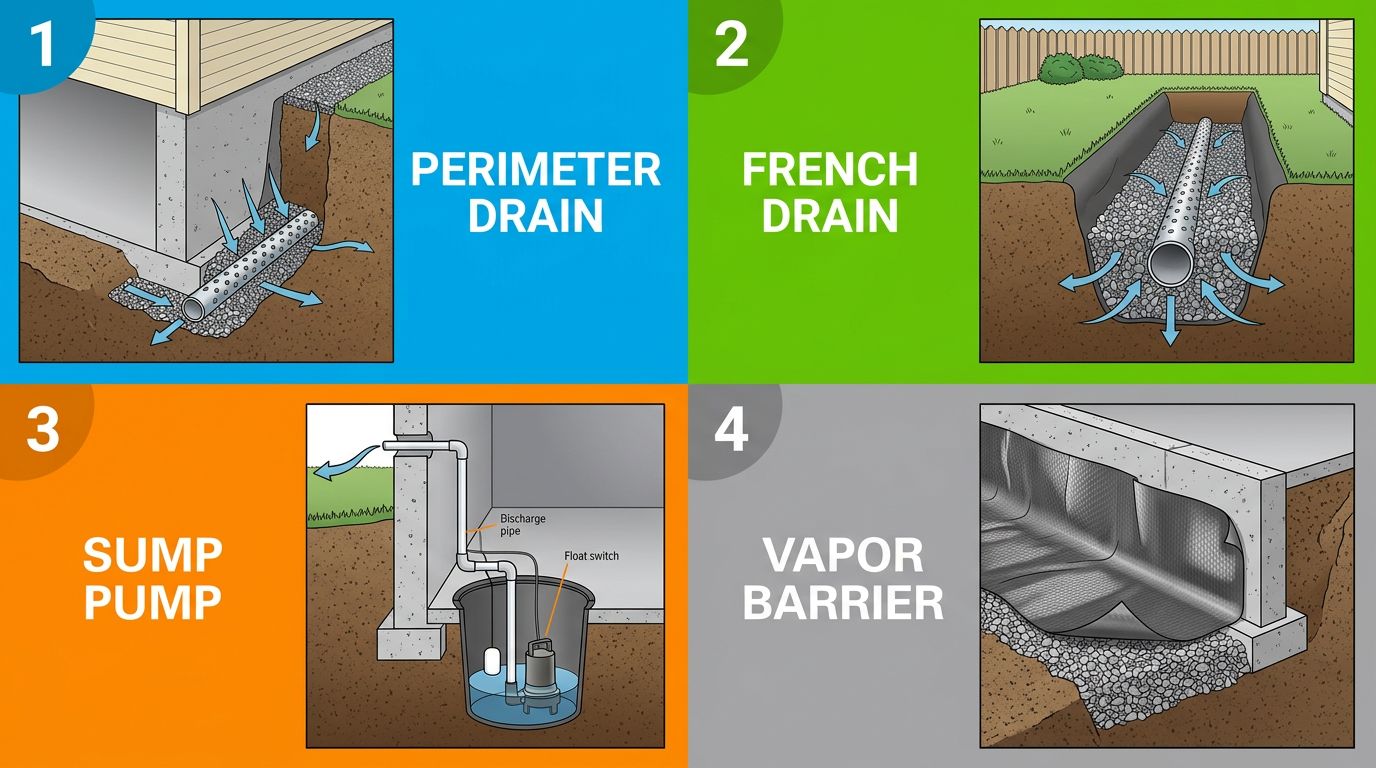
Comparison of Denver foundation moisture-control systems
Vapor Barriers: Controlling Moisture in Crawl Spaces and Basements
Vapor barriers serve a different purpose from drainage systems: they control moisture migration through floors and walls rather than managing liquid water. Made from polyethylene sheeting, vapor barriers typically range from 6 to 20 mil in thickness, with material specifications established by ASTM International under standards ASTM E1745 and E1993. These barriers are installed over crawlspace floors and sometimes on basement walls to reduce humidity and prevent condensation. However, it’s essential to understand that vapor barriers manage moisture vapor—they do not prevent liquid water intrusion from poor drainage or hydrostatic pressure. A vapor barrier alone cannot stop basement flooding if groundwater pushes against the foundation. For comprehensive protection, we recommend combining vapor barriers with perimeter drains and sump pumps, creating a layered defense that addresses both water in its liquid form and the moisture vapor that can cause mold, mildew, and structural deterioration.
Comparing Perimeter Drains and French Drains for Denver Homes
While each system plays a distinct role, the comparison below focuses on the two most commonly evaluated drainage solutions for Denver foundations.
| Feature | Perimeter Drain | French Drain |
|---|---|---|
| Function | Collects water at the base of the foundation footing and directs it away. | A trench filled with gravel and a perforated pipe that redirects surface and subsurface water. |
| Best For | Basements, crawlspaces, and slab-on-grade foundations with high water tables. | Yards with poor surface drainage or localized pooling; often used outside the foundation perimeter. |
| Installation Depth | Installed at the footing level (typically 4–8 ft deep). | Installed 1–3 ft deep, depending on application. |
| Effectiveness Against Hydrostatic Pressure | High – directly relieves pressure at the foundation base. | Moderate – reduces surface water but may not relieve deep hydrostatic pressure. |
| Maintenance | Low – requires periodic inspection and sump pump maintenance if connected. | Moderate – may clog over time; needs occasional flushing or replacement of gravel. |
The cost estimates above reflect Denver 2024 market conditions as reported in ENR industry data. Actual project costs depend on soil conditions, access limitations, and the specific requirements of your foundation. Perimeter drains carry a higher initial investment because of their deeper installation and direct connection to foundation protection, but they provide the most effective defense against hydrostatic pressure for homes with basements or below-grade living spaces. French drains offer a more accessible solution for surface water issues at a lower price point, though they may need to be paired with other systems for complete foundation protection.
We bring 30 years of family-owned experience to every foundation drainage assessment, and our team evaluates each property’s unique conditions before recommending any system combination. Multiple systems often work in tandem—a perimeter drain feeding a sump pump, a French drain handling yard runoff, and a vapor barrier controlling crawlspace humidity—to create comprehensive moisture management. All information presented here is for general purposes; actual results depend on site conditions and professional inspection. For your specific Denver-area property, consult a licensed structural engineer or qualified foundation professional to determine the right combination of drainage and moisture control solutions.
How to Choose the Right Foundation Drainage System for Your Denver Home
Choosing the right foundation drainage system in Denver starts with understanding your soil—because what lies beneath your home determines how water moves around it. Denver’s Front Range geology is dominated by expansive clay soils that swell when wet and shrink when dry, creating constant pressure on foundation walls. A well-designed subsurface drainage system intercepts water before it reaches your footing, protecting your home from hydrostatic pressure, cracking, and long-term structural movement. With three decades of local experience, we recommend letting your specific soil and foundation type guide the decision rather than relying on generic online advice.
Step 1: Evaluate Your Soil and Water Table
Denver soil is rarely uniform—even within a single neighborhood, you may find pockets of clay, sand, or loam. Clay-rich soils hold water tightly and expand significantly, which means your drainage system must remove moisture before it saturates the soil adjacent to your foundation. A simple DIY test can give you a preliminary read: dig down about a foot, grab a handful of moist soil, and roll it between your palms. If it forms a tight, smooth ribbon that holds together, you are dealing with predominantly clay soil. If it crumbles and refuses to bind, sand or loam is likely dominant.
For a more definitive analysis, we recommend checking with your local building department for geotechnical reports on file or requesting a soils evaluation through a foundation contractor. Additionally, some Denver neighborhoods sit over naturally high water tables, which means groundwater rises close to the surface seasonally. In those areas, a gravity-only drain may not be enough—a sump pump becomes essential to actively lift water out and away.
Step 2: Match Your Foundation Type to the Right System
Once you have a sense of your soil and water conditions, the next step is matching your foundation type to the drainage system engineered for it. Different foundations face different water challenges, and the solution that works beautifully for a basement may be overkill or maybe even insufficient, for a slab-on-grade home. The decision guide below summarizes the recommendations our team has developed after 30 years of installing perimeter drains, French drains, and sump pump systems across the Denver metro.
| Foundation Type / Water Table | Recommended Primary System | Supplemental Systems |
|---|---|---|
| Basement with high water table | Perimeter drain with sump pump | Exterior waterproofing, vapor barrier |
| Crawlspace with moisture issues | Perimeter drain (if footing deep) or French drain (if shallow) | Vapor barrier, sump pump (if water enters) |
| Slab-on-grade with surface water pooling | French drain around slab perimeter | Grading improvements, downspout extensions |
| Any foundation with expansive clay soils | Perimeter drain at footing level | Moisture barriers, soil moisture management, helical piers if settlement occurred |
The table draws on general civil engineering principles for drainage design, local building codes common to the Denver metro area, and our own installation history. For a basement with a confirmed high water table, a perimeter drain paired with a sump pump provides the most reliable active water management system. In contrast, if you have a crawlspace with persistent dampness but no standing water, a well-placed perimeter drain—or even a French drain if your footings are shallow—can often control moisture levels without the added complexity of a pump.
For Denver homes with basement moisture, the recommended drainage system is a perimeter drain with a sump pump. Ongoing concrete sealing in Denver can signal moisture issues that a good drainage system will address before they escalate into structural problems. For slab-on-grade homes where surface water pools near the foundation after rain, a French drain around the slab perimeter, combined with regrading and downspout extensions, often resolves the problem without requiring deep excavation.
Step 3: Consider Budget and Long-Term Value
Foundation drainage systems represent a significant but worthwhile investment—one that we always recommend pricing through a custom on-site quote rather than through online estimates. The variables are simply too numerous: depth to footing, soil type, access constraints, and whether a sump pump is required all influence the final figure. Rocky Mountain Steel Piering provides detailed, binding quotes based on a thorough inspection of your property, so you are not guessing at what the job will actually cost.
What is clear is the long-term value. Installing a proper drainage system now can prevent the need for costly repairs like helical pier installation cost—which runs into the thousands and is far more disruptive than managing water proactively. Foundation crack repair, concrete lifting, and structural reinforcement are all expenses that a well-designed drainage system helps you avoid. Think of your drainage system as insurance for your foundation: an upfront investment that pays out year after year by keeping your home dry, stable, and free from moisture-driven damage.
Step 4: Questions to Ask Before Hiring a Drainage Contractor
Not all drainage contractors bring the same level of expertise, especially when it comes to Denver’s challenging soils. We recommend asking the following questions before signing any contract:
- Are you licensed and insured for foundation and drainage work in Colorado?
- Do you provide engineered designs, and do your designs follow civil engineering standards and practices for drainage systems?
- What is your specific experience with Denver’s expansive clay soils and high water tables?
- Can you supply references from recent drainage projects in my area?
- Will your quote include a detailed site inspection, and is it binding once in writing?
- What warranty do you offer on the system, and does it cover both materials and workmanship?
These questions help you separate contractors who have deep local expertise from those who may apply a one-size-fits-all approach. Our experience shows that a contractor who can speak confidently about Denver’s soil and water challenges—and who produces an engineered plan rather than a sketch on a notepad—is the one you want handling your foundation water management.
With your soil and foundation type identified, you can now match the specific drainage system that fits your Denver home. All recommendations are general; consult a licensed structural engineer for your specific project.
Installation Methods and Materials for Denver Drainage Systems
For effective foundation drainage systems in Denver, proper installation techniques and material selection are critical to long-term performance. As a family-owned and operated company since 1996, we at Rocky Mountain Steel Piering, Inc. understand that Denver’s expansive clay soils and variable terrain demand robust, engineered solutions. The following methods represent our approach to protecting your home’s foundation from water damage, integrating industry best practices with decades of local experience.
Perimeter Drain Installation: Trenching, Materials, and Slope
We install perimeter drains using open trenching or partial excavation, with a trench width of 12–18 inches and depth extending below the footing. We use rigid PVC schedule 40 or SDR35 pipe, though flexible corrugated pipe with a smooth interior is also an option. The pipe is bedded in 3/4-inch washed gravel and wrapped in filter fabric to prevent soil intrusion. A minimum slope of 1% (1/8 inch per foot) directs water to a sump pump or daylight outlet, with a check valve on the discharge line to prevent backflow. Should unstable soil be encountered, our team may recommend helical piers to stabilize the foundation. For pricing details, review our helical pier installation cost page, noting all estimates are preliminary until an on-site inspection.
Sump Pump Systems: Types, Backup, and Discharge Considerations
For Denver basements, we recommend submersible sump pumps with 1/3 to 1/2 horsepower for reliable, quiet operation. A deep-cycle marine battery backup is essential to protect against power outages during heavy storms. The discharge line uses 1-1/2 or 2-inch schedule 40 PVC, routed at least 10 feet from the foundation to a proper drainage area. We always install a check valve near the pump to stop backflow. RMSSCO offers free quotes for sump pump installations, ensuring your basement stays dry year-round. Remember, all project outcomes depend on specific site conditions.
French Drain Installation Techniques for Denver Yards
A French drain starts with a trench 18 to 24 inches wide and 2 to 3 feet deep, positioned below the foundation level. We place 3/4 to 1-1/2 inch washed gravel to one-third depth, then lay a 4 to 6-inch perforated pipe with holes at the 6 o’clock position, all wrapped in filter fabric. The slope is maintained at 1% away from the structure, following civil engineering standards and practices for drainage design. We can pair this with downspout extensions to enhance surface water diversion, creating a comprehensive Denver drainage system installation tailored to your landscape.
Vapor Barrier Installation: Material Choices and Sealing Best Practices
In crawlspaces, we use 6 to 20-mil polyethylene sheeting meeting moisture barrier standards ASTM E1745 specifications. Seams are overlapped 6 to 12 inches and sealed with 2-inch wide tape or adhesive, and the material is attached to walls with mechanical fasteners, extending 6 to 12 inches up the foundation. This barrier integrates with perimeter drains to manage both liquid water and water vapor. For homes with more complex moisture issues, consult a licensed structural engineer for a definitive diagnosis. Our expertise ensures these systems work together to keep your home dry and stable.
Frequently Asked Questions About Foundation Drainage in Denver
Understanding foundation drainage systems in Denver helps commercial property owners make informed decisions about protecting their buildings from water intrusion and soil instability. Below, we address the most common questions we receive about foundation drainage solutions for Denver commercial buildings.
1. What is foundation drainage and why is it needed in Denver?
Foundation drainage refers to perimeter drain systems and French drains that manage groundwater around commercial structures. In Denver’s expansive clay soils, proper drainage prevents hydrostatic pressure buildup that can compromise foundations. We design drainage systems for Denver foundations that meet civil engineering standards and practices from the American Society of Civil Engineers (ASCE), ensuring long-term structural protection.
2. What types of foundation drainage systems are available?
We install French drains and perimeter drain systems integrated with moisture barrier standards ASTM compliant vapor barriers. These systems work together to intercept groundwater and prevent vapor intrusion. When site conditions require additional support, helical piers provide stable anchoring for drain infrastructure in poor soils.
3. How much does foundation drainage cost?
Costs vary significantly based on site conditions, soil composition, and project scope. Industry benchmarks, such as french drain installation cost in construction data from Engineering News-Record (ENR) provide general ranges, but every project is unique. We encourage property owners to request a custom quote after our on-site inspection, which allows us to provide an accurate, binding estimate.
4. How does foundation drainage relate to concrete sealing and crack repair?
Effective drainage works in tandem with concrete sealing in Denver to prevent water intrusion through foundation cracks. Our FAQ resources explain how crack chasing, epoxy injection, and concrete sealing maintain drainage system integrity, ensuring water is directed away from the structure rather than seeping through compromised concrete.
5. What is the role of helical piers in foundation drainage?
Helical piers support drain systems in challenging soil conditions common across the Front Range. They provide immediate load capacity with minimal site impact. For detailed information, we offer resources on helical pier installation cost and project considerations.
As The Experts in Steel Piers, we have been family-owned and operated since 1996. Our A+ BBB accredited team provides trained, certified installation for every project. Please note that all estimates are preliminary, and we recommend consulting a licensed structural engineer for definitive design recommendations. Ready to start your construction project? Contact us for a custom quote and site inspection.
Final Steps to Protect Your Foundation with Pro Drainage
Investing in professional foundation drainage systems in Denver is one of the most effective decisions you can make to divert water, reduce hydrostatic pressure, and prevent long-term structural damage. Because every property presents unique soil and grading conditions, our team provides a custom quote following a thorough on-site evaluation — no two drainage solutions are alike.
As a family-owned and operated company since 1996 with an A+ BBB rating, we approach each project with a focus on predictable, engineered performance. For complete foundation protection, consider also concrete sealing in Denver as part of your maintenance plan.
Ready to start your construction project? Contact us today for a tailored assessment and a plan that fits your property’s needs.
Resources
- Get Expert Foundation Assessment for Denver ADU Conversions
- Get Custom Concrete Sealing Quotes in Denver
- Learn About Helical Pier Installation Costs in Colorado
- Repair Foundation Cracks with Epoxy Injection and Drainage
- Compare Push Piers vs Helical Piers for Foundation Repair
- Learn About Standardized Helical Pier Load Testing per AC358
- Get Foundation Crack Repair Cost with Epoxy Injection
- Explore ASCE Resources for Civil Engineering Standards
- Discover ASTM International Standards for Engineering
- Explore ENR for Construction Industry News and Trends