
Push Piers vs Helical Piers: Denver Comparison Guide
Table of Contents
1. Understanding Key Differences
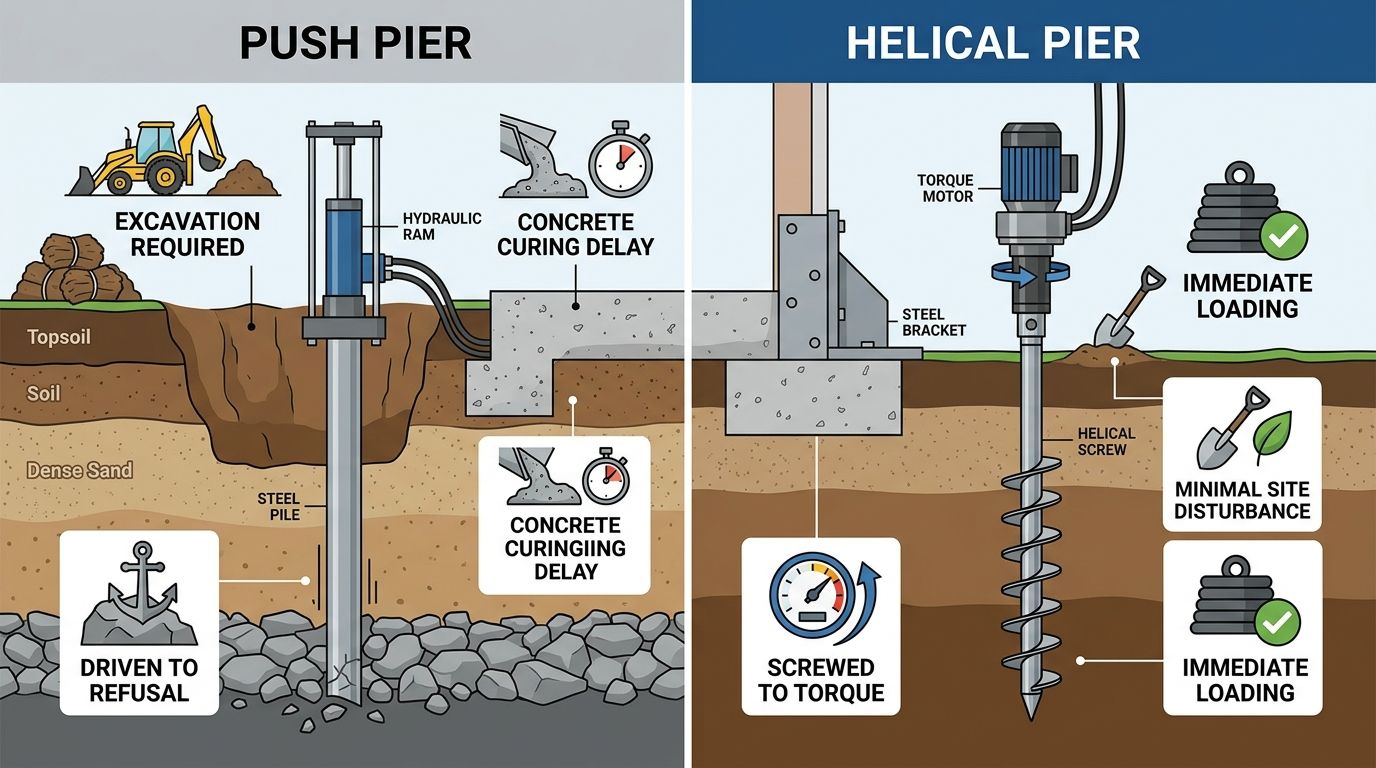
To determine the best repair solution, you need to understand the key differences in helical vs push piers. Helical piers are screwed into the ground like a large screw, while push piers are hydraulically driven to refusal. Each transfers loads differently: helical piers use bearing plates along the shaft, whereas push piers rely on skin friction at the tip.
According to industry benchmarks from ENR, helical piers can accept immediate loading, while the bearing capacity of push piers can be affected by soil disturbance during installation. Given the expansive clay and high groundwater that cause “foundation problems in Colorado Front Range”, a fast screw-in method often proves more effective than hydraulic drive, minimizing disturbance in variable soils.
With these fundamental distinctions in mind, let’s examine helical piers in more detail.
2. Comparing Installation Costs
When evaluating push piers vs helical piers for a foundation stabilization project, installation costs can vary significantly. Our team at Rocky Mountain Steel Piering, Inc. knows that a direct price comparison depends on multiple on-the-ground factors, so we base every recommendation on a custom-quote approach rather than fixed pricing.
The primary cost components for both systems include equipment mobilization, labor hours, and material requirements. Helical pier installation often involves lower labor costs because the piers can be rotated into service rapidly with no concrete curing, especially in weak or unstable soil profiles. In contrast, push pier installation expenses may be higher due to the need for excavation, concrete mixing, and curing time, which extends the on-site schedule and increases overall project costs.
Site-specific variables such as soil type, accessibility, and the required pier depth can shift the cost comparison considerably. For an “office tenant improvement project”, the ability to load helical piers immediately and keep tenant disruption to a minimum often yields notable schedule savings. Because every foundation condition is unique, our family-owned business relies on a thorough on-site inspection to prepare an accurate, no-obligation estimate.
After evaluating costs, look at how each pier type performs under specific load conditions to make the best long-term decision for your structure. Final costs will always depend on site conditions and a detailed inspection.
3. Evaluating Installation Speed
After comparing basic pier types, the next critical factor is how quickly each system can be installed. For many property owners weighing push piers vs helical piers, installation speed directly influences project timelines and overall disruption. The Experts in Steel Piers, we have seen firsthand how this factor shapes decisions on foundation repair projects.
Helical piers are screwed into the ground using hydraulic torque, which allows immediate loading with no concrete curing. In contrast, push pier installation typically requires concrete to cure before full load capacity is achieved, adding days to the schedule. Our helical pier installation also includes real-time torque monitoring to verify capacity on the spot, eliminating the need for separate load tests and further speeding up the process. For example, on a 1920s residential repair project in Denver, our team installed six helical piles to depths of 25 to 30 feet, stabilizing a rock and rubble foundation efficiently under an engineered plan.
The advantages of helical vs push piers become even clearer in poor or loose soils, where helical piers often reach stable strata faster. However, actual installation speed always depends on site conditions, soil composition, and access constraints. A licensed engineer’s evaluation is essential to determine realistic timelines for your specific project. Factors such as equipment maneuverability and the presence of underground obstructions can also influence the pace of work.
Installation speed is just one consideration when choosing a foundation repair solution. The next section will explore other key differences that can impact long-term performance. Ready to start your construction project? Contact us for a custom estimate.
4. Soil Performance Insights
Before choosing a repair method, it is essential to understand how soil performance influences outcomes, particularly when comparing push piers vs helical piers in expansive soils. Along Colorado’s Front Range, aggressive clay soils swell when wet and shrink when dry, placing constant stress on foundations and often creating the need for deep foundation solutions. In many cases, this expansive soil movement is the primary driver of settlement and structural cracking.
Helical piers gain immediate load capacity through screw-like penetration, minimizing soil disturbance during installation and requiring no excavation. In contrast, push pier installation relies on hydraulic force and typically requires the removal of soil, which can further destabilize already problematic ground. Helical piers can also be installed in very tight spaces with minimal site impact, a key advantage in poor soil conditions. For soil-specific engineering guidance, consult “NSPE professional development resources” and licensed engineers.
5. Best for Residential Projects
While push piers may handle heavier commercial loads, for residential projects helical piers offer unmatched advantages—particularly when evaluating push piers vs helical piers. We typically recommend helical pier systems for homes across the Front Range because they can be installed with minimal disturbance to landscaping and existing structures.
Colorado’s aggressive expansive clay soils put constant stress on residential foundations, and helical vs push piers considerations favor helical systems because they achieve capacity in unstable soils without excessive excavation. We installed six helical underpinning piles at a 1920s Denver residence with a rock-and-rubble foundation, driving each to 25–30 feet with immediate load capacity and minimal site impact. Helical pier installation uses lighter, more maneuverable equipment than push pier installation, making it ideal for tight residential access areas.
While push piers remain viable for heavy commercial applications, most residential loads are lower and our helical solutions provide sufficient capacity with faster, less invasive installation. For homeowners needing reliable foundation repair along the Front Range, helical piers are the clear choice.
6. Pros and Cons Simplified
Now that we’ve covered the technical details, here’s a simplified look at the pros and cons to help you compare at a glance. When weighing push piers vs helical piers for your commercial foundation repair, the right decision depends on site conditions, structural loads, and access constraints.
When we consider helical vs push piers, helical systems are often up to 66% faster to install in poor soils, according to Engineering News-Record (ENR). They provide immediate load-bearing capacity with no concrete curing, minimize site disruption, and excel in weak or variable soil strata. However, they may not be the first choice where extremely shallow bedrock limits installation depth or when load requirements exceed practical helical diameters without engineering review.
Push pier installation typically suits sites where deep excavation is already planned and stable soils can support high compression loads. This method may be preferred for historic renovations requiring minimal soil disturbance below grade, but it generally involves a slower timeline due to excavation and concrete curing, a larger site footprint, and potential difficulty in very soft surface soils that cannot support the pier weight during installation.
At RMS Construction Services, The Experts in Steel Piers, we know that delaying foundation repair can lead to worsening structural issues. With these trade-offs in mind, consult a licensed structural engineer to assess your specific site before making a final decision. The next section will help you determine which system aligns with your project’s unique requirements.
7. Helical Piers at a Glance
When considering push piers vs helical piers, understanding the basics of each system is essential for making an informed foundation repair decision. Helical piers are steel screw-in foundation elements that we install by applying torque, which provides immediate load-bearing capacity without requiring any cure time. These versatile systems work well for both commercial and residential projects, including hospitals requiring minimal disruption during renovations and historical buildings that demand careful structural support. As a family-owned and operated company since 1996, Rocky Mountain Steel Piering brings decades of specialized experience to every helical pier installation, backed by our A+ BBB accreditation earned over years of consistent service.
The screw-in design of helical piers causes minimal site disturbance and allows for faster installation rates in poor soil conditions. When exploring helical vs push piers, the key mechanical difference is that helical piers use a rotating screw action while push piers rely on hydraulic force driven against the structure’s weight. This distinction matters when evaluating site conditions and project timelines. We recommend consulting a licensed structural engineer for definitive diagnosis, as every foundation presents unique challenges that require professional evaluation. Now that we have outlined helical piers, let’s examine how they differ from push piers in greater detail. Ready to start your construction project? Contact The Experts in Steel Piers today for a personalized consultation.
All estimates are preliminary and subject to on-site inspection. We do not guarantee specific results for every project; actual outcomes depend on individual site conditions.
8. Push Piers at a Glance
While helical piers offer advantages in many conditions, push piers remain a time-tested option in the push piers vs helical piers comparison for foundation repair. These steel pilings are driven into stable soil using hydraulic rams, transferring a structure’s weight to competent bearing strata. During push pier installation, piers are advanced until refusal is reached and capacity is verified by pressure gauge readings, making the system suitable for both residential and commercial structures.
In the helical vs push piers decision, a key difference is load-transfer mechanism. According to Engineering News-Record (ENR), push piers rely on end-bearing capacity while helical piers use helical plates for immediate pull-down load transfer. Push piers also require excavation around existing footings, whereas helical piers can be installed in tighter spaces. ENR notes that push piers are typically cost-effective for compact, shallow soils but may not perform as well in loose or expansive soils compared to helical piers. As noted by RMS Services, ignoring foundation cracks can lead to severe structural issues that push piers can address. Understanding these differences helps in choosing the right system for your project.
Choosing Between Push Piers and Helical Piers
When evaluating push piers vs helical piers for foundation stabilization, it’s important to understand that both systems underpin a structure, but they differ in installation method and ideal soils. Push pier installation relies on driving piers through unstable ground to competent bearing strata, while helical piers are screwed into place with minimal excavation, making them suitable for poor soil profiles in Colorado and the Front Range region.
Helical vs push piers also differ in efficiency: helical pier systems can be installed up to 66% faster in weak soils and accept load immediately, with no concrete cure time. Our “helical pier foundation repair” solutions are ideal for commercial projects where timeline and minimal disruption are critical. As The Experts in Steel Piers, our team at Rocky Mountain Steel Piering, Inc. has specialized in these superior systems since 1996.
The final choice between pier types depends on a professional inspection of soil conditions, load requirements, and access constraints. We recommend contacting us for a free, no-obligation estimate. Our family-owned and operated company has served Littleton and the Denver metro area for 30 years with an A+ BBB rating. Ready to start your construction project? Call us today—and consult a licensed structural engineer for a definitive diagnosis and design recommendations.
Resources
- Get Trusted Helical Pier Repair for Historic Denver Homes
- Discover Helical Piers for Cost-Effective Foundation Repair
- Find Proven Foundation Repair for Colorado Front Range Homes
- Get Efficient Polyurethane Foam Lifting for Concrete Slabs
- Find Expert Steel Piering and Structural Repair Services
- Find Helical Pier Solutions for Foundation and Wall Stabilization
- Stop Foundation Crack Damage with Early Helical Pier Repair
- Find Details of Award-Winning Bellevue Office TI Project
- Explore NSPE Resources for Engineering Professional Development